
.png?width=1080&height=1080&name=Grey%20Wolf%20Delist%20case%20study%20(1).png)
Industry
Public Policy
Challenge
Federal agencies refused to delist the gray wolf from the Endangered Species Act despite overwhelming scientific evidence that recovery goals had been exceeded. This inaction harmed rural communities, livestock producers, and wildlife balance, while leaving hunters and state governments with little influence over federal policy decisions.
Results
Campaign Now partnered with Hunter Nation to execute a nationwide, multi-channel advocacy campaign that reshaped the public narrative, mobilized rural voters, and applied coordinated legislative pressure. The campaign generated national attention, thousands of constituent actions, and meaningful momentum toward restoring state-led wildlife management.
Key Service
Grassroots Advocacy & Issue-Based Mobilization
“The mighty wolf is neither threatened nor endangered and should finally be delisted. I encourage all members of Congress to vote YES on the “Pet and Livestock Protection Act” and put this sacred beast back in the conservation asset column where it belongs. I am proud to be part of Hunter Nation as we are the most powerful and positive force for real conservation and wildlife balance in America today!”

“This wasn’t just about wolves — it was about freedom, fairness, and who gets to decide the future of America’s outdoors.”

“Hunter Nation has been the conservation organization leading the fight for responsible predator management for years. We view this as the most consequential hunting legislation in decades. Thank you, Congressman Tiffany, for your leadership and I pledge that Hunter Nation will work tirelessly with you to get this legislation passed."


About Hunter Nation
Hunter Nation is the nation’s leading grassroots advocacy organization committed to protecting America’s hunting heritage and defending the foundational values of faith, family, and freedom. Built on the belief that hunters are among the most patriotic and civically minded citizens in the country, Hunter Nation works to unite millions of outdoorsmen and women into a powerful voice for constitutional rights and traditional values.
Challenge & Opportunity
In early 2024, Hunter Nation faced a defining challenge: federal refusal to delist the gray wolf from the Endangered Species Act, despite overwhelming evidence that wolf populations had long exceeded recovery goals. The imbalance was wreaking havoc on livestock, wildlife, and rural economies, yet federal agencies remained unresponsive to scientific data and local voices.
Hunter Nation recognized that the fight for responsible wolf management would require a level of influence few outdoor or conservation organizations possessed. Unlike most advocacy groups in this space, Hunter Nation stood out as one of the only organizations in America with a registered federal lobbyist dedicated to the wolf delisting issue—a presence that gave hunters and rural stakeholders a real voice in Washington. Through that advocacy infrastructure, Hunter Nation supported expert testimony before the U.S. House Natural Resources Committee on the Pet and Livestock Protection Act of 2025 (H.R. 845), helping ensure the scientific case for delisting was formally entered into the congressional record and reported in national outlets.
At the same time, the organization found natural allies in Congressman Tom Tiffany (WI-07) and Congresswoman Lauren Boebert (CO-03)—two of the most vocal champions for returning wildlife management to the states. Their partnership with Hunter Nation transformed the delisting effort from a single-issue campaign into a broader movement for rural sovereignty and science-based conservation. Together, they elevated the debate from state capitals to the halls of Congress, uniting hunters, ranchers, and legislators under one message: conservation should be guided by results, not rhetoric.
To capitalize on that moment, Hunter Nation partnered with Campaign Now, combining authentic, on-the-ground credibility with elite campaign strategy and data-driven outreach. Together, they would create a unified narrative—one that blended science, emotion, and political mobilization—to reclaim conservation from bureaucracy and restore wildlife management to the states.
What We Did
To turn outrage into action, Hunter Nation partnered with Campaign Now to design and execute a full-scale, multi-channel advocacy campaign that united science, storytelling, and citizen mobilization. Together, they repositioned wolf management as a question of rural sovereignty and responsible conservation—not partisan politics. Campaign Now developed a disciplined message architecture that guided every touchpoint, from expert testimony on Capitol Hill to grassroots calls in Wisconsin. Using ecological data and real-world human stories, the campaign reframed the wolf issue as a balance-of-nature crisis, not a bureaucratic debate, emphasizing that delisting was both scientifically justified and morally necessary.
With that foundation, Campaign Now deployed a targeted voter engagement system that reached over 20,000 hunters, ranchers, and rural voters through personalized mail, phone outreach, and digital media. The campaign launched the “True Wolf Story” video series, amplified by $90,000 in in-kind Google Ad Grants, achieving more than 500,000 views across YouTube and Meta. Each message drove supporters to sign petitions, contact lawmakers, and pledge their votes—resulting in over 7,000 petition signatures and a 15% membership conversion rate. Coordinated with Hunter Nation’s legislative testimony in Washington and Madison, these combined efforts generated national attention, legislative traction, and a blueprint for how modern advocacy can blend data-driven strategy with authentic grassroots power.
Results
In 2024–2025, Hunter Nation launched a nationwide, multi-channel campaign to educate the public, pressure legislators, and mobilize grassroots supporters around a singular goal: delist the Gray Wolf from the Endangered Species Act (ESA) and return predator management to the states. The campaign, backed by a $200,000 media budget and bolstered by in-kind digital grants, became a model of rapid-response rural advocacy—blending science, emotion, and politics into one of the most effective conservation pushes in recent history.
This case study outlines how Hunter Nation:
- Shifted public perception around wolf overpopulation.
- Engaged state and federal lawmakers.
- Produced and deployed original media content targeting persuadable audiences.
- Built a powerful base of support in key battleground states like Wisconsin.
- Turned a $200K donor investment into national momentum.
Overview
The Gray Wolf was declared endangered in 1974, and the federal recovery plan worked—too well. In regions like the Great Lakes and Yellowstone, wolf populations skyrocketed well beyond recovery benchmarks:
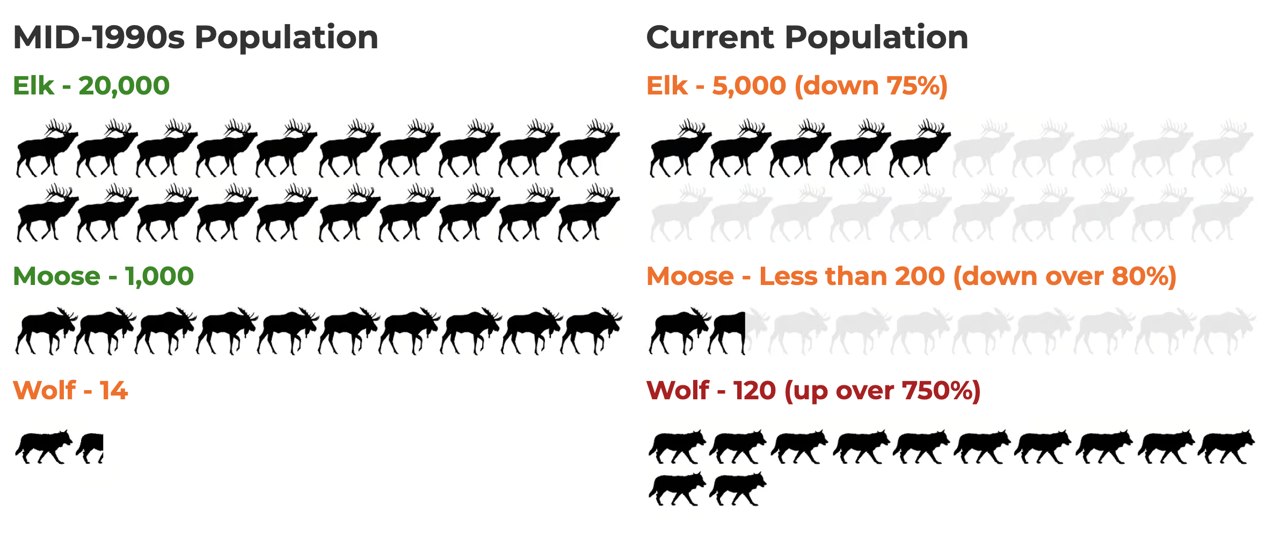
- Yellowstone National Park: Wolf populations rose 750%, while elk dropped 75% and moose fell.
-
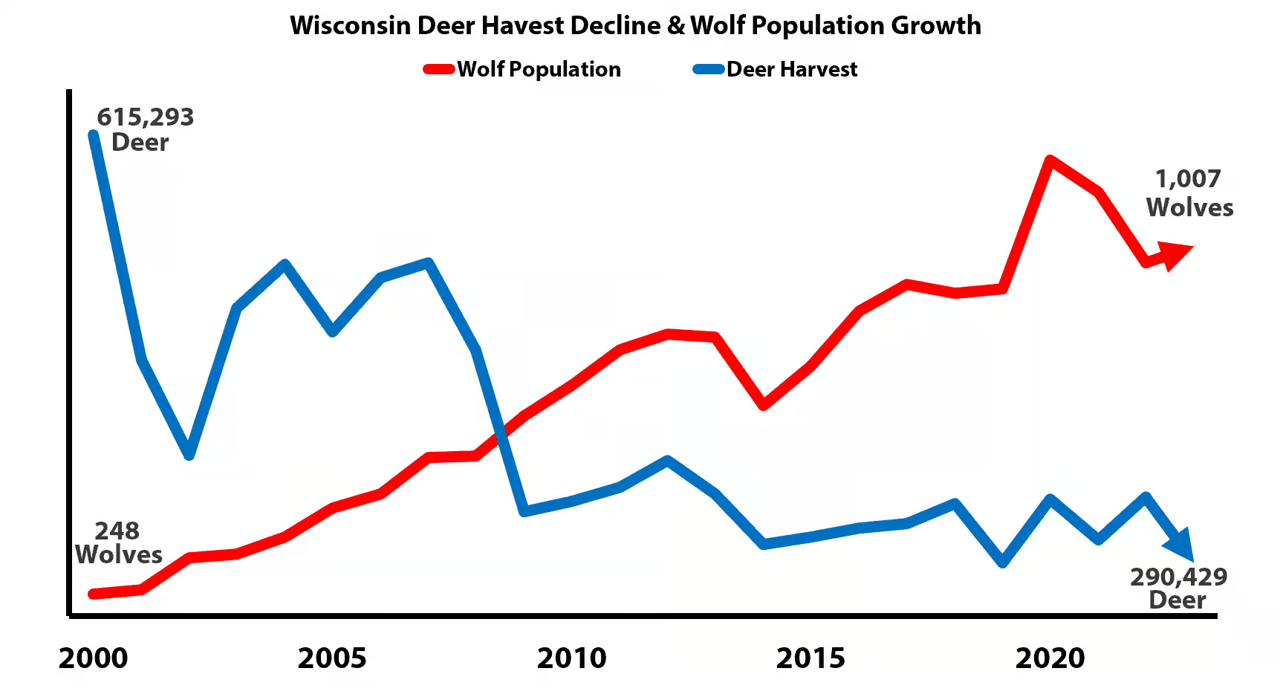
Wisconsin: Whitetail deer harvests declined from 615,293 in 2000 to under 300,000 in 2023, correlating with a wolf population increase from 248 to over 1,000.
Despite surpassing all recovery goals, the wolf remained protected under the ESA, limiting states’ ability to responsibly manage predator-prey balance and protect rural communities. This federal gridlock left farmers, pet owners, and outdoorsmen with few options.
The Campaign Strategy
Hunter Nation launched a multi-tiered campaign aimed at restoring state management of gray wolf populations in early 2025. The effort was driven by the belief that federal and state agencies had allowed gray wolf populations to exceed recovery thresholds, leading to harm in rural communities. The strategy rested on three pillars: legislative advocacy, multimedia public education, and grassroots mobilization.
Legislative Action: Aligning Federal and State Pressure
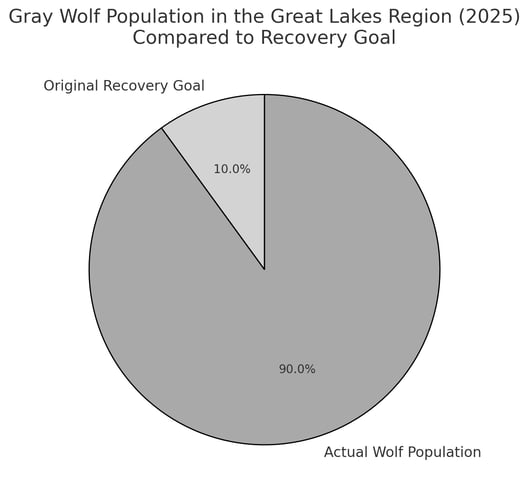
At the federal level, Hunter Nation supported H.R. 845—the Pet and Livestock Protection Act of 2025—which would delist gray wolves from federal endangered species protections. Dr. Nathan Roberts provided expert testimony before the U.S. House Natural Resources Committee on March 25, 2025, arguing that wolf populations in the Great Lakes region had reached 4,000 to 5,000—ten times the original recovery goal. He presented data showing that harvest rates of up to 29% had no long-term impact on wolf sustainability.
Gray wolf populations in the Great Lakes region have exceeded recovery goals by 900%, highlighting the urgency for state-led management.
Meanwhile, in Wisconsin, the fight centered around administrative rule CR 23-047, which would remove numeric wolf population goals from state law. Hunter Nation saw this as a regulatory loophole that would make effective management nearly impossible. Chris Vaughan testified before the Wisconsin Senate Committee on Financial Institutions and Sporting Heritage, emphasizing that numeric goals were essential for accountability and conservation science. Hunter Nation also partnered with the Wisconsin Bear Hunters Association and the Wisconsin Cattlemen’s Association to apply pressure on lawmakers.
The coalition succeeded in generating significant resistance in the legislature, though a veto from Governor Tony Evers remains a possible roadblock.
Public Education: Storytelling and Digital Influence
To support its legislative work, Hunter Nation Foundation launched a public awareness campaign grounded in personal storytelling and scientific education. The campaign was designed to highlight the real-world consequences of unchecked wolf populations—especially for pet owners, ranchers, and rural families.
Campaign content featured the “True Wolf Story” series —short documentary clips under three minutes showcasing individuals impacted by wolf encounters. These were complemented by data-driven infographics comparing predator-prey dynamics in Yellowstone and Wisconsin. The messaging argued that wolves were no longer endangered and that unmanaged populations posed a risk not only to wildlife but to livestock, pets, and rural economies.
Grassroots Mobilization: Building Public and Political Pressure
The final prong of Hunter Nation’s strategy involved activating its member base and reaching new constituents through direct voter engagement. This mobilization effort was designed to drive petition signatures, voter turnout, and membership growth.
In February 2025, Hunter Nation mailed a package to Wisconsin supporters that included a letter from founder Keith Mark, a printed petition, and a QR code linking to an online version. The materials were customized with local imagery and endorsements from Rep. Tom Tiffany and Chairman Rock Bordelon. The membership appeal offered tiers ranging from free to $200+, with disclaimers carefully crafted to comply with Wisconsin’s charitable solicitation laws.
In March and April, the campaign shifted to live phone outreach. Over 20,000 outbound calls were placed to voters and lapsed Hunter Nation members. Callers confirmed petition support, collected voter data, and promoted participation in the April 1 Wisconsin Supreme Court election, which was seen as critical for shaping wildlife policy.
Key Outcomes from Grassroots Mobilization Include:
Campaign materials and outreach scripts consistently tied wolf delisting to broader themes of constitutional rights, rural sovereignty, and the responsible use of natural resources.
Hunter Nation’s wolf delisting campaign demonstrates how coordinated messaging, scientific testimony, and emotional storytelling can converge to shape state and federal wildlife policy. While the long-term impact of this campaign will depend on legislative follow-through and gubernatorial action, the case already offers a clear example of how digital advocacy and grassroots pressure can be effectively combined for conservation-oriented goals.
Impact & Metrics
Hunter Nation’s Gray Wolf Delisting Campaign delivered measurable results across legislative, media, and grassroots fronts—proving that targeted investment and narrative precision can reshape public policy debates. The numbers below reflect more than outreach; they represent momentum built in rural communities long ignored by federal wildlife management. Every view, call, and petition signature brought pressure to bear on lawmakers and helped reframe wolves not as icons of wilderness, but as unmanaged predators disrupting the balance of nature and threatening livelihoods.
|
Category |
Outcome |
|
Legislative |
Expert testimony delivered in U.S. House (Mar 25) and WI Senate hearings; secured majority legislative opposition to CR 23-047 in Wisconsin, though gubernatorial veto remains a barrier. |
|
Media Reach |
500,000+ total views on short-form “True Wolf Story” videos across Meta, YouTube, and website placements. |
|
Petition Signatures |
7,000+ physical and digital signatures urging Congress and the U.S. Fish & Wildlife Service to delist the Gray Wolf. |
|
Membership Growth |
10,000+ new base members added during campaign via direct mail and call outreach. |
|
Press & Coverage |
3 press releases; earned coverage in local outlets, hunting community publications, and legislative records. |
|
Cost Efficiency |
$200K cash budget stretched through $90K in-kind Google Ads grant and member-led outreach operations, including 20,000+ personal voter calls and 100,000+ targeted mailers. |
Challenges Faced
Despite its strategic success, the campaign faced several persistent obstacles that underscore the complexity of wildlife policy reform. Chief among them was executive opposition: although Hunter Nation helped build a majority coalition in the Wisconsin legislature to oppose CR 23-047, Governor Tony Evers’ anticipated veto remains a formidable roadblock to implementing science-based wolf population goals at the state level.
On the communications front, media bias posed a significant hurdle. National news outlets often amplify the perspectives of environmental and animal rights groups while ignoring the tangible harm caused by unchecked wolf populations—forcing Hunter Nation to develop its own storytelling infrastructure, including grassroots videos and alternative digital platforms.
Finally, as the campaign scaled rapidly, regulatory complexity increased, requiring careful coordination between Hunter Nation’s 501(c)(4) operations and the Hunter Nation Foundation’s 501(c)(3) arm. Legal disclaimers, state-level solicitation language, and opt-in consent protocols had to be added to all print and digital assets to maintain compliance without sacrificing momentum.
Conclusion
The 2024–2025 Hunter Nation Gray Wolf Delisting Campaign represents a case study in coordinated issue advocacy, combining legislative lobbying, targeted media, and grassroots mobilization to influence both federal and state wildlife management policy. At its core, the campaign sought to reframe the gray wolf’s status under the Endangered Species Act (ESA) by presenting evidence that recovery benchmarks had long been exceeded—particularly in the Great Lakes region—and advocating for a transfer of management authority from federal to state agencies.
Through formal testimony before the U.S. House Committee on Natural Resources and the Wisconsin State Legislature, the campaign anchored its arguments in ecological data and the North American Model of Wildlife Conservation. It simultaneously employed digital storytelling and direct voter contact to shape public opinion, increase petition signatures, and drive member participation. While legislative support was secured in Wisconsin, the state’s executive branch posed a continuing obstacle to reform, illustrating the institutional friction between branches of government in the environmental regulatory process.
The campaign also highlighted common strategic tensions in modern advocacy work: navigating 501(c)3/501(c)4 compliance, balancing narrative and scientific messaging, and overcoming asymmetric media representation. Ultimately, the Hunter Nation effort demonstrates how value-driven interest groups can translate constituency concerns into policy influence through a well-financed, multi-tiered strategy—especially when those efforts intersect with electoral cycles and broader rural-urban policy divides.