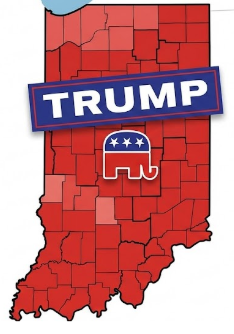

Indiana’s Republican Party is entering 2026 divided, with redistricting turning routine primaries into loyalty tests tied directly to Donald Trump’s influence.
What to Know
- Indiana Senate Republicans blocked a mid-cycle redistricting plan in late 2025, defying pressure from party leadership and the White House.
- The proposed maps would have eliminated Indiana’s remaining Democratic U.S. House seats.
- President Donald Trump has publicly targeted GOP senators who opposed the maps.
- Primary challengers aligned with Trump and Governor Mike Braun are beginning to emerge.
- Advocacy groups representing rural voters and sportsmen are warning about voter dilution and instability.
Indiana has long been one of the most stable Republican states in the country. General elections are rarely competitive, and power struggles usually play out quietly inside the Statehouse. That stability is now under pressure. A failed redistricting effort has exposed deep fractures inside the Indiana GOP and set the stage for a 2026 primary cycle defined less by policy than by loyalty.
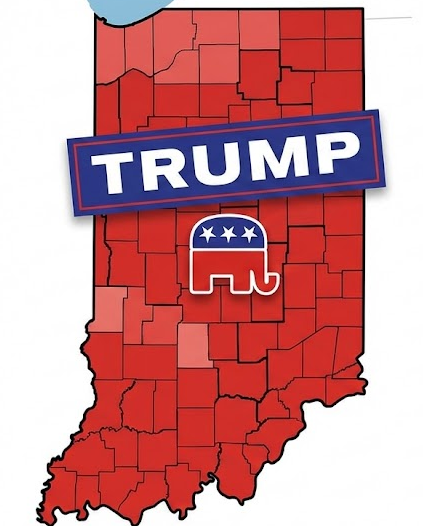
For campaigns, the shift matters because primaries now carry real risk. For voters, it raises questions about representation and accountability. For party leadership, it is a test of whether institutional control can withstand national political pressure
Redistricting Triggers an Intraparty Break
In late 2025, the Indiana State Senate rejected a mid-decade congressional redistricting plan. Twenty-one Republican senators joined Democrats to block the maps, citing concerns about process and precedent. The proposal was designed to secure a clean Republican sweep of Indiana’s congressional delegation by dismantling the last two Democratic-leaning districts. Supporters framed it as a strategic necessity.
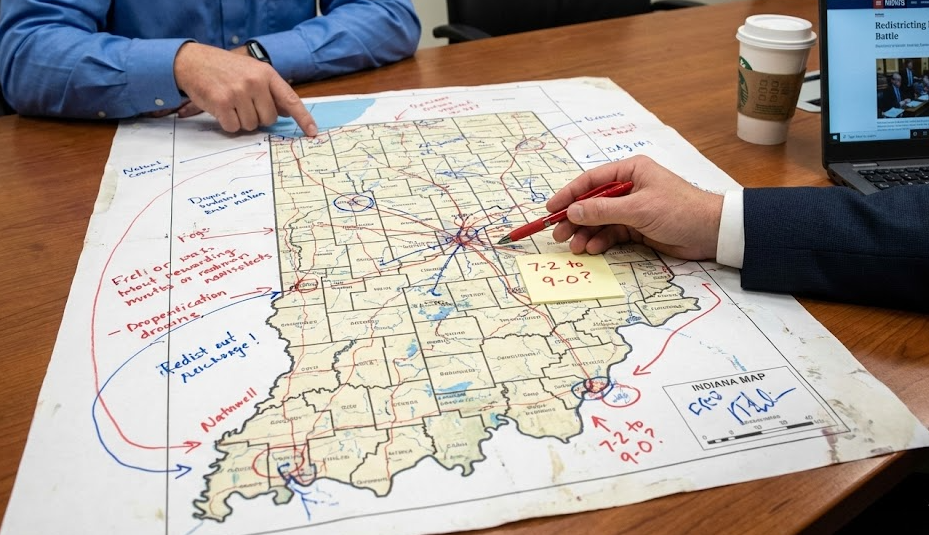
Opponents argued that mid-cycle redistricting would undermine public trust and destabilize districts already approved by voters, pointing to the mechanics of the proposed maps. The plan would have increased Republican-held U.S.
House seats from 7 to 9 by splitting Indianapolis into four congressional districts and reworking northwest Indiana along Lake Michigan, breaking up counties and communities of interest in the process. Several senators said they heard sustained constituent opposition to those county splits and questioned reopening congressional lines outside the normal redistricting window.
Trump Turns Redistricting Into a Loyalty Test
President Donald Trump responded to the Indiana Senate vote by publicly criticizing Republican senators who opposed the maps, framing the defeat not as a disagreement over process but as a failure of party loyalty. He labeled several holdouts as disloyal and made clear that he would support primary challengers willing to back aggressive redistricting tactics. In doing so, Trump elevated a state-level procedural fight into a national loyalty test tied directly to his broader influence over the party.
One of the most prominent targets was Senate President Pro Tem Rodric Bray, a central figure in Indiana Republican leadership for more than a decade. By singling out Bray, the Trump-aligned wing sent a signal that leadership status and institutional seniority would not shield lawmakers from retaliation.
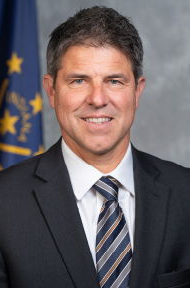
Senate President Pro Tem Rodric Bray
The dispute was no longer about whether mid-decade redistricting was appropriate under Indiana norms. It became a question of whether elected Republicans were willing to act as enforcers of national strategy, even when it conflicted with state-level precedent.
That shift carries direct implications for how candidates approach the 2026 cycle. When redistricting is framed as a loyalty measure, incumbents face pressure to prioritize alignment over judgment. Lawmakers with long records of conservative voting and district service can still be vulnerable if they resist national directives.
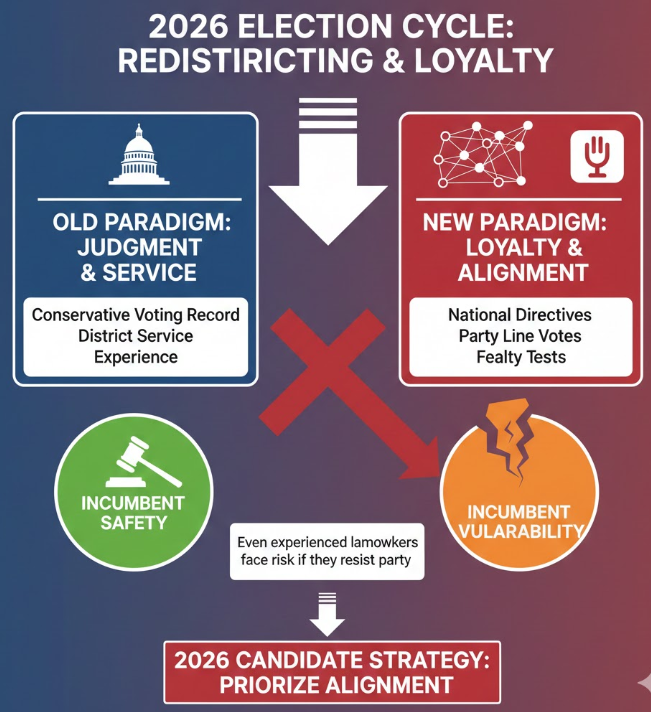
The incentive structure changes from rewarding legislative experience to rewarding compliance, particularly in low-turnout primaries dominated by highly motivated movement voters.
What the Record Shows
The scale and substance of the redistricting fight are clear in the public record. In December 2025, the Indiana Senate rejected the House-approved congressional map by a 31–19 vote, with 21 Republicans joining all 10 Democrats to block a plan designed to produce a 9–0 Republican U.S. House delegation.
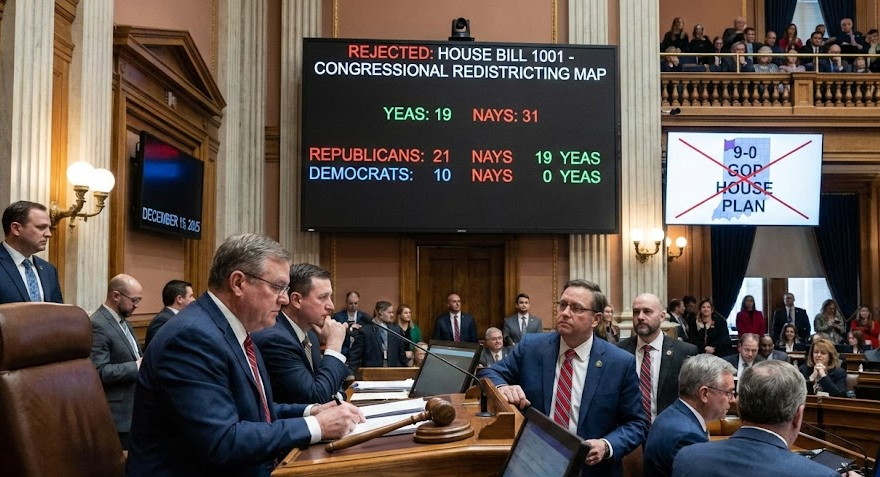
The proposal would have dismantled the districts held by Democratic Reps. André Carson and Frank Mrvan. Multiple senators described an unusually aggressive pressure campaign surrounding the vote, including two visits to Indianapolis by Vice President JD Vance and direct phone calls from President Donald Trump urging support for the maps.
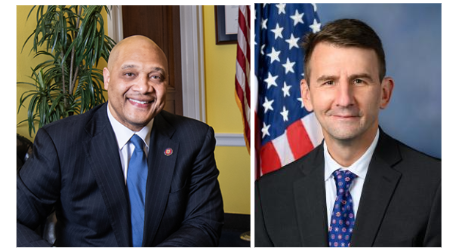
Representative André Carson (left) and Representative Frank Mrvan
Several lawmakers said opposition was driven less by partisan outcome than by concerns over mid-decade redistricting and outside interference, according to reporting by Indiana Capital Chronicle.
The fallout has been political, not procedural. Governor Mike Braun stated after the vote that he would work with President Trump to challenge Republican senators who opposed the maps, including Senate President Pro Tem Rodric Bray. That threat prompted public criticism from veteran GOP lawmakers, while speculation about Bray’s leadership position ultimately proved unfounded. One concrete consequence was Sen. Liz Brown stepping down from her Senate leadership communications role, citing a breakdown in trust with conservative voters. Senate leaders and rank-and-file members have since emphasized cooperation ahead of the January return to session, but multiple lawmakers acknowledged lingering tension between the governor’s office and the chamber. All details and quotations in this section are drawn from the Indiana Capital Chronicle’s December 15, 2025 reporting by Tom Davies.
Why Rural Representation Is at Stake
Groups like Hunter Nation are focused less on party infighting and more on the structural consequences of redistricting fights that tend to fall hardest on rural communities. District lines decide who chairs and staffs committees overseeing land use, conservation funding, wildlife management, and Second Amendment policy. When those lines are redrawn to maximize partisan math rather than reflect geography, rural voters often lose leverage inside legislatures where margins already favor urban population centers.

That dilution is not theoretical in Indiana. Hunting, conservation, and outdoor recreation are not niche interests but economic and cultural anchors across much of the state. Splitting rural districts or merging them into suburban or urban-heavy seats reduces the likelihood that lawmakers with direct experience in land stewardship or sportsmen’s issues hold decision-making power. The result is fewer advocates at the table when budgets are written, regulations are debated, and enforcement priorities are set.
Hunter Nation and similar organizations warn that frequent map changes also erode legislative continuity. Lawmakers who have spent years building subject-matter expertise can be swept out in primaries driven by national messaging, replaced by candidates whose appeal is ideological alignment rather than local knowledge.
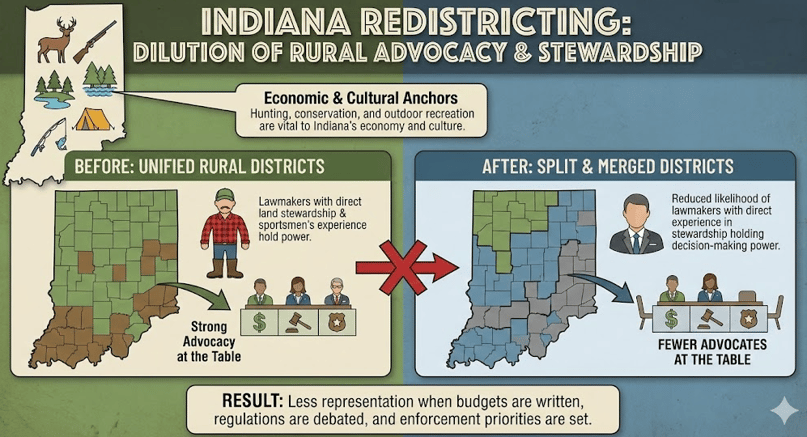
For rural voters, the risk is long-term. Representation shifts from lived experience to symbolic politics, leaving policy decisions about land, wildlife, and access in the hands of officials increasingly disconnected from the communities most affected.
The 2026 Primary Landscape
The failed redistricting vote has already reshaped the 2026 outlook. Trump-aligned challengers are preparing to run against incumbent senators who broke with party leadership. Messaging is shifting away from district-specific issues toward broader questions of loyalty and alignment with the national movement.
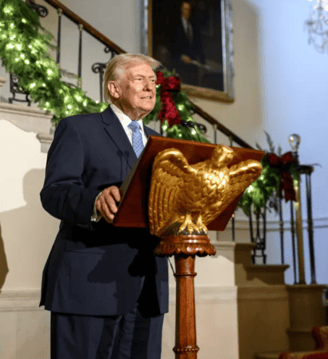
President Donald J. Trump; image via White House
For campaign strategists, Indiana now looks less predictable. Turnout dynamics in primaries will matter more than ever, and outside groups are likely to play a larger role in defining narratives.
Wrap Up
Indiana’s redistricting fight illustrates how internal party disputes can redefine safe states. What was once a low-drama primary environment is becoming a battleground over control, process, and political identity. For voters, the stakes are representation and stability. For candidates, the risk is being pulled into national fights that overshadow local priorities.
Looking ahead to 2026 and beyond, Indiana offers a preview of a broader Republican challenge. Movement-driven primaries can deliver short-term victories but often at the cost of experienced governance. How Indiana Republicans navigate this cycle will signal whether the party prioritizes durable coalitions or continued internal escalation as the next decade of elections approaches.
-Sep-03-2026-09-50-31-2388-AM.jpg)