
Once the manufacturing core of America, these two states may again decide who controls the U.S. House.
What to Know
- Michigan and Pennsylvania together contain four of the nation’s most competitive House districts.
- Michigan’s Toss-Up and Tilt races hinge on suburban realignment and union engagement.
- Pennsylvania’s Lehigh Valley and central corridor remain fertile ground for both parties.
- Economic identity, job security, and the cost of living now outweigh cultural divisions.
- The Rust Belt may again determine the balance of national power in 2026.
The 2026 fight for the House centers on a few competitive districts, with Michigan and Pennsylvania containing many of the most pivotal. Brennan Center data indicates that few genuinely competitive congressional seats remain, and these states hold several key districts that will determine control of Congress. Politically split areas, such as diverse, blue-collar suburbs and union strongholds, reflect national partisan shifts.
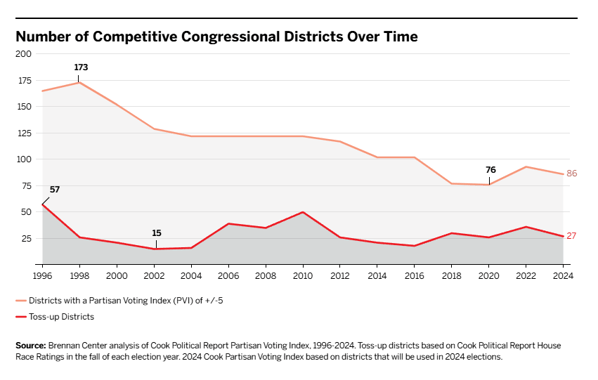
Screenshot of the chart taken from the Brennan Center
Michigan and Pennsylvania are historically crucial political states. Polling shows economic concerns, particularly the cost of living and industry stability, are paramount for voters in both. Union support is now split, and independents are swing voters, focusing on the party they see as best addressing these core economic issues.
Michigan: From Factory Floors to Swing Districts
Michigan is becoming a clear example of the challenges facing both parties in 2026. The state’s political identity, once shaped by the auto industry and a unified labor base, has splintered into a mix of suburban moderates, union independents, and conservative small towns.
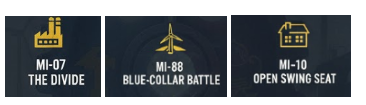
Inside Elections identifies MI-07, MI-08, and MI-10 as three of the most competitive districts in the nation, and the Cook Political Report places each in the Toss Up or Tilt categories for 2025 and 2026.
MI-07: Barrett’s Razor-Thin Coalition
Republican Tom Barrett is heading into one of the most competitive re-election battles in the country. Michigan’s 7th Congressional District, home to roughly 781,000 residents, sits in south-central Michigan and remains politically divided after voting for Joe Biden by a margin of fewer than 2,000 votes in 2020. The district’s demographic profile reinforces that competitiveness.
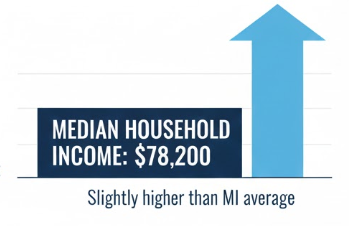
The median household income is about $78,200, slightly higher than the Michigan average, and manufacturing-intensive communities make up a core part of the local economy.
The district also exhibits a relatively stable workforce, with a mean commute time of approximately 26 minutes and a working-age population that accounts for more than 60% of the total population.
These conditions create a highly sensitive electorate. Many union households support Democratic positions on wages and workplace protections, but remain cautious about environmental rules or regulatory shifts they believe could threaten industrial jobs. At the same time, the district’s high rate of homeownership, its older-skewing voter base, and its strong share of married households contribute to a reliably conservative undercurrent.
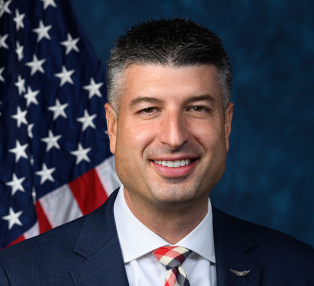
Representative Tom Barrett
Barrett, a former Army helicopter pilot, has built his message around energy policy, domestic manufacturing, and economic stability. His path relies on holding a narrow coalition of working-class independents, older Republican voters, and rural communities that prioritize cost-of-living concerns and job security over national ideological debates.
MI-08: A Vulnerable Freshman in a Shifting Map
To the north, Democrat Kristen McDonald Rivet now represents one of Michigan’s most closely watched swing seats. She won the open 8th District in 2024 with about 51% of the vote, succeeding retiring Democrat Dan Kildee and ending decades of uninterrupted Kildee family representation in mid-Michigan. The district has grown more competitive under post-2022 lines, and major forecasters rated the 2024 race as anything from Toss Up to Lean Democratic, reflecting how narrow the margins have become.

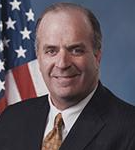
Congresswoman Kirsten McDonald Rivet (left) and Representative Dan Kildee (right)
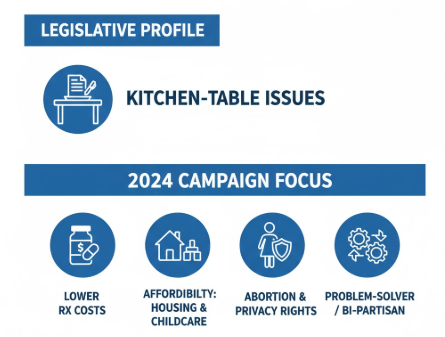
McDonald Rivet entered Congress with a profile built in the state Senate, where she emphasized practical, kitchen-table issues. In the 2024 campaign, she focused on lowering prescription drug costs, addressing housing and childcare affordability, and protecting abortion and medical privacy, positioning herself as a problem-solver willing to work across the aisle.
Her Republican opponent, Paul Junge, centered his message on inflation, the rising cost of goods, and stricter immigration enforcement, arguing that voters were ready for a more conservative voice. Both candidates raised more than five million dollars, underscoring how central MI-08 has become to each party’s House strategy.

Representative Paul Junge
The result placed MI-08 firmly in the category of seats that can vote for Donald Trump at the top of the ticket while sending a Democrat to Congress. That split-ticket behavior, combined with the district’s more conservative tilt after redistricting and the loss of long-time incumbency advantages, ensures that McDonald Rivet will remain high on both parties’ target lists heading into 2026.
MI-10: An Open Seat in the Detroit Suburbs
MI-10 is now one of Michigan’s most volatile races after Republican John James announced he will not run again. The DCCC quickly highlighted his exit as a major opening for Democrats, noting that James consistently overperformed in a district that is otherwise competitive.

Congressman John James
Macomb County, which anchors the district, has undergone steady political realignment. Bridge Michigan’s mapping of recent elections shows how the county shifted away from its old Reagan Democrat profile and split into two distinct patterns.
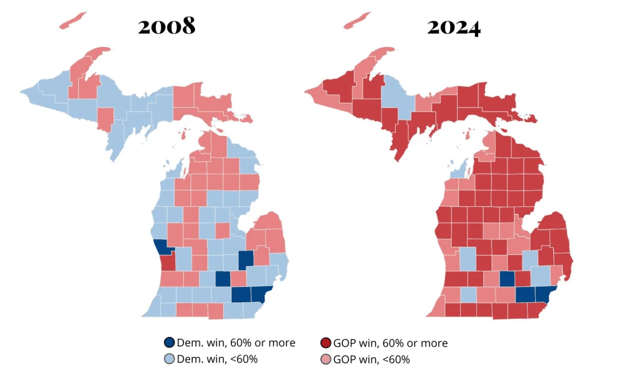
Screenshot taken from Bridge MI
Suburban communities have been trending toward Democrats since 2016, while blue-collar areas remain highly competitive.
AP News reporting on Michigan’s broader political changes shows the same pattern. The state’s voters prioritize economic stability, cost of living, and local job security, and their voting patterns have become more issue-focused rather than ideological.
The open MI-10 race will hinge on whether Democrats can convert their suburban gains into a consistent voting coalition while also reconnecting with union households. Republicans remain competitive in working-class areas, but they no longer have the benefit of James’s personal brand. The district will be decided by which party speaks most convincingly to voters who are watching inflation, taxes, and the future of local manufacturing.
Pennsylvania: The Lehigh and Central Corridors
Pennsylvania remains one of the most closely examined political states in the country. It reflects the national divide in miniature, with cities like Philadelphia and Pittsburgh anchoring Democratic strength and vast rural stretches voting reliably Republican. The real battleground lies in the state’s mid-sized industrial regions such as Allentown, Scranton, and Harrisburg, where shifts of only a few points can determine control of multiple House seats.
PA-07: A Toss-Up in the Lehigh Valley
PA-07 shifted again in 2024 when Republican Ryan Mackenzie defeated Democratic incumbent Susan Wild. Ballotpedia reports that Wild was one of only 15 House members nationwide to lose re-election and that PA-07 was one of 19 districts that changed partisan control. The district has remained competitive for multiple cycles. Both national parties targeted the district through the NRCC’s priority list and the DCCC’s Frontline program.

Congressman Ryan Mackenzie
Wild campaigned on her legislative work, including lowering drug prices and supporting Medicare and local manufacturing. Mackenzie emphasized his record in the Pennsylvania House and used an America First message to argue that Washington had failed on inflation and public safety.
Campaign finance reports illustrate how uneven the financial landscape was in PA-07. According to the Federal Election Commission, Susan Wild entered the race with a commanding fundraising advantage, reporting $8,960,928 in receipts and $8,946,230 in disbursements by the end of 2024.

Screenshot of the table of FEC data from BallotPedia
Ryan Mackenzie reported $203,832 in receipts and $66,217 in disbursements as of the end of 2023. The FEC’s data shows that Wild relied on a well-developed national donor network while Mackenzie operated with a far leaner operation, a contrast that underscores how competitive the district remained in spite of a major financial imbalance.
Election forecasters split widely, with ratings ranging from Likely Democratic to Toss Up. Mackenzie ultimately won with 50.4% of the vote. Ballotpedia notes that the district was already closely divided at the presidential level, with Biden only narrowly ahead in 2020. PA-07 remains a central battleground for both parties and is expected to be one of Pennsylvania’s most closely watched districts heading into 2026.
PA-08: Democratic Lean with Working-Class Tension
PA-08 shifted again in 2024 when Republican Rob Bresnahan defeated Democratic incumbent Matt Cartwright. Ballotpedia reports that Cartwright was one of only 15 House members nationwide to lose re-election and that PA-08 was one of 19 districts that changed party control.


Congressman Rob Bresnahan (left), Representative Matt Cartwright (right)
The district has long been one of the most competitive in Pennsylvania. WVIA and Cook Political Report both described the race as one of the most expensive and closely watched contests in the country, and major forecasters split between Toss Up, Lean Democratic, and Tilt Democratic ratings.
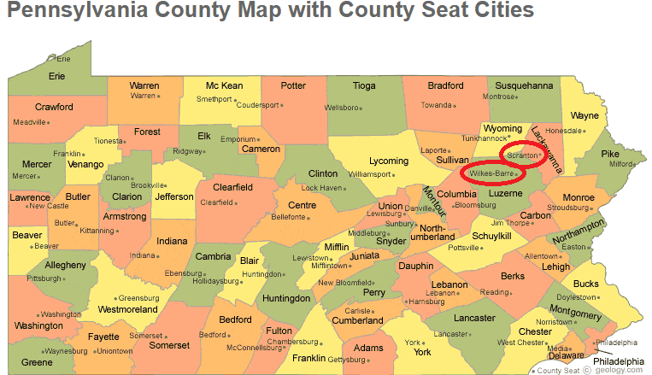
Screenshot of PA County Map and County Seat Cities from Geology; red circles added for emphasis.
The area includes Scranton and Wilkes-Barre, communities with deep Democratic and union roots, but margins have tightened in every cycle since 2016.
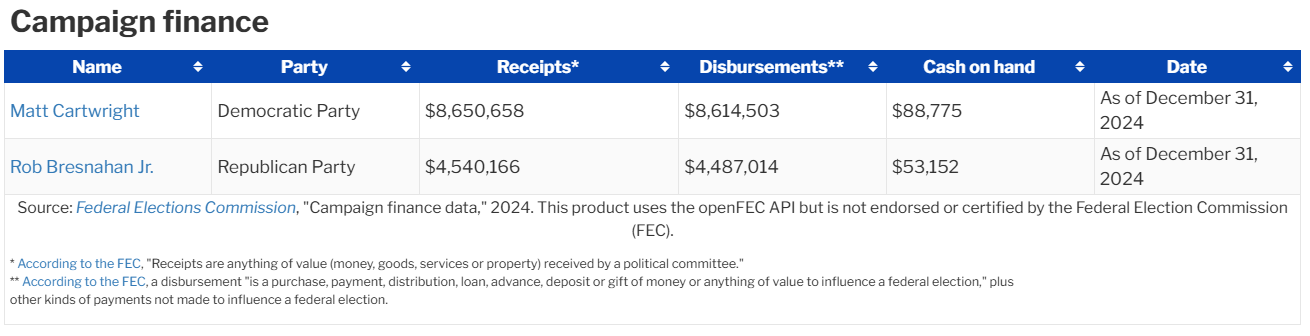
Screenshot of the FEC data on BallotPedia
The Federal Election Commission reports that Matt Cartwright entered the race with $8,650,658 raised and $8,614,503 spent. Rob Bresnahan reported $4,540,166 raised and $4,487,014 spent. Despite Cartwright’s financial advantage and long tenure, Republicans continued gaining ground with working-class voters focused on inflation, immigration, and economic uncertainty. PA-08 remains a district with Democratic roots but growing Republican strength, and it will stay a central battleground heading into 2026.
PA-10: A Polarizing Incumbent in the Harrisburg Region
Further south, PA-10 is emerging as a high-intensity battleground as Democrats line up to challenge Republican incumbent Scott Perry. The Pennsylvania Independent reports that eight Democratic candidates at a January forum in Harrisburg argued that Perry’s role in efforts to overturn the 2020 election, combined with his anti-abortion and anti-ACA voting record, makes him unfit for a district that is shifting politically.

Congressman Scott Perry
Democrats focused heavily on Perry’s attempts to block certification of Pennsylvania’s 2020 electoral votes and his repeated votes to repeal the Affordable Care Act. Several candidates argued that Perry’s far-right positioning no longer reflects the district’s changing electorate.
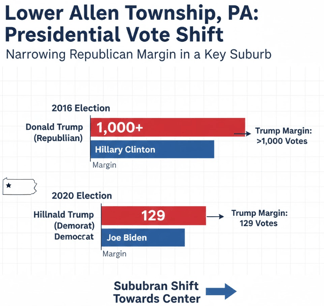
Those changes are visible in the surrounding suburbs. The Philadelphia Inquirer notes that townships near Harrisburg, including Lower Allen, have steadily trended leftward. Donald Trump carried Lower Allen by more than 1,000 votes in 2016, but by only 129 in 2020, illustrating a broader suburban shift toward the center.

These dynamics have altered the district’s outlook. The Cook Political Report moved PA-10 from “likely Republican” to “lean Republican,” pointing to the strength of Democratic recruit Janelle Stelson and growing discomfort with Perry’s hard-right brand. While the district still leans red, demographic change and Perry’s controversial record ensure PA-10 will be a top race to watch heading into 2026.
PA-17: A Democratic Hold with Volatile Edges
PA-17 stayed in Democratic control after Rep. Chris Deluzio defeated Republican Rob Mercuri 53.8% to 46.1%, according to Ballotpedia. Although forecasters such as Cook Political Report and Sabato’s Crystal Ball rated the race Lean or Likely Democratic, both national parties treated it as a high-priority contest. The DCCC placed Deluzio in its Frontline program, and the NRCC listed PA-17 as one of its targeted Democratic-held seats.

Representative Chris Deluzio
Deluzio has built his profile around his Navy service, voting-rights background, and support for organized labor. He has emphasized union organizing, veterans’ health care, and rail-safety reform following the East Palestine derailment. Mercuri, a state representative and Army veteran, centered his campaign on fiscal conservatism, criticism of Biden-era economic policy, and a strict approach to immigration.
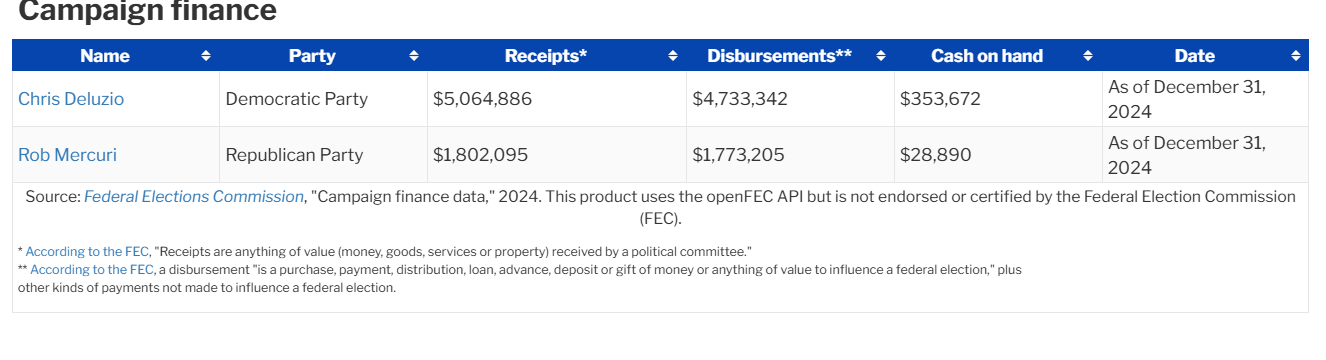
Screenshot of FEC data from BallotPedia
Federal Election Commission filings show Deluzio raised $5,064,886 and spent $4,733,342, while Mercuri raised $1,802,095 and spent $1,773,205. With Democrats maintaining an advantage but Republicans continuing to invest heavily, PA-17 remains likely to stay blue, yet it will still be a district to watch heading into 2026.
Economic Undercurrents
Both states reflect a deeper transformation in industrial politics. The traditional Democrat–labor alliance has weakened, replaced by a transactional politics centered on affordability, healthcare, and energy costs. Union membership remains higher than the national average in Michigan (13.3%) and Pennsylvania (12.7%), yet partisan loyalty among those members has fallen sharply.

Michigan’s electric vehicle industry and Pennsylvania’s energy corridor illustrate the divide. Democrats tout green manufacturing as a path to job creation, but Republicans warn that environmental mandates could destabilize legacy sectors. These conflicting narratives have polarized union leadership but fragmented rank-and-file support.
Wrap Up
For Democrats, the road to regaining the House majority runs through these two states. If they can hold MI-08 and PA-07 while capturing the open MI-10, their path to 218 seats becomes far easier. For Republicans, the formula is simpler: defend Barrett in MI-07, hold Perry in PA-10, and force Democrats to spread resources thin between the Midwest and the coasts.
Campaign Now’s analysis indicates that fewer than 400,000 voters across both states could decide control of Congress. Digital advertising budgets are already climbing, with both national committees reserving more than $60 million combined in Michigan and Pennsylvania media markets.
The 2026 midterms will test whether industrial realignment continues or stabilizes. If the Midwest once again breaks late toward one party, the result will likely define not just the House majority but the tone of the 2028 presidential race.