Influencers can succeed in political messaging because audiences often experience creator content as peer communication rather than institutional persuasion. Formal ads arrive with an obvious campaign purpose, while creator content enters feeds through voices people already follow for information, identity, entertainment, or community connection.
A December 2025 review of Pew Research on news influencers reported that about one in five Americans regularly received news from social media influencers, rising to nearly four in ten adults under 30. Among people who received news from influencers, 65% said the content helped them understand current events and civic issues. These findings do not prove that every creator message persuades, but they show why creators have become meaningful entry points into political information.
Research on small-scale political creators identified accounts with fewer than 10,000 followers as especially persuasive in some political contexts. Their advantage comes from proximity and repeated community contact rather than celebrity reach. Local parents, teachers, veterans, workers, faith leaders, and small business owners can translate policy into consequences their audiences recognize.
Timing strengthens this effect. When creators introduce a candidate, issue, or ballot measure before the final advertising rush, voters have more time to encounter and discuss the message without immediately treating it as a high-pressure campaign appeal. Paid media can then reinforce an argument that already feels familiar instead of introducing it for the first time.
Influencer strategy becomes campaign infrastructure only when the partnership is designed before content is published. The work begins with creator fit and continues through outreach, compensation, usage rights, approvals, distribution, and measurement. A viral post cannot compensate for a weak operating structure behind it.
Discovery and Fit Matter More Than Follower Count
Creator discovery and partnership planning can begin with platform-native searches, hashtag reviews, community referrals, social listening, and examination of the voices already discussing the campaign’s priority issues. Expensive discovery software may help at scale, but it does not replace human review of the creator’s audience, tone, credibility, and community role.
Fit depends on more than audience size. Geography, issue relevance, engagement quality, platform behavior, past political content, audience authenticity, cultural fluency, and reputational history all affect whether a partnership makes sense. A national account may offer more reach, while a smaller local creator may carry greater credibility with the exact voters a campaign needs to reach.
Outreach also signals how the campaign intends to manage the relationship. Clear context, an appropriate compensation range, realistic expectations, and a genuine discussion of alignment usually create a stronger foundation than a generic request for a sponsored post.
One of the most consequential failures of 2024 was not messaging, but assumption. Many Democratic campaigns treated turnout among core constituencies as inevitable rather than earned. Coalition partners were activated late, influencers were substituted for organizers, and engagement was framed transactionally rather than relational. The result was disengagement, not ideological defection.
Turnout shortfalls among voters of color, young voters, and progressive activists reflected weakened coalition ecosystems rather than sudden shifts in belief. When activists feel instrumentalized and influencers are misaligned with campaign values, credibility erodes quickly. Once credibility weakens, even strong policy alignment fails to translate into participation.
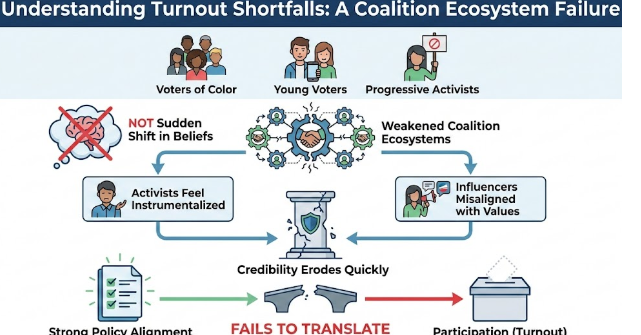
Coalition maintenance is no longer optional. In a fragmented media environment, trust moves through people and networks, not ads alone. Campaigns that fail to invest in those relationships early pay the price later in inefficient turnout efforts and declining enthusiasm.
Trusted Messengers Are Part of the Distribution System
Coalition partners, organizers, creators, local validators, email lists, SMS programs, and peer networks are not separate from media strategy. They are distribution channels through which trust moves, especially when voters are more willing to believe familiar people than another paid placement.
Campaign texting works differently when it is treated as a conversation rather than a broadcast. A mass blast treats voters as an audience, while a responsive program can answer questions, identify concerns, record intent, and improve the next contact.
This makes relationship maintenance part of the media mix itself. Paid communication can introduce the message, but relational and owned channels help determine whether voters trust it, respond to it, and remain connected long enough to participate.
Modern political advertising is optimized for scale, not persuasion. Campaigns are rewarded for impressions, frequency, and reach, even though none of those metrics guarantee that a voter actually absorbs or believes a message. The result is a system where campaigns can spend heavily, dominate media plans, and still fail to move opinion because nothing they say is memorable or credible enough to stick.
High-attention environments like live sports strip away that illusion. In those settings, creative quality is no longer abstract or theoretical. There is no algorithm softening delivery, no targeting trick compensating for weak messaging, and no second exposure to fix a bad first impression. Ads are watched in full and judged instantly. Voters know immediately whether a message feels real, relevant, or completely disconnected from their lived experience.
In high-attention environments, creative quality can outperform a larger but less memorable plan. A clear emotional signal may register more strongly than dozens of technically delivered placements that fail to connect because attention does not compensate for a message voters find generic or unbelievable.
Campaigns gain an advantage when they treat creative as a strategic function rather than a production task. Earlier message testing, faster rejection of weak concepts, and protection of clear language improve the likelihood that attention becomes recall and trust. Scale remains useful, but only when the message gives the audience a reason to keep watching.
Campaigns with limited resources are forced into a level of strategic clarity that well-funded operations often avoid. When flooding the zone is not an option, every decision carries weight. Budgets become a forcing mechanism that requires campaigns to answer hard questions early about audience, message, and priorities instead of deferring them behind scale.
These campaigns tend to define the objective of each channel before committing budget. Teams know whether a placement is meant to persuade, mobilize, reinforce support, collect information, or move a voter into direct contact. That clarity makes it easier to choose credible messengers, reject low-value activity, and protect staff time from work that does not support the campaign’s central goal.
The Media Mix Is Also a Staffing Model
Channel integration depends on the people responsible for producing, adapting, measuring, and moving content across the campaign. A plan can include the right platforms and still fail when approvals are slow, creative is not adapted to channel behavior, or no one owns the transition from attention to action.
The modern campaign team increasingly combines platform-native creators, copywriters, analysts, communications staff, paid-media specialists, and field operators inside a shared feedback system. Each role sees a different part of voter behavior, and the mix improves when those signals inform creative and placement quickly.
Budget discipline works when responsibility is clear. Campaigns of every size benefit from faster approvals, shared measurement, and explicit ownership of how paid, organic, relational, and field channels support one another.
Campaigns operate in an information environment where declining confidence in institutions overlaps with growing concern about synthetic media, manipulated content, and unreliable sources. That creates a compounded trust problem in which voters may question both the message and the system delivering it.
An April 2026 Marist Poll found that 66% of Americans trusted election administration, down from 76% in 2024, while 85% expected artificial intelligence to be used to spread misinformation during the 2026 election. These figures provide a dated snapshot, but they illustrate a broader risk: voters who suspect manipulation may also distrust legitimate campaign communication.
This shifts media strategy from visibility alone toward credibility. Messages are evaluated through the source, channel, messenger, and perceived intent behind them. Campaigns that establish trust early and reinforce it consistently are better positioned than those relying on sheer frequency to overcome skepticism.
Passive attention will continue to erode as connected TV, social platforms, podcasts, digital audio, live sports, and owned channels divide the electorate across different viewing and participation habits. Broadcast rights, platform rules, and political-ad policies will remain operational constraints that determine where campaigns can buy attention and where they must build alternative routes.
Artificial intelligence is becoming a workflow layer for analysis, testing, response, targeting, and content production. Its political future will depend on voter readiness, legitimacy, and trust, which means campaigns should treat AI as an evolving capability rather than assume autonomous optimization has already become the standard model.
The strongest media systems will combine platform fluency with human judgment. The goal is not to appear everywhere, but to understand where attention can be earned, where credibility can be reinforced, and how each contact moves a voter toward the next meaningful action.
Wrap Up
The evolution of the political media mix reflects a deeper change in how voters experience politics. Attention is fragmented, trust is conditional, and loyalty must be maintained rather than assumed. Campaigns built around saturation alone can still generate impressions, but they are increasingly likely to spend more without creating belief or participation.
Winning campaigns operate as connected systems. They identify where different voters can actually be reached, assign a clear role to each channel, develop creative that earns attention, and use trusted messengers, owned communication, and field operations to convert that attention into action. They also build teams capable of testing, learning, and adapting without allowing speed or volume to replace strategic purpose.
Political media is no longer just a budget allocation exercise. It is an infrastructure linking reach, attention, credibility, response, and turnout. The defining question is not how many ads a campaign can run, but whether the entire system gives voters a reason to watch, believe, respond, and participate.