How a generation-long realignment turned rural America from competitive territory into a GOP advantage, and what that means heading into the 2026 midterms and beyond.
What to Know:
- How a generation-long realignment turned rural America from competitive territory into a GOP advantage, and what that means heading into the 2026 midterms and beyond.
- Rural politics is frequently interpersonal before ideological: respect, cultural fit, and authenticity can matter more than policy detail.
- A “prioritization gap” has hardened: many rural voters believe Democrats fight hardest for cities and higher-status constituencies while rural decline feels secondary.
- Economic change (trade, consolidation, deindustrialization, post-2008 divergence) helped create a lasting rural sense of falling behind, with Democrats often blamed as the “new economy” party.
- Democrats’ shift to centralized, turnout-driven strategy weakened local civic infrastructure, while conservative networks and local institutions filled the “dot-connecting” role.
- Many rural voters feel politically invisible even while rural areas retain structural power, fueling defensive voting and resentment.
- Republicans became the beneficiaries by aligning with place, work, and respect narratives, but the advantage can be squandered without consistent presence and credible messengers.
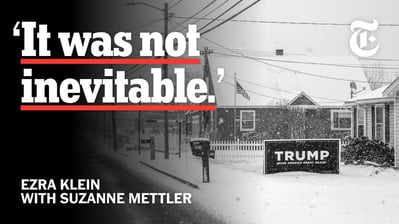
To understand how this divide hardened from a policy disagreement into an identity crisis, extensive reporting and research have been synthesized here. This deep dive incorporates the Associated Press’s investigation into the party’s rural collapse, Katherine J. Cramer’s fieldwork on 'rural consciousness,' and Suzanne Mettler and Trevor Brown’s research on the 'rural-urban divide' as featured on The Ezra Klein Show."

How the Democratic Brand Turned Radioactive in Rural America | The Ezra Klein Show
Why the Democratic Brand Became Radioactive in Rural America
The New “Pariah” Party in Small Towns
In many rural communities, the Democratic label has shifted from “the other team” to a social stigma. As outgoing Democratic Rep. Jim Cooper warned, "You’re almost automatically a pariah in rural areas if you have a D after your name".
.jpg?width=199&height=299&name=image%20(1).jpg)
Candidates are no longer evaluated first on local biography, work history, or a record of service. They are evaluated through an inherited national brand that, fairly or not, signals cultural distance from small-town life.
That stigma has operational consequences. In rural places where politics is interpersonal before it is ideological, a “D” next to a name can make it harder to recruit volunteers, raise money, earn endorsements, or even persuade voters to publicly associate with a campaign. As AP News reported from rural Pennsylvania, the brand is now so toxic that the brand is now so toxic that "some liberals have removed bumper stickers and yard signs and refuse to acknowledge publicly their party affiliation". Over time, the brand becomes self-reinforcing: fewer visible Democrats in public life makes the label feel even more “out of place,” which further discourages visibility.
National Slogans vs. Local Candidates
Rural Democrats increasingly struggle to run as local candidates because politics is filtered through national media, national controversies, and national slogans. As former Kentucky Democratic Party chair Sannie Overly observed, the opposition has "been able to nationalize these races in a way that have made even state and local Democrats hard to elect". Many voters never meet the state legislative candidate or county commissioner. What they do encounter—repeatedly—are the most polarizing national signals, which are then mapped onto every local Democrat.
This is why “kitchen-table” messaging often fails to land. Former rural candidate J.D. Scholten noted that on issues like minimum wage and Medicaid expansion, "we're seeing our policies are winning but candidates are not". Even when a rural Democrat talks about roads, broadband, jobs, or public safety, many voters have already pre-sorted them into a national category: a proxy for the party’s loudest activists, most unpopular cultural cues, or least trusted institutions.
-1.jpg?width=199&height=279&name=image%20(2)-1.jpg)
Scholten described speaking to farm groups where they agree on policy, but the moment they realize he is a Democrat, "boom it was over". In practice, the race becomes a referendum on party identity, not a choice among local problem-solvers.
.jpg?width=499&height=273&name=image%20(3).jpg)
Local candidates struggle against toxic national branding and deepening rural-urban tribalism. Based on AP News reporting and Mettler & Brown’s Rural Versus Urban. (Created by Campaign Now with Gemini.)
Respect First, Policy Second: The Rural Credibility Test
Once a brand is socially “radioactive,” policy becomes secondary to a prior screening question: Is this person one of us, and do they respect people like us? Rural voters are often less focused on white-paper details than on whether the candidate signals respect for rural work, community norms, and local judgment, or whether they signal contempt, condescension, or indifference.
That is why “authenticity” is not a stylistic preference; it is a credibility test. Rural communities have strong “phony detectors.” Staged photo-ops, temporary cultural costumes, and generic talking points can backfire because they confirm the core suspicion driving the brand problem: they’re performing rural, not belonging to it.
In this environment, Republicans often start with an advantage because the GOP is more frequently perceived as the rural “in-group,” while Democrats are forced to overcome negative national brand cues before they can even be heard. But that advantage is not automatic or permanent. It is strengthened by consistent presence, credible messengers, and community trust and weakened by complacency, neglect, or candidates who feel disconnected from local realities. The structural point is simple: the more rural races are fought on national brand signals instead of local relationships, the harder it is for Democrats to compete on individual merit, and the easier it is for Republicans to consolidate support across cycles.
.jpg?width=199&height=299&name=image%20(4).jpg)
Katherine J. Cramer’s The Politics of Resentment
The Prioritization Gap: Why Rural Voters Feel Second-Class in the Democratic Coalition
The collapse of rural support for Democrats is driven less by a single policy dispute than by a broad perception that the party no longer treats rural communities as full members of its coalition. Many rural voters increasingly see Democrats as a vehicle for metropolitan priorities and cultural signaling, while the day-to-day deterioration of small towns feels peripheral at best. That perception becomes a governing story: Democrats are seen as fighting hardest for cities and for groups framed as higher priority, while rural concerns are treated as background noise.
.jpg?width=499&height=358&name=image%20(5).jpg)
Explaining the 20-point rural-urban voting gap through the lens of resentment. Based on Mettler & Brown’s Rural Versus Urban and Cramer’s The Politics of Resentment. (Created by Campaign Now with Gemini.)
Once that story takes hold, economic anxiety often turns into distributive injustice—the belief that public resources flow out of rural places and return as benefits for someone else. When Democrats propose new spending, many rural voters do not hear “help is coming”; they hear “more extraction.” The result is a zero-sum interpretation of politics: a new benefit announced for a city is assumed to come at the expense of a struggling county, and promises about jobs or infrastructure can sound like rhetoric that never reaches rural roads, clinics, or schools.
This gap widens when national politics is framed through language that feels accusatory or dismissive to rural working-class voters. Many hear identity-based messaging as a cue that their own hardship is being minimized or treated as morally suspect. That does not mean rural voters are indifferent to fairness; it means they often reject a narrative that implies they are the problem rather than a constituency worth fighting for. For Republicans, this creates a durable opening: simply acknowledging rural status anxiety and "back-of-the-line" frustration can be enough to validate the grievance and keep the coalition aligned, even when specific policy preferences are mixed.
.jpg?width=199&height=221&name=image%20(6).jpg)
Political scientist Katherine J. Cramer, whose listening groups in Wisconsin revealed that many rural voters feel ignored and disrespected by urban elites
The Long Rural Slide: How a New Economy Left the Heartland Behind
The rural–urban economic gap did not appear overnight. It built over decades as the U.S. economy shifted toward sectors and regions that rewarded metropolitan density and credential-heavy work. In many rural counties, small-town manufacturing contracted, local employers consolidated or disappeared, and younger workers left for larger labor markets. At the same time, family-scale farming and resource-dependent communities faced mounting pressure from consolidation and volatility, leaving fewer “anchoring” institutions that once sustained main streets.
The 2008 financial crisis hardened the divide. Many metro areas recovered faster as growth concentrated in finance, tech, and professional services. In many rural places, recovery felt slower, thinner, or absent—reinforcing the perception that prosperity was increasingly “somewhere else,” and that national economic success stories did not include them.
.jpg?width=299&height=299&name=image%20(7).jpg)
“Dirt road” relationship-building versus the alienating “cookie-cutter” playbook. Based on State Senator Chloe Maxmin’s strategy. (Created by Campaign Now with Gemini.)
Even when global market forces and technology drove much of the disruption, the political accountability landed unevenly. As Ezra Klein observed regarding the economic devastation in rural areas, "there is what happens and then there is who is blamed for what happens". Trade, deregulation, and economic modernization became associated, fairly or not, with a national leadership class that rural voters increasingly viewed as urban-centered. Political scientist Suzanne Mettler argues that this hardened into a view of Democrats as a party of "affluent people... who don't seem to understand them" or their communities
Republicans benefited by validating the sense of abandonment and speaking in “jobs-first” terms that matched rural economic memory: work that is visible, place-based, and rooted in local industry. The result is not simply disagreement over policy; it is a durable belief that one party understands the heartland’s economic losses and the other is comfortable managing them from a distance.
How Democrats Ceded Rural Civic Infrastructure to the Right
From Party Halls to Mailing Lists
Democrats once competed in rural America through in-person infrastructure: precinct captains, county chairs, unions, and steady community presence.Over time, especially after 2008, the model shifted toward centralized turnout bursts, national fundraising, and list-driven targeting. In many rural counties, local party capacity thinned out, volunteer networks shrank, and “showing up” became seasonal. Relationship-based loyalty weakened, and rural identity became easier for opponents to define.
.jpg?width=320&height=320&name=image%20(8).jpg)
Rural economic decline fuels the perception that cities “drain” resources and ignore “fair share.” Based on economic restructuring data and Katherine Cramer’s research. (Created by Campaign Now with Gemini.)
Who “Connects the Dots” Now in Rural Communities
When local party organizations fade, the key question is who interprets politics for everyday life. With fewer unions and fewer local Democratic validators, a vacuum opened up. Republicans have filled it through durable community institutions including faith networks, gun-rights groups, agricultural circles, and other local connectors that translate national issues into local meaning and provide trusted validation for candidates.
Why Progressive Messages Rarely Get a Hearing
Without strong local validators, Democratic candidates face an information environment that is structurally unfavorable. In many communities, conservative media ecosystems and nationalized cultural narratives set the default frame—often drowning out granular policy claims or local service records. Even when Democratic governance produces tangible benefits, the credit is easily lost if local messengers are absent and the community’s trusted channels do not carry the story. This is not just a messaging problem; it is an infrastructure problem.
That long retreat sends a signal that rural places are not being competed for year-round, only "contacted" when needed. Over time, that fuels political invisibility: voters feel they are not listened to, not respected, and not meaningfully represented. That sets up the next dynamic, the "silence" problem, which is low external efficacy and the belief that government happens somewhere else, without them.
The Silence of Rural America: Why Voters Feel Politically Invisible
Many rural residents describe a persistent sense that national politics is happening to them, not with them. As Katherine J. Cramer explained in an interview with Jacobin, rural voters "strongly perceive that all the decisions are made elsewhere" by people who are not familiar with the challenges they face.
Survey research published in Politics & Policy captures that perception: majorities of rural respondents say their communities have too little influence on government, and that belief tracks closely with a broader collapse in “external efficacy” (the feeling that leaders hear and respond to people like them). When voters start from the assumption that nobody is listening, even well-designed policy messages tend to land as performance rather than help.
.jpg?width=600&height=327&name=image%20(9).jpg)
Rural consciousness prioritizes identity and genuine presence over policy details. Based on Katherine J. Cramer’s The Politics of Resentment. (Created by Campaign Now with Gemini.)
This feeling persists even though rural America has structural leverage through institutions like the Senate and the Electoral College. The paradox is that institutional weight does not automatically translate into day-to-day respect, cultural visibility, or confidence that government priorities reflect rural life. Many rural voters experience their political power as defensive, a backstop against decisions made elsewhere, rather than as genuine representation.
Consolidating the Heartland: The GOP Strategy
Republicans did not “win rural America” in one election cycle. They became the beneficiaries of a longer realignment in which rural voters increasingly interpret politics through respect, status, and place—not just through programmatic policy. That advantage is real, but it is not automatic. It can be reinforced by credible presence and trusted messengers, or weakened by complacency, overreach, and candidates who feel disconnected from local realities.
From Ideology to Identity: Aligning with “Rural Consciousness”
Democrats have often approached rural voters with policy checklists: what a bill funds, what a program expands, what a reform fixes. Republicans have more consistently met rural voters at a prior question: “Do you see me, and do you respect my community?” That is the logic of rural consciousness: a place-based identity shaped by the belief that small towns are treated as peripheral by institutions headquartered in far-away cities, staffed by people who do not live with the consequences of their decisions.
The Republican advantage is that it often begins by validating the premise rather than arguing against it. Even when voters hold mixed or pragmatic views on individual issues, they may still vote for the side that signals cultural recognition and in-group belonging. In that environment, policy disagreements do not necessarily break coalitions; disrespect does.
The Producer vs. Protected Class Framing
A second driver of the GOP’s rural durability is a moral framing of fairness and deservingness. In many rural communities, “hard work” is culturally defined as physical labor, long hours, and place-based productivity. By contrast, office-based work, especially government and adjacent professional roles, can be viewed as sheltered from risk, protected by rules, and buffered by benefits that private-sector workers do not have.
Republicans have effectively turned this into a story about distributive justice: who pays, who benefits, and who gets listened to. This does not require attacking public employees as individuals; it rests on a broader contrast between “people who build and produce” and “people who regulate, administer, and lecture.” Once that framing takes hold, debates about budgets, regulations, and mandates stop sounding like technical governance and start sounding like a status contest. The GOP benefits because it is more often perceived as the party willing to say, plainly, that rural work and rural taxpayers are being taken for granted.
Filling the Organizing Vacuum
Messaging matters, but presence matters more. As Democrats shifted toward centralized turnout operations and nationalized fundraising, many rural communities experienced an everyday absence: fewer local party meetings, fewer trusted validators, fewer visible relationships that could vouch for a Democratic candidate in a skeptical setting. That absence is consequential because rural persuasion is often relational. Voters are more likely to accept a new message when it comes through a known person or institution rather than a seasonal ad buy.
Republicans and conservative-aligned networks have benefited from being the consistent interpreters of politics in many small towns—helping translate national controversies into local meaning and giving voters a stable “permission structure” to stay aligned. Over time, that turns partisanship into a default identity. The “R” next to a name starts to function as a shorthand for cultural fit, while Democratic candidates have to spend scarce time proving they are not hostile to the community’s values.
Authenticity and Credible Messengers
Finally, rural politics is filtered through a credibility test. Voters are often less interested in a candidate’s résumé than in whether the candidate respects them, understands their constraints, and shows up without condescension. This is where authenticity matters, not as performance, but as consistency. When candidates appear to be visiting rural places as a backdrop rather than a constituency, it reinforces the very resentment Democrats struggle to overcome.
Republicans have benefited by elevating candidates who can communicate cultural alignment with minimal translation, through biography, language, temperament, and familiarity with the rhythms of rural life. That does not mean a candidate must be “from” a place to represent it; it means the candidate must be credible in that place. The party that treats rural communities as a serious audience—rather than a scolding target or a marketing segment—tends to hold the advantage.
Wrap Up
Heading into the 2026 midterms and beyond, the biggest takeaway is that identity is increasingly driving rural voting behavior, with many heartland voters choosing based on “who they are” more than “what they want,” so even strong economic offers can fail if they don’t first close the respect gap. That dynamic also explains why messaging around “hard work” is so sensitive: when campaigns ignore the rural definition of effort and deservingness, voters often read it as unfair redistribution shaped by urban priorities. Just as important, durable majorities cannot be built on election-season ads alone; they require year-round presence, because local relationships create the permission structure for voters to stay aligned.
In that context, authenticity beats aesthetics every time, and candidates who “perform rural” without listening and credibility get rejected because voters want to be heard, not mirrored. Until national party branding shifts in a way that lowers the temperature, many rural voters will keep using institutional leverage as a defensive shield against what they perceive as urban overreach.