The 2026 House battlefield is not defined by sweeping national trends, but by a razor-thin slice of districts where control can shift on the margins. With most seats effectively locked in, the balance of power now hinges on a limited number of competitive races, many separated by only a few points. This compressed map leaves little room for error and magnifies the impact of turnout, messaging, and resource allocation, making the fight for the majority tighter and more unforgiving than at any point in the modern era. The current competitive distribution underscores just how narrow the fight has become:
- 12 Toss-Up districts
- 13 Tilt districts
- 19 Lean districts
- 20 Likely districts
Republicans are defending most of the true Toss-Up districts and nearly half of all Tilt seats, putting their majority squarely in the danger zone. These are seats with thin margins and volatile electorates, where even small mistakes can have immediate consequences. Democrats hold the bulk of the Lean seats, but many sit in states facing demographic shifts, economic anxiety, or turnout instability. Those advantages are real, but fragile. The result is a highly concentrated battlefield. Control of the House will be decided in a narrow set of races where precision matters more than momentum, and where a single misstep in spending, messaging, or turnout can be enough to flip the majority.
The Cook Political Report, a nonpartisan election-rating service, currently lists 17 House races as Toss-Ups. 14 are held by Republicans and 3 by Democrats, giving the GOP much more territory to defend.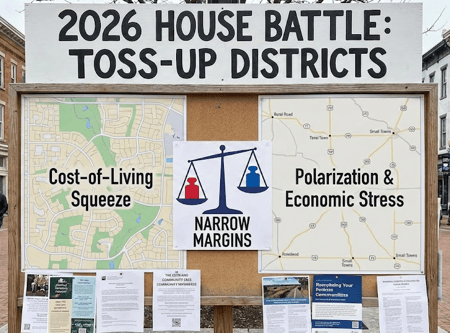
The Republican-held Toss-Ups stretch across Arizona, California, Colorado, Iowa, Michigan, New Jersey, New York, Pennsylvania, Virginia, and Wisconsin. Democrats hold only Ohio’s 9th, Texas’s 34th, and Washington’s 3rd. That imbalance means a small number of losses could put the Republican majority at risk.
These districts respond quickly when the political environment changes. With presidential approval below 40% and strong anti-incumbent frustration, national pressure is already reaching the most competitive seats. Control of the House will depend on turnout, persuasion, and campaign execution in this small group of battlegrounds.
Lean and Tilt districts sit just outside the true Toss-Up category. Rating organizations use different labels, but these seats often show political movement before the wider map changes. They can survive a neutral environment, but they become vulnerable when national conditions turn against the party holding them.
The Cook Political Report’s April 7 update moved 5 races toward Democrats and only 1 toward Republicans. Pennsylvania’s 8th District moved from Lean Republican to Toss-Up, while Ohio’s 1st District moved from Toss-Up to Lean Democratic. Those changes show that pressure is reaching seats Republicans previously expected to defend more comfortably.
Headings, paragraphs, blockquotes, figures, images, and figure captions can all be styled after a class is added to the rich text element using the "When inside of" nested selector system.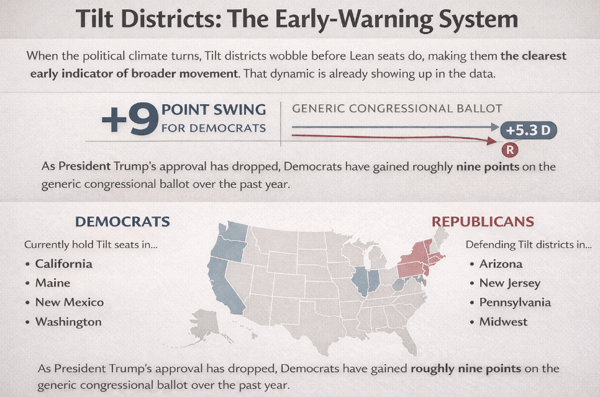
Freshman Republicans in Michigan’s 7th, Pennsylvania’s 7th, and Colorado’s 8th also won narrow races in 2024. A Democratic generic-ballot advantage of roughly 5 to 7 points could erase those margins. When Lean seats begin moving into the Toss-Up column, party committees must decide whether to expand the battlefield or redirect money toward defense. The current movement gives Democrats more opportunities while forcing Republicans to protect a wider map.
Lean and Likely Districts: The Perimeter Risk
Lean districts form the outer edge of the 2026 battlefield. They usually hold in neutral political environments, but they are far less secure than their labels suggest. When turnout softens, presidential approval declines, or economic anxiety sharpens, these seats are often the next to crack. In a D+5 national environment, they become pressure points rather than safe ground.
Democrats currently control most Lean seats, spread across California, Nevada, the Midwest, and the Northeast. Many of these districts benefit from favorable demographics, but they are not immune to midterm dynamics, particularly in areas experiencing cost-of-living strain or uneven turnout. Republicans hold fewer Lean seats overall, but remain exposed in suburban districts where resistance to the party has hardened and national conditions matter more than incumbency.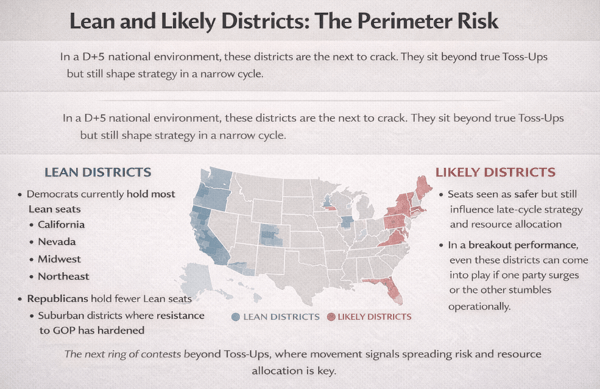
Likely districts sit further from the center of the fight, but they still shape strategy in a narrow cycle. When the national environment shifts sharply, these seats influence how parties allocate resources, where they play defense, and how aggressively they expand the map late. In a year where a five-point national advantage does not guarantee a wave, even Likely districts can become relevant if one side achieves a breakout performance or the other falters operationally.
Together, Lean and Likely districts define the perimeter risk of the 2026 House map. They are not where the fight begins, but they are where it can unexpectedly spread, turning a contained contest into a broader, more volatile battle for control.
Together, California, New York, Michigan, and Pennsylvania form the structural foundation of the 2026 House battlefield. These states host the densest clusters of competitive districts and the most electorally sensitive voter coalitions.
California and New York: The Coastal Battlegrounds
California and New York account for more than one-third of all competitive House races. Population churn, affordability pressures, and suburban realignment dominate these contests. California’s Central Valley, Inland Empire, and coastal suburbs present simultaneous Democratic vulnerabilities and opportunities. New York’s Long Island, Hudson Valley, and exurban corridors remain among the most volatile districts in the country.
Suburban movement is no longer entirely one-directional. Cygnal’s May 2026 survey found that suburban voters shifted 7 points toward Republicans in 60 days, narrowing the Republican suburban deficit from 11 points to 4 points. Most of that movement came from non-college suburbs and households earning between $75,000 and $125,000.
College-educated suburbs still favor Democrats by 18 points, but mixed districts such as California’s 45th and New York’s 4th contain both voter groups. These districts remain difficult for Republicans, but Democrats cannot assume that anti-Trump sentiment alone will hold every suburban voter.
Michigan and Pennsylvania: The Industrial Core
Michigan and Pennsylvania anchor the industrial spine of the national map. These states combine union fragmentation, suburban diversification, and economic identity voting. Districts across south-central Michigan and Pennsylvania’s Lehigh and Harrisburg corridors remain razor-thin and highly responsive to cost-of-living sentiment, job security, and candidate credibility.
Michigan’s battlefield expanded when Rep. John James left the 10th District creating an open seat in the Macomb-Oakland County suburbs. Without an incumbent’s personal advantage, the district immediately became a serious target for both parties.
Republican primary divisions have added uncertainty to the race. For Democrats, the open seat creates an opportunity in a district where suburban voter behavior is already changing. The outcome will depend on candidate quality, turnout, and whether either party can build support beyond its reliable base.
The earlier sections explain where the 2026 House battle will take place. The Iran conflict helps explain one factor changing the political environment. After the United States began military operations against Iran on February 28, 2026, the effects quickly reached household budgets through higher fuel and energy costs.
Gas prices increased by 35% in one month, rising from about $2.80 to $4.14 per gallon by April 6. A Pew survey found that 69% of Americans were worried about gas prices. Reuters/Ipsos later reported that 75% held the administration responsible for the increase, while 64% said higher prices had directly affected their household finances.
The political effect is especially important among independent voters. Emerson polling found that 47% opposed the military action, while 40% supported it. Separate Reuters/Ipsos polling identified cost of living as the top issue for Americans when thinking about the 2026 congressional elections. Cygnal’s May 2026 survey also identified a persuadable group equal to 12% of likely voters, many of whom were independent, moderate, and concerned about inflation. These voters could become decisive in close districts because they are judging the conflict through its effect on everyday costs.
The 2026 House map rewards discipline and punishes overreach. For Republicans, exposure in Toss-Up districts demands tight message control, efficient defense, and restraint in expansion. Maintaining credibility with suburban moderates, older voters, and economically stressed independents is essential, particularly as national conditions weigh more heavily than incumbency in vulnerable seats. Overcommitting resources to long-shot districts risks weakening the core and accelerating losses where margins are already thin.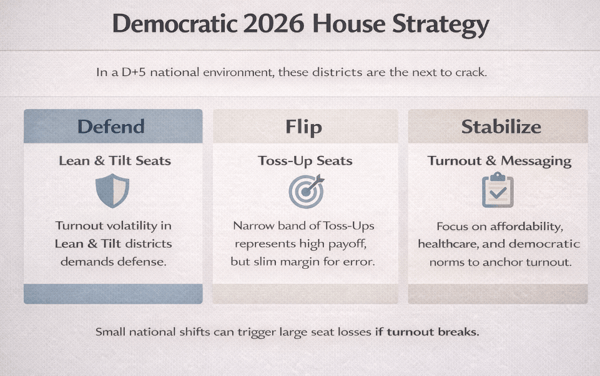 A growing share of voters in competitive House districts are no longer reachable through conventional persuasion. These voters are not undecided in the traditional sense. They are insulated by tightly closed media ecosystems that filter out opposing information and reinforce partisan identity.
This insulation dramatically reduces the effective electorate in swing districts, helping explain why national polling advantages increasingly fail to translate into proportional seat gains. Even when the national mood shifts, district-level movement is often muted to one or two points. As a result, campaigns are being forced to rethink strategy. Persuasion is no longer the dominant path to victory. Mobilization, turnout discipline, and base activation now offer more reliable returns in a compressed battlefield.
What the National Number Really Measures
The generic congressional ballot measures the country’s overall political mood by asking voters which party they would support for Congress. It is useful for understanding the direction of the election, but it does not predict the result of every individual district.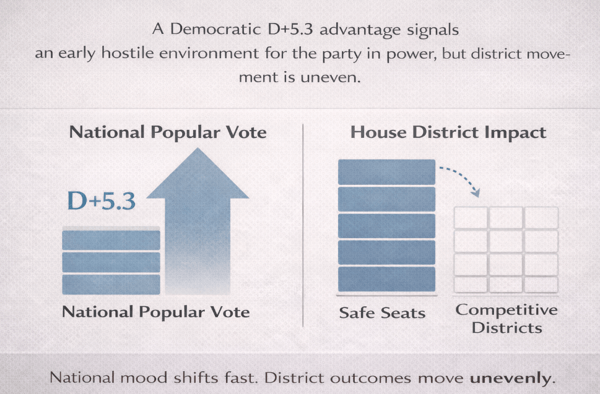
Cygnal’s May 2026 survey placed Democrats ahead by 6.1 points, compared with a 5.3-point advantage in January. A separate Cook Political Report survey of 36 competitive districts found Democrats leading 50% to 44%. Those districts had supported Donald Trump by an average of about 2 points in 2024, showing that Democratic improvement was reaching the actual battlefield.
The Democratic advantage is not fixed. In one Cygnal informed-ballot test, a strongly worded immigration-enforcement contrast moved the result from D+6.1 to R+18. That test is not an election forecast, but it shows that unsettled voters remain sensitive to how issues are framed. The generic ballot describes the current mood; campaign messages and district-level execution determine whether that mood becomes actual votes.
Redistricting has changed the House battlefield, but it has not removed political risk. New district lines can help one party protect seats, yet they can also create narrow margins that become vulnerable when turnout or national opinion changes.
Republican pollster Patrick Ruffini’s May 2026 analysis estimated hat redistricting moved the House seat closest to deciding control from Trump +3.1 to Trump +5.1. Under the new maps, a Democratic wave reaching Trump +9 would produce a narrow 222–213 Democratic majority. Under the older maps, the same environment could have produced a much larger 239–196 majority. Ruffini’s analysis therefore estimated a difference of 17 seats.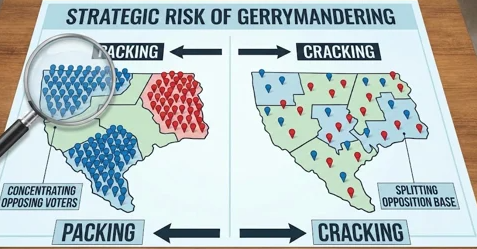
Ballotpedia reported that 5 states adopted new maps between 2024 and 2026, producing a net Republican advantage of about 3 seats, while map disputes remained unresolved in 5 other states. An April 29, 2026 Supreme Court decision involving Louisiana added further legal uncertainty. Redistricting can shape the map, but court rulings, voter turnout, candidate quality, and national conditions can still change the outcome.
The Supreme Court Just Handed Republicans a New Path to House Control
The 2026 midterm map is being set long before November by ideologically distinct primary electorates in a small number of high-impact states. In places like Arizona, Georgia, Michigan, Pennsylvania, Texas, and beyond, crowded primaries and open-seat contests are forcing candidates to adopt clear, often rigid positions early in the cycle.
Surviving these primaries comes with a tradeoff. Candidates emerge finely tuned to the demands of their state’s primary voters, but frequently constrained in their ability to pivot toward independents and moderates in the general election. Issue priorities, character expectations, and perceived threats vary sharply by state, making a single national message ineffective.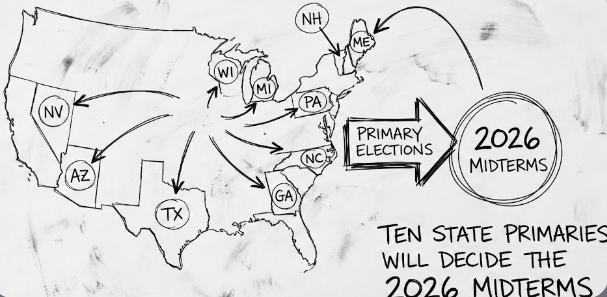 In a cycle likely to be decided on the margins, the candidates who matter most may not be the ones with the strongest November messaging, but the ones who can navigate primary demands without foreclosing general-election viability. How these early contests shape the field may ultimately determine control of Congress.
A New Era of Knife-Edge Majorities
In a House fight this tight, primaries are no longer a warm-up act. They are the filter that determines which candidates are even capable of winning in November. The 2026 majority will not be lost on Election Day alone. It will be shaped, constrained, and in many cases decided months earlier, in low-turnout contests where ideology hardens, messages narrow, and flexibility disappears. The parties that ignore this reality do so at their own risk.
Meta will enforce its 7-day blackout on new political, electoral, and social-issue ads in 2026. Any ad that has received at least one impression before the cutoff may continue running, but no new creative can be launched once the blackout begins. Political advertisers must complete identity verification, include a visible “Paid for by” disclaimer, and disclose when artificial intelligence is used to create or materially alter ad content.
For campaigns, this rule fundamentally alters final-week operations. Opposition research, rapid-response attacks, and debate pivots cannot be deployed on Facebook or Instagram unless they were already live prior to the blackout. Creative testing and contingency production must happen earlier in October. The final week becomes an execution window, not an invention window.
If a message is not active before the blackout begins, it does not exist in the highest-saturation digital environment in the country.
The 2026 cycle is governed by calendar mechanics as much as voter persuasion. Meta’s blackout begins seven days before Election Day. Google pauses new election ads once polls close. FEC pre-general reporting deadlines shape late-cycle transparency. Streaming inventory tightens four to six weeks out, increasing CPMs and limiting premium placements.
TikTok maintains a permanent ban on paid political advertising. LinkedIn prohibits political ads entirely. Other platforms allow advertising but require verification, disclaimers, and compliance review that can delay launch if not anticipated.
Campaigns that anchor production schedules to these platform windows avoid late-cycle disruption. Those that ignore timing constraints risk missed launches, higher costs, and restricted inventory at peak voter attention.
How to Survive 2026 Political Ad Blackout-Week
Blackout-week survival requires upstream discipline. Core persuasion creative must be approved and delivering impressions before Meta’s cutoff. Contingency messaging should be pre-built and quietly live so budgets can scale within existing ads if needed.
Campaigns should diversify across platforms to preserve flexibility. X and Snapchat may offer late-cycle deployment options. Google and YouTube remain viable until polls close. Connected TV requires early booking due to inventory compression. Owned email and SMS channels remain fully controllable assets.
Compliance is not administrative detail. Verification delays, improper disclaimers, or AI disclosure failures can halt execution during the most critical stretch. In 2026, preparation replaces improvisation.
Streaming fragmentation forces campaigns to buy across multiple platforms to replicate what cable once delivered. Algorithms shift. Approval policies tighten. Inventory sells out early. Costs rise late.
Owned media provides insulation. Email lists and SMS databases are not subject to blackout windows, algorithmic throttling, or shifting platform moderation standards. Campaigns control distribution, segmentation, and activation without per-impression costs.
Paid media expands reach. Owned media stabilizes operations. In a volatile platform environment, direct communication infrastructure becomes a structural advantage rather than a supplemental tactic.