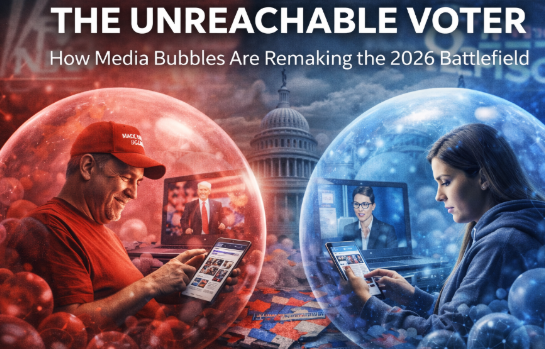

A growing segment of the electorate is now functionally immune to campaign persuasion, a structural challenge detailed in a new Resonate report that will redefine the fight for Congress.
What to Know
- Up to 22% of voters in battleground states are now “functionally unreachable,” according to a 2024 Resonate study.
- These voters get 85%+ of their political information from closed, partisan media loops, insulating them from outside messaging.
- The share of persuadable voters in the average swing district has fallen from about 15% in 2016 to roughly 6% in 2024.
- As a result, a 5-point national polling advantage may yield only a 1–2 point shift in hardened districts.
- Campaign strategy is shifting away from persuasion toward base mobilization, where returns are more predictable and cost-effective.
In the high-stakes world of modern politics, campaigns invest millions to persuade a dwindling pool of undecided voters. But what if a growing, critical mass of those voters are simply unreachable? According to "Reach the Unreachable," a landmark 2024 post-election analysis from the research firm Resonate, that is precisely the new reality. Their rigorous study reveals a startling trend that will have profound implications for the 2026 midterm elections: a significant and growing share of the American electorate is now functionally immune to campaign persuasion.

Screenshot of study title page by Resonate
As Resonate’s data makes clear, it is a structural problem rooted in the fragmented and polarized media landscape that has come to define American life. As campaigns gear up for another pitched battle for control of Congress, they must now grapple with the reality Resonate has uncovered: a shrinking battlefield where the most important voters may be the ones they can no longer reach.
The Echo Chamber, Quantified
The Resonate report provides a data-driven look at a phenomenon many campaigns have long suspected: the rise of impenetrable media bubbles. Analyzing the media consumption habits of more than 230,000 verified voters, the study identifies a cohort it labels the “Functionally Unreachable.”
Resonate defines a media bubble as:
“A defined segment of people who consume one type of content intensely and are isolated from content outside that specific worldview.” – Resonate
This group makes up 22% of voters in pivotal states like Arizona, Wisconsin, and Pennsylvania, and sources over 85% of its political news from a closed loop of ideologically aligned outlets. For voters on the right, this may mean a single cable network reinforced by talk radio and aligned podcasters. For voters on the left, it can look like progressive digital publications and algorithm-driven social feeds populated almost exclusively by like-minded voices.
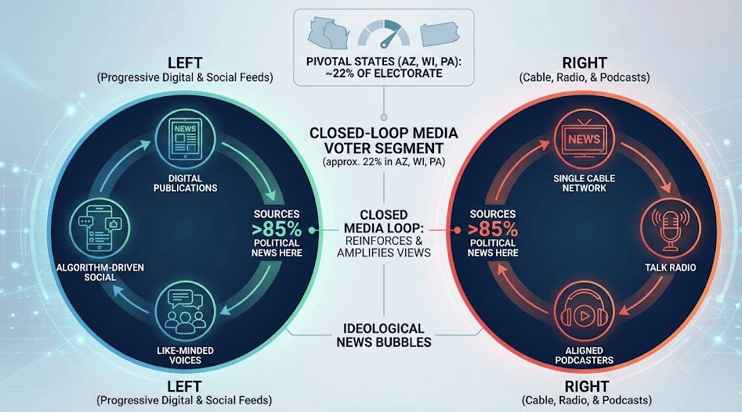
This reality undermines the traditional model of political persuasion. Campaigns still rely on a “surround sound” strategy of paid advertising, earned media, and direct contact to reach undecided voters. Resonate’s data shows why that approach increasingly fails. When voters are trapped inside media bubbles, opposing messages often never penetrate their information ecosystem at all. As the report bluntly notes:
“Penetrating these isolated bubbles and disrupting the flow of narrow information presents a significant challenge.” – Resonate
For this segment of the electorate, persuasion is not simply difficult. It is structurally constrained.
The Incredible Shrinking Battlefield
The rise of unreachable voters is reshaping the modern electoral battlefield, especially in competitive House districts where outcomes are often decided by narrow margins. Resonate’s research shows that a significant share of the electorate is now sealed inside media bubbles, sharply reducing the number of voters who are realistically open to persuasion.
Resonate identifies these voters as being trapped beyond the reach of traditional campaign tactics. Rather than engaging broad categories of swing voters, campaigns must now target highly specific microsegments of the electorate.
“To win elections in 2024, you need to target microsegments of voters who are trapped beyond your reach in a media bubble.” – Resonate
These voters may be persuadable on individual issues, but their media consumption habits prevent standard advertising, earned media, and voter contact strategies from reaching them at scale.
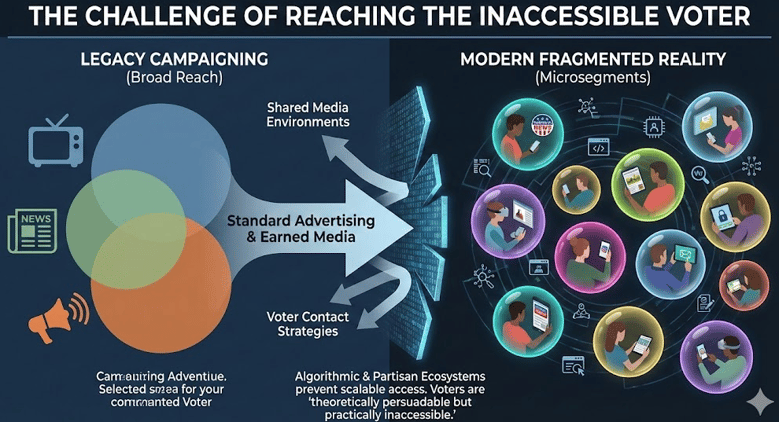
The report makes clear that this shift has eroded the effectiveness of legacy campaign models. Static targeting strategies, which assume voters share overlapping media environments, struggle in a fragmented 24 hour news cycle where information flows are tightly controlled by algorithmic and partisan ecosystems. As Resonate notes, political campaigns increasingly find themselves unable to reach voters who are theoretically persuadable but practically inaccessible.
The consequence is a smaller and more volatile persuasion environment. When campaigns can only access a narrow slice of the electorate, minor disruptions such as a late news cycle shift or uneven turnout can produce outsized effects. In close races, success is no longer determined by broad message reach, but by whether campaigns can penetrate the shrinking pool of voters who remain reachable at all.
From National Wave to Local Ripple
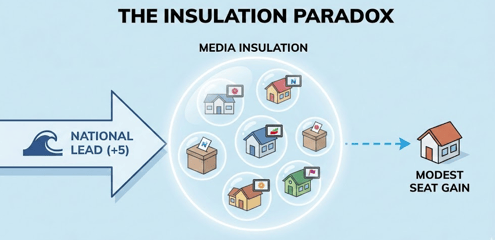
The rise of media insulation helps explain a growing paradox in American elections. National political environments and polling advantages no longer translate evenly into House seat gains. A national lead of 5 points on the generic ballot would once have signaled a wave election. Today, it often produces only modest movement at the district level.
Political scientists describe this shift as the nationalization of elections. Voters increasingly cast ballots based on party identity rather than individual candidates or local issues. Candidates of the same party rise or fall together, and district partisanship becomes a far more powerful predictor than campaign quality or local conditions. This makes it substantially harder for national momentum to break through districts whose partisan lean is constantly reinforced by national media ecosystems.
That reinforcement is intensified by what analysts describe as media insulation. Voters are not simply polarized in their opinions, but in their perception of reality itself. As one analysis of modern media ecosystems notes, exposure to conflicting information is no longer persuasive. It is experienced as hostile. In these environments, voters are conditioned to reject outside messaging regardless of content or messenger.
The New Imperative: Mobilization Over Persuasion
Resonate’s data points to an uncomfortable truth for modern campaigns. Persuasion is no longer the primary battlefield. Large segments of the electorate are locked in, unreachable, and functionally immune to messaging. Under those conditions, the path to victory is no longer about changing minds. It is about activating allies.
That reality is forcing a strategic reset. Campaigns are increasingly treating persuasion as a luxury and mobilization as a necessity. Dollars that once went to broad messaging are now flowing into precision turnout operations. Field staff are redeployed. Ad buys are sharpened. Data models are used to hunt down low-propensity voters who already agree with you but do not reliably show up.
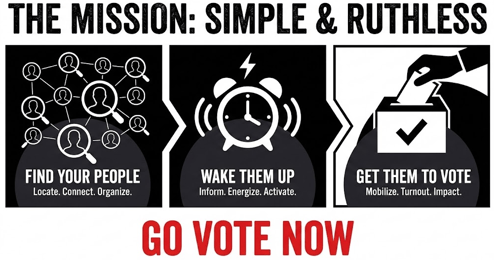
The mission is simple and ruthless. Find your people. Wake them up. Get them to vote. This shift also explains why modern campaigns sound angrier, narrower, and more culturally specific than they did a decade ago. These messages are not designed to persuade the middle. They are designed to energize the base. In an environment where reach is constrained and persuasion is rare, enthusiasm becomes the most valuable currency.
Winning is no longer about assembling the broadest coalition. It is about building the most motivated one. In today’s elections, depth beats breadth, turnout beats tone, and the campaign that best excites its own voters often beats the one that tries to charm everyone else.
Wrap Up
The rise of the unreachable voter, as detailed by Resonate, is a fundamental challenge to the American political system. It is a trend that is likely to accelerate as media fragmentation continues and political polarization deepens. For campaigns heading into 2026, it requires a radical rethinking of how to communicate. The old playbook of mass media advertising and broad-based messaging is obsolete. Instead, campaigns must become experts in niche media and hyper-specific, data-driven mobilization.
For 2026 and beyond, this structural shift has profound implications for the health of our democracy. A political system in which a large number of citizens are immune to persuasion is a system at risk of becoming increasingly dysfunctional and unresponsive. It incentivizes candidates to cater only to their base, abandoning any pretense of broad appeal or compromise.
If the only viable path to power is to energize your side while ignoring or vilifying the other, the prospects for national unity and effective governance grow dimmer. The Resonate report is a wake-up call, a data-driven confirmation that the ties that bind us are fraying, and if we are to bridge our divides, we must first find a way to break out of our bubbles and start talking to each other again.