What to Know
- Pivot Counties are counties that shifted away from the Democratic presidential coalition during the mid-2010s and have remained aligned with Republicans since
- They are concentrated in the Midwest, Great Lakes region, and parts of the rural South, overlapping with states that routinely decide national power.
- In 2024, Republican candidates carried nearly all Pivot Counties, often by double-digit margins, while Democratic wins were rare and narrow.
- Pivot Counties now act less like swing territory and more like indicators of long-term coalition change.
- Pivot County margins shape statewide races, but candidate quality, local economic accountability, and movement in surrounding suburbs determine whether that structural advantage holds.
Pivot Counties entered the political conversation after 2016 because they revealed a real fracture, not a momentary swing. These communities moved away from the Democratic presidential coalition during the mid-2010s in ways that signaled deeper changes in trust, identity, and political alignment. Early interpretations treated that movement as cyclical, assuming voters would revert once conditions stabilized or messaging adjusted.
The results since then have made clear that assumption was wrong. By 2024, Pivot Counties did not drift back toward balance. Their margins widened, and their voting patterns became more consistent, confirming that the shift first visible in 2016 had settled into something durable. These counties now highlight where institutional trust has weakened, where persuasion requires far more effort, and where national political brands exert overwhelming influence on local outcomes.

Today, Pivot Counties function less as targets of nostalgia and more as instruments of diagnosis. They show campaigns where credibility breaks first, where abstract messaging fails fastest, and where strategic missteps carry disproportionate costs. Heading into 2026, understanding how Pivot Counties behave is essential for any campaign trying to identify where the map is most vulnerable to pressure and where it is most likely to hold.
What Pivot Counties Are and Why They Matter
Pivot Counties follow a distinct voting path that makes them analytically useful: Democratic support in the late 2000s, followed by a Republican break in the mid-2010s. That sequence matters because it captures a rupture in voter trust, not a routine back-and-forth between parties.
These counties are not randomly distributed. They are concentrated across the Midwest, the Great Lakes, and portions of the rural South, with heavy representation in states such as Iowa, Wisconsin, Michigan, Minnesota, Ohio, Illinois, Pennsylvania, and Maine. As a result, they sit squarely within media markets and legislative districts that shape statewide and national outcomes.
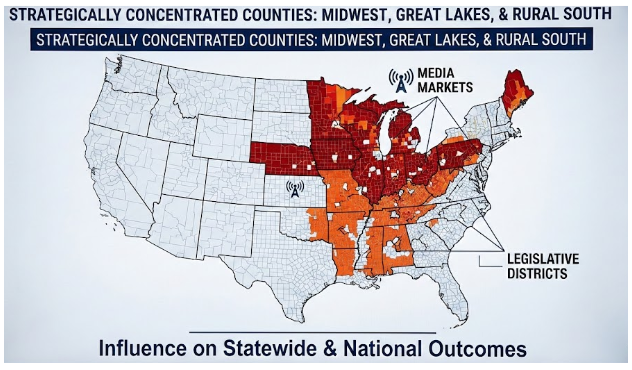
Influence on Statewide & National Outcomes
From a campaign perspective, Pivot Counties act as an early signal system. Shifts in working-class economic confidence tend to surface here before they appear in topline national polling or in more insulated urban and suburban electorates. When a coalition begins to weaken, these counties usually register the stress first.
Over time, that pattern has given Pivot Counties a new role. They are less about predicting winners and more about diagnosing alignment. They show where persuasion has stalled, where trust has hardened, and where political realignment is already underway well before it becomes obvious in Election Day narratives.
What 2024 Revealed About Pivot Counties
The 2024 results settled a lingering debate. Pivot Counties did not normalize. They consolidated. Donald Trump carried 197 of the 206 Pivot Counties, winning them by an average margin of R+18.4. Kamala Harris won just nine, and her average margin in those counties was D+2.3. This was not volatility. It was reinforcement.
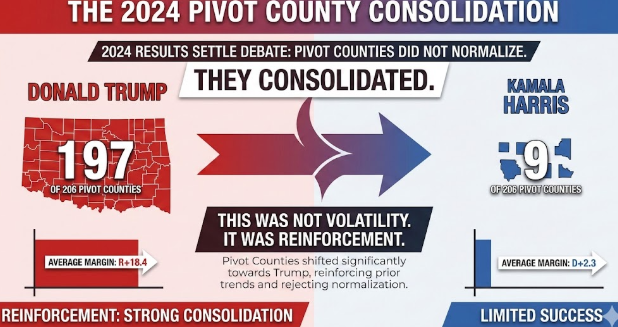
Pivot County Consolidation 2024
County-level data from Wisconsin, Michigan, Pennsylvania, and Arizona illustrates how Pivot County shifts shaped statewide outcomes. In each state, Republican margins in Pivot Counties offset Democratic gains in urban and suburban centers, narrowing the path to victory even where turnout was strong.
The implication is practical. Pivot Counties are no longer evenly contested terrain where late persuasion can swing results. They are structurally Republican unless conditions change dramatically, and their movement places immediate pressure on statewide strategies.
For campaigns, this means Pivot Counties now influence outcomes by constraining margin for error elsewhere. When these counties move further right, urban turnout must be higher, suburban persuasion must be cleaner, and messaging discipline becomes less forgiving.
Pivot Counties Cannot Be Read in Isolation
Pivot Counties establish one side of the statewide margin, but they do not determine the result alone. Their Republican consolidation increases the pressure on urban turnout and suburban persuasion, making nearby communities part of the same electoral system rather than separate campaign environments.
A party can dominate former swing counties and still lose statewide when suburban erosion grows faster than its rural and small-town advantage. The reverse is also true: even modest suburban recovery can become decisive when Pivot County margins remain durable.
The practical value of Pivot Counties therefore comes from reading them alongside the surrounding suburbs. Their margins show how much ground a campaign must recover elsewhere, while suburban movement reveals whether that structural advantage is expanding, holding, or being neutralized.
Who Lives in Pivot Counties and What Drives Them
Pivot Counties are defined less by ideology than by a stable and identifiable voter profile. These counties skew older, with disproportionate influence from Gen X and older millennial voters. Educational attainment tends to be lower than the national average, with fewer four-year college degrees. Local economies are anchored in manufacturing, agriculture, energy, logistics, and healthcare support work, sectors that are highly sensitive to economic disruption and policy follow-through.
Culturally, these voters are place-rooted and pragmatic. Local identity, self-reliance, and work function as moral signals, not lifestyle preferences. Trust in national media and political institutions is low, shaped by long-term economic pressure and a belief that elite decision-makers are distant from everyday realities.
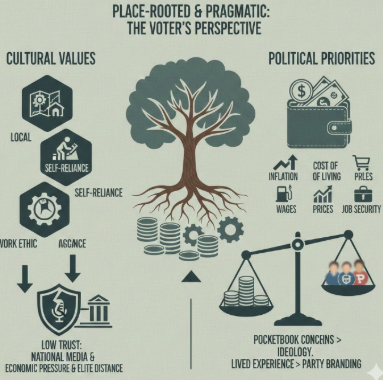
Pocketbook concerns dominate political judgment. Inflation, cost of living, wages, fuel prices, and job security consistently outweigh abstract ideological debates. Politics is evaluated through lived experience rather than party branding or symbolic appeals.
This profile explains why Pivot Counties continue to move consistently even as national messaging shifts. These voters are not disengaged. They are attentive, skeptical, and quick to penalize campaigns that feel abstract, performative, or disconnected from daily life.
Affordability Is Experienced Through Fixed Monthly Costs
Economic pressure in Pivot Counties is often experienced through recurring household obligations rather than national economic indicators. Housing, transportation, insurance, utilities, healthcare, and credit payments shape how families judge whether conditions are improving because those costs arrive every month and cannot be easily avoided.
This helps explain why positive national statistics do not always translate into political confidence. Slower inflation or higher wages may improve the broader picture, but voters continue to feel pressure when fixed expenses absorb a large share of household income. Economic messaging is more credible when it reflects the costs voters regularly encounter rather than relying only on topline measures.
Economic Pressure Becomes Political When It Has a Local Address
Economic anxiety becomes more politically durable when voters can connect it to a familiar employer, a closed facility, a shrinking public service, or a governing decision. National trends create the background, but recognizable local consequences determine how responsibility is assigned.
This dynamic makes Pivot Counties especially sensitive to manufacturing losses, agricultural pressure, healthcare closures, and changes affecting locally important industries. Economic disruption becomes more than a general mood when it is attached to a workplace, institution, or community that voters know personally.
Campaign Lessons and the Road Ahead
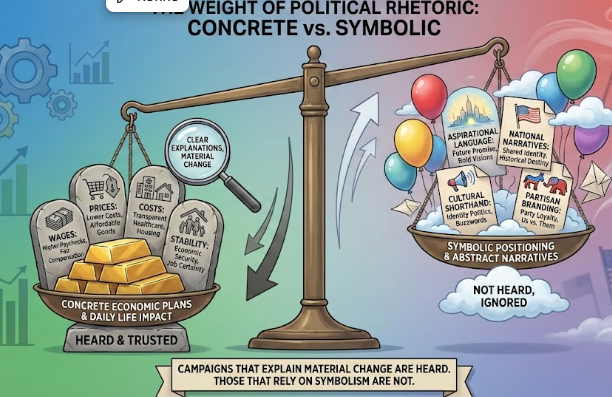
Pivot Counties now require a fundamentally different operating posture from campaigns because the voters who define them are no longer intermittently persuadable. They are structurally skeptical. That skepticism is rooted in lived experience rather than ideology. Economic populism performs better than ideological signaling because voters evaluate politics through outcomes.
Clear explanations of costs, wages, prices, and stability carry more weight than aspirational language or symbolic positioning. Campaigns that can explain what will materially change in daily life are heard. Those that rely on national narratives, cultural shorthand, or partisan branding are not.
Credibility in Pivot Counties is built through proximity and familiarity. Local messengers matter more than national figures, regardless of party. Candidates and validators who share community experience, speak plainly, and demonstrate practical understanding of local conditions are trusted more than imported voices or high-profile endorsements. Voters are attentive to who is speaking, not just what is said, and they quickly discount messaging that feels scripted or imposed from the outside.
Messaging must be disciplined and results-oriented. Pivot County voters have little tolerance for ambiguity and even less patience for overpromising. Failed delivery does not reset expectations. It compounds mistrust. These voters remain politically engaged, but their engagement is conditional. Confidence is extended selectively and withdrawn quickly when performance falls short.
Candidate Pipelines Can Reopen Hardened Territory
Pivot County outcomes are shaped not only by voter alignment and message, but also by the candidates available to represent each party. Long-serving incumbents can discourage serious competition, consolidate donors and endorsements, and prevent new local candidates from building the visibility needed to challenge an established political structure.
Open seats can change that calculation by removing the advantage of familiarity and creating space for earlier recruitment, localized positioning, and competition over community credibility. A structurally aligned county may remain difficult terrain, but the absence of an entrenched incumbent can make its voters more willing to reconsider individual candidates.
Local offices also help build the candidate bench required for those opportunities. School boards and similar community positions provide governing experience, public visibility, volunteer relationships, donor networks, and a record of managing conflict before a candidate seeks legislative or statewide office.

The New Swing Voter
Swing voters still decide elections, but they no longer behave the way campaigns expect. Research shows many voters change their views on key issues without changing party loyalty, limiting the impact of traditional persuasion.
At the same time, algorithm-driven feeds now shape what voters see before campaigns ever reach them. Studies from Cambridge and Nature show repeated exposure to content on issues like crime, immigration, and the economy can gradually shift attention and attitudes, even when users know the information may be biased.
This has created a different kind of swing voter. Instead of highly engaged moderates, the most movable voters today are often less engaged and more influenced by digital exposure. What they see repeatedly becomes what they prioritize. In this environment, persuasion is not just about argument. It is about exposure. Campaigns that win are not simply the most convincing. They are the most consistently seen.
Wrap Up
Looking ahead to 2026 and 2028, Pivot Counties represent both opportunity and constraint. Republicans must sustain credibility with these voters while managing exposure in nearby suburban areas, while Democrats must choose between investing in long-term rebuilding where trust has eroded or accepting narrower paths that rely more heavily on non-pivot swing territory. Each approach carries consequences for coalition strength, statewide margins, and long-term durability.
The next political shift will not be announced by national polling alone. It will emerge where economic pressure deepens, institutional trust weakens, local leadership creates openings, or visible community consequences change how voters assign responsibility. The 2024 election confirmed that many Pivot Counties have moved beyond easy recovery, with hardened margins that raise the cost of every statewide race and make credibility the central contest.
Pivot Counties are not unwinnable, but they require precision, local fluency, credible candidates, and proof of delivery rather than nostalgia-driven strategy. Their impact also depends on whether nearby suburbs reinforce or offset their margins, which means campaigns must evaluate counties and surrounding communities as one connected electoral system. The strategic question is no longer whether Pivot Counties matter, but whether campaigns can combine local recruitment, economic accountability, and county-to-suburb planning to understand where the map is most likely to hold, bend, or break.