

Pivot counties remain highly volatile and geographically clustered. 2024 data suggests they are trending more conservative than the national electorate.
What to Know
- Ballotpedia identified 206 pivot counties that voted Obama in 2008 and 2012, then Trump in 2016, spread across 34 states.
- In 2016, Trump won these counties by 580,000+ votes with an average margin of 11.45 points.
- Iowa (31) and Wisconsin (23) contain the largest raw totals of pivot counties, making them high leverage states for persuasion targeting
- Maine has the highest share: pivot counties are 50% of its counties and contain 47.08% of the state population, which is why small shifts can look huge statewide.
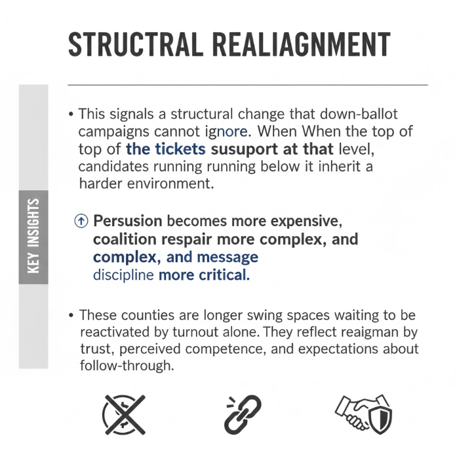
- In 2024, Trump won 197 pivot counties by an average 18.4 points, while Harris won nine by an average 2.3 points, reinforcing that most of this universe is now structurally Republican unless conditions change.
Pivot counties became famous because they captured a real political rupture: communities that twice backed Barack Obama, then swung to Donald Trump. The temptation is to treat them like a museum exhibit from 2016. That is a strategic mistake. In 2024, pivot counties did not “normalize.” They continued trending toward Trump, and by larger margins than in prior cycles.
|
Category |
2024 (Trump) |
2024 (Harris) |
2020 (Trump) |
2020 (Biden) |
|
Counties Won |
197 |
9 |
181 |
25 |
|
Average Margin |
R+18.4 |
D+2.3 |
R+14.1 |
D+3.3 |
|
Median Margin |
R+17.3 |
D+1.9 |
R+13.2 |
D+3.4 |
Data from Ballotpedia
For 2026, the operational takeaway is simple: pivot counties are not a standalone electorate, but they are a clean diagnostic tool. They show where persuasion has collapsed, where turnout and trust are soft, and where down ballot candidates will be forced to run either with or against national brand gravity.
Where the Most Pivot Counties Are, and Why That Matters
The geographic clustering is the first message. Iowa and Wisconsin alone account for 54 pivot counties, and several other Midwestern and Great Lakes states hold meaningful stacks: Minnesota (19), Michigan (12), Illinois (11), Ohio (9), and Pennsylvania (3).
|
State |
Your Figure |
Official Data |
|
Iowa + Wisconsin |
54 |
54 |
|
Minnesota |
19 |
19 |
|
Michigan |
12 |
12 |
|
Illinois |
11 |
11 |
|
Ohio |
9 |
9 |
|
Pennsylvania |
3 |
3 |
Data from Ballotpedia
2024 Pivot County Map via Ballotpedia
They also shape candidate behavior because they sit inside media markets and legislative districts that campaigns cannot ignore.
Maine Is the Outlier That Proves the Rule
Maine stands out in Ballotpedia’s pivot county data because the concentration is unusually high. Half of the state’s counties meet the pivot definition, and those counties account for nearly half of the population. That density compresses the political map. Campaigns are not navigating dozens of marginal zones. They are operating in a small number of counties where shifts register quickly and decisively at the statewide level.
|
County |
2024 Harris% (Votes) |
2024 Trump% (Votes) |
2024 Margin |
2020 Margin |
2016 Margin |
2012 Margin |
2008 Margin |
|
Androscoggin |
46.91% (26,983) |
53.09% (30,540) |
R+6.2 |
R+2.81 |
R+9.38 |
D+12.78 |
D+15.22 |
|
Aroostook |
37.38% (11,970) |
62.62% (20,051) |
R+25.2 |
R+19.93 |
R+17.19 |
D+7.62 |
D+9.58 |
|
Franklin |
46.10% (7,143) |
53.90% (8,353) |
R+7.8 |
R+3.94 |
R+5.47 |
D+18.41 |
D+20.29 |
|
Kennebec |
48.90% (35,798) |
51.10% (37,410) |
R+2.2 |
R+0.25 |
R+3.58 |
D+13.46 |
D+14.78 |
|
Oxford |
43.48% (12,440) |
56.52% (16,171) |
R+13.0 |
R+8.79 |
R+12.94 |
D+14.73 |
D+16.04 |
|
Penobscot |
45.38% (36,705) |
54.62% (44,179) |
R+9.2 |
R+8.34 |
R+10.91 |
D+2.93 |
D+5.12 |
|
Somerset |
36.51% (9,097) |
63.49% (15,821) |
R+27.0 |
R+23.37 |
R+22.67 |
D+1.68 |
D+5.70 |
|
Washington |
37.34% (4,807) |
62.66% (8,065) |
R+25.3 |
R+19.78 |
R+18.44 |
D+1.60 |
D+1.01 |
This structure creates a high-risk, high-reward environment. When messaging and validation align, movement looks dramatic. When they do not, losses accelerate just as quickly. In states like Maine, there is little insulation from error. National messaging that feels abstract or performative does not diffuse across many regions. It lands, or it fails, in places that matter immediately.
For 2026, the lesson is not that Maine is uniquely persuadable. It is that states with dense pivot county footprints punish campaigns that rely on broad slogans and reward those that demonstrate local fluency. When a single county swing can function as a statewide swing, voters are less tolerant of ambiguity and more focused on whether a campaign understands their lived conditions.
2024 Confirmed the Pivot County Rightward Lean
The original significance of pivot counties came from their dramatic shift between 2012 and 2016. What 2024 confirmed is that this shift was not temporary. Most pivot counties did not drift back toward parity. They moved further right. Donald Trump carried 197 of the 206 pivot counties in 2024 by an average margin of 18.4 points. Kamala Harris carried only nine, and those wins were narrow.
Data from Ballotpedia
This signals a structural change that down-ballot campaigns cannot ignore. When the top of the ticket consolidates support at that level, candidates running below it inherit a harder environment. Persuasion becomes more expensive, coalition repair more complex, and message discipline more critical. These counties are no longer swing spaces waiting to be reactivated by turnout alone. They reflect a deeper realignment driven by trust, perceived competence, and expectations about follow-through.
Treating pivot counties as if they remain ideologically fluid misunderstands what the last two cycles have shown. They are politically active, but they are not politically neutral.
Pivot Counties as a Stress Test, Not a Symbol
Pivot counties are often treated as a shorthand for voter volatility, but their real value is more practical. These places are where campaigns find out how much tolerance voters have for abstraction, delay, or brand drift. Counties that have already broken once are less patient with campaigns that assume loyalty will snap back on its own. They are quicker to penalize messaging that feels generic and quicker to reward clarity that feels grounded in local reality.
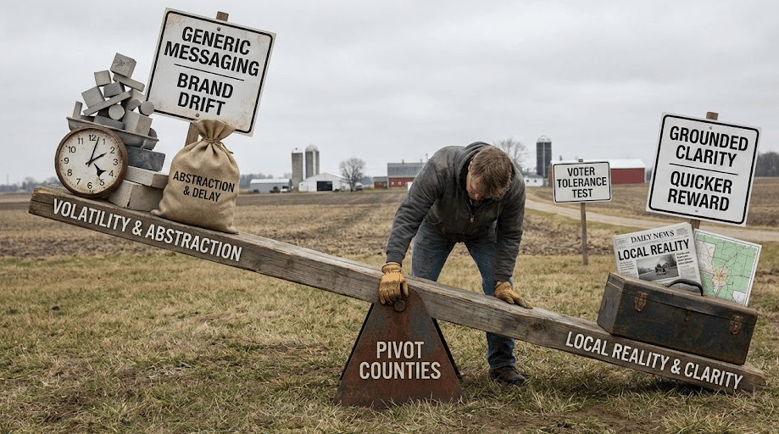
That makes pivot counties less about persuasion at scale and more about credibility under pressure. When a coalition weakens, these counties usually show it first. They are politically engaged, but not forgiving.
A campaign that loses traction here is rarely losing because voters are disengaged. It is losing because voters believe the campaign does not understand what matters locally or cannot deliver on what it promises. In that sense, pivot counties function as an early warning system. If a message fails here, it is unlikely to perform better in surrounding districts that share the same economic and cultural conditions.
Wrap Up
The 2024 results reinforced that pivot counties are no longer drifting spaces. In most of them, margins moved further in one direction rather than snapping back toward balance. That shift changes how campaigns should think about resource allocation heading into 2026. Winning or even stabilizing performance in these counties now requires more precision, stronger validation, and clearer proof of follow-through than it did in earlier cycles.
For down-ballot candidates, this matters immediately. When presidential margins harden in pivot counties, local races inherit that gravity whether they want it or not. Media buys become less efficient, persuasion becomes more expensive, and mistakes compound faster. Campaigns that assume they can outrun the top of the ticket without adapting their message often discover too late that voters are evaluating everything through the same trust lens.
The practical takeaway is not that pivot counties are unwinnable. It is that they now demand a different operating posture. Campaigns that treat them as legacy swing territory tend to overpromise and underperform. Campaigns that treat them as credibility contests, where specificity and local fluency matter more than ideological signaling, have a better chance of limiting losses or regaining ground. In a close cycle, that difference can determine whether a map bends or breaks.