Why modern political campaigns are replacing saturation strategies with attention economics, creative discipline, and platform fluency
What to Know:
- The 2024 election confirmed that saturation media strategies no longer persuade voters in a fragmented, opt-out attention environment.
- Campaign success is now driven by disciplined alignment between message, platform, and timing rather than total media spend.
- High-attention environments like live sports and connected TV have become scarce assets that require early planning and operational precision.
- Voter loyalty can no longer be assumed, as turnout increasingly depends on trust maintained through relationships and credible messengers.
- Creative quality has emerged as the decisive force multiplier, with strong messaging outperforming large budgets in high-attention settings.
The 2024 election marked a decisive break from the way campaigns have historically approached political media buying. For decades, success was defined by volume. More ads, more frequency, broader coverage. That logic assumed voters were reachable, attentive, and passively absorbing messages delivered through a limited number of channels.
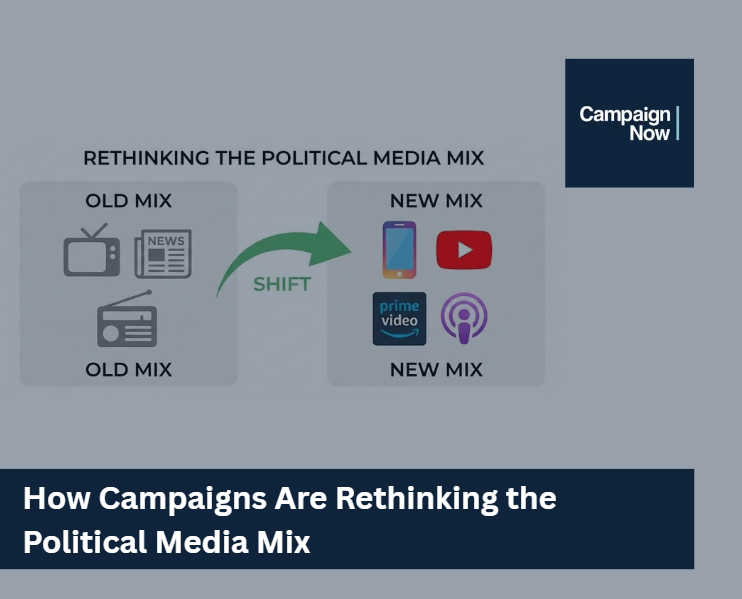
That assumption no longer holds. Voters now live across fragmented platforms, consume content on their own schedules, and actively avoid political messaging they do not trust. In response, campaigns have been forced to evolve. Media strategy has shifted from broadcast dominance to precision coordination, where message, platform, and timing must align to earn attention rather than demand it.
Insights from the AAPC webinar Crafting the Winning Media Mix revealed a rare point of agreement across party lines. Democratic and Republican strategists alike acknowledged that winning campaigns are no longer defined by how much they spend, but by how intelligently they deploy resources, how disciplined their creative is, and how well they understand where persuasion actually happens.
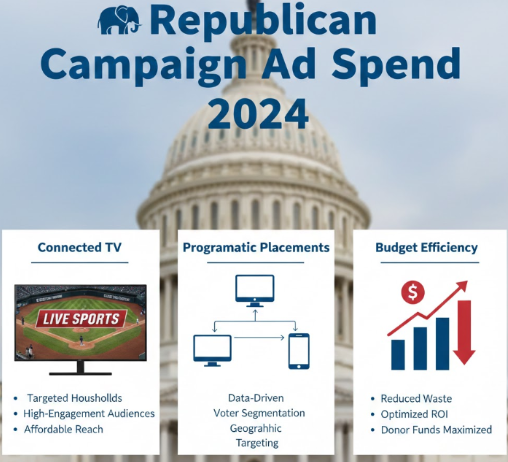
Democratic campaigns, by contrast, lost ground by delaying media entry points and relying too heavily on assumed turnout from key constituencies. Critical voter groups, including younger voters and voters of color, were not reached consistently or early enough to lock in engagement. By the time late-stage persuasion began, attention had already fragmented.
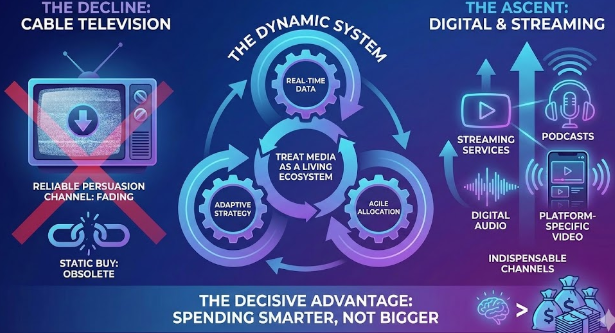
Cable television continued its decline as a reliable persuasion channel, while streaming, podcasts, digital audio, and platform-specific video became indispensable. The campaigns that adapted fastest were those that treated media as a dynamic system rather than a static buy. Spending smarter, not bigger, proved to be the decisive advantage.
Live Sports and the Search for Guaranteed Attention
As most media environments fracture under the pressure of on-demand viewing and algorithmic feeds, live sports remain a rare exception. Sports programming still delivers real-time, communal viewing where audiences are present, emotionally engaged, and far less likely to skip or multitask.
For campaigns, this matters because persuasion depends on narrative completion. Ads that are skipped, muted, or partially viewed rarely move voters. Live sports provide one of the last environments where campaigns can reliably deliver a full message repeatedly within a compressed window.
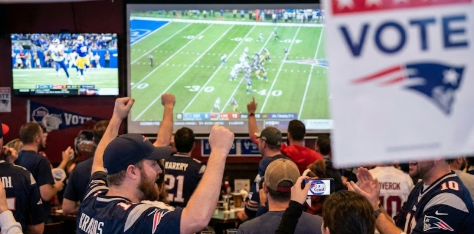
As sports rights migrate to streaming and connected TV platforms, this advantage increasingly extends beyond traditional broadcast. However, access is no longer guaranteed. Fragmented rights, platform-specific ad policies, and compliance constraints introduce new risks that require early planning and operational discipline. Campaigns that treat sports as an afterthought are increasingly boxed out or priced up at the moment attention matters most.
Read the full article here: Live Sports Is the Last Political Ad Safe Haven
Voter Loyalty Is No Longer Automatic
One of the most consequential failures of 2024 was not messaging, but assumption. Many Democratic campaigns treated turnout among core constituencies as inevitable rather than earned. Coalition partners were activated late, influencers were substituted for organizers, and engagement was framed transactionally rather than relational. The result was disengagement, not ideological defection.
Turnout shortfalls among voters of color, young voters, and progressive activists reflected weakened coalition ecosystems rather than sudden shifts in belief. When activists feel instrumentalized and influencers are misaligned with campaign values, credibility erodes quickly. Once credibility weakens, even strong policy alignment fails to translate into participation.
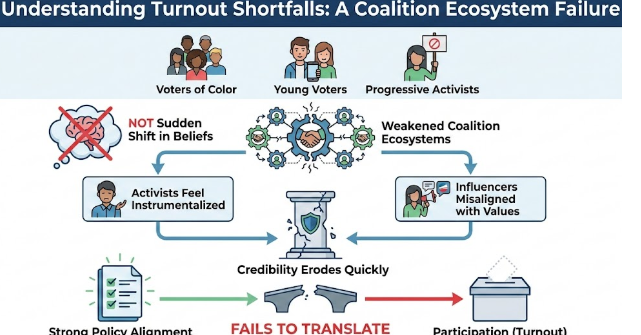
Coalition maintenance is no longer optional. In a fragmented media environment, trust moves through people and networks, not ads alone. Campaigns that fail to invest in those relationships early pay the price later in inefficient turnout efforts and declining enthusiasm.
Read the full article here: Democrats Can’t Afford to Assume Voter Loyalty Anymore
Why Creative Breakthroughs Matter More Than Budget Size
Modern political advertising is optimized for scale, not persuasion. Campaigns are rewarded for impressions, frequency, and reach, even though none of those metrics guarantee that a voter actually absorbs or believes a message. The result is a system where campaigns can spend heavily, dominate media plans, and still fail to move opinion because nothing they say is memorable or credible enough to stick.
High-attention environments like live sports strip away that illusion. In those settings, creative quality is no longer abstract or theoretical. There is no algorithm softening delivery, no targeting trick compensating for weak messaging, and no second exposure to fix a bad first impression. Ads are watched in full and judged instantly. Voters know immediately whether a message feels real, relevant, or completely disconnected from their lived experience.
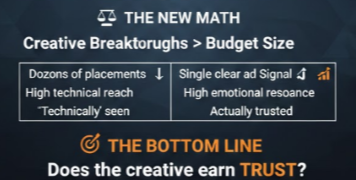
This is why creative breakthroughs consistently outperform budget size. A single ad that delivers a clear emotional signal can outperform dozens of digital placements that technically reach more people but fail to register. Strategists privately acknowledge that once a campaign secures attention, the only remaining variable that matters is whether the creative earns trust. Media efficiency collapses the moment voters tune out, regardless of how sophisticated the buy looks on paper.
The campaigns gaining ground are the ones treating creative as a strategic function rather than a production task. They invest earlier in message testing, cut weaker concepts faster, and protect clarity from internal dilution. Instead of chasing scale, they focus on resonance. In an environment where attention is scarce and skepticism is high, creative discipline has become one of the few advantages money cannot buy.
Read the full article here: Why Creative Breakthroughs Outperform Big Budgets
What Budget-Constrained Campaigns Get Right
Campaigns with limited resources are forced into a level of strategic clarity that well-funded operations often avoid. When flooding the zone is not an option, every decision carries weight. Budgets become a forcing mechanism that requires campaigns to answer hard questions early about audience, message, and priorities instead of deferring them behind scale.
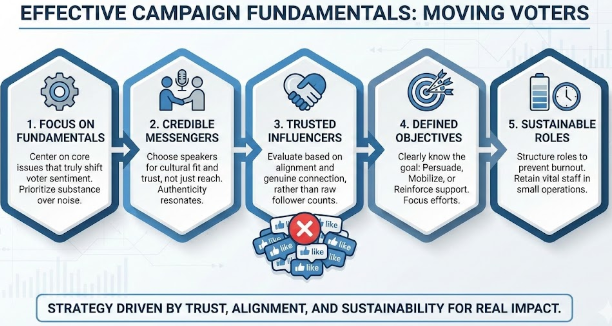
These campaigns tend to focus on fundamentals that actually move voters. Messengers are chosen for credibility and cultural fit, not raw reach. Influencers are evaluated on trust and alignment rather than follower counts. Objectives are clearly defined so teams know whether they are persuading, mobilizing, or reinforcing support. Roles are structured to prevent burnout because losing a staffer in a small operation has immediate consequences.
Creative in these environments is usually tighter and more grounded. Messages are built around lived experience, local context, and specific grievances rather than abstract national narratives. Without layers of approvals, ideas move faster and retain their original intent. Feedback loops are shorter, and weak creative is abandoned quickly instead of protected for political reasons.
Large campaigns often struggle precisely because they have more room to drift. Multiple approval layers dilute language, flatten emotion, and reward risk avoidance over effectiveness. Internal consensus can become more important than voter belief. Money improves production quality and media access, but it does not compensate for messages that feel generic or disconnected from real voter concerns.
The constraint itself becomes the advantage. Limited budgets force campaigns to treat trust as a finite resource and attention as something that must be earned. In an environment where voters are skeptical and disengaged, that discipline frequently produces stronger creative, clearer strategy, and more durable persuasion.
Read the full article here: What Budget-Constrained Campaigns Get Right That Big Ones Don’t
Looking Ahead to 2026 and 2028
The next election cycles will be shaped by the continued erosion of passive attention. Connected TV, social media, and live sports will increasingly anchor political media strategies, while broadcast rights and platform rules determine where campaigns can and cannot operate.
Artificial intelligence and data modeling are beginning to inform not just targeting, but sequencing and timing. Campaigns are moving toward feedback-driven systems that adjust creative and placement continuously rather than relying on static plans built months in advance.
Success will belong to campaigns that treat media as infrastructure rather than ornamentation. The goal is no longer to be everywhere. It is to be present where attention, trust, and timing intersect.
Wrap Up
The evolution of the political media mix reflects a deeper shift in how voters experience politics. Attention is scarce. Trust is conditional. Loyalty must be maintained rather than assumed. Campaigns that cling to legacy strategies built for a broadcast era will continue to spend more while achieving less.
Winning campaigns are learning to operate differently. They plan earlier. They spend more deliberately. They invest in creative that respects the audience rather than talks past it. They understand that persuasion flows through credible messengers and high-attention environments, not sheer repetition.
Heading into 2026 and beyond, the strategic advantage belongs to campaigns that recognize media as a living system shaped by human behavior, not just a line item on a budget sheet. The question is no longer how many ads a campaign can run. It is whether voters are willing to watch, believe, and act on what they see.