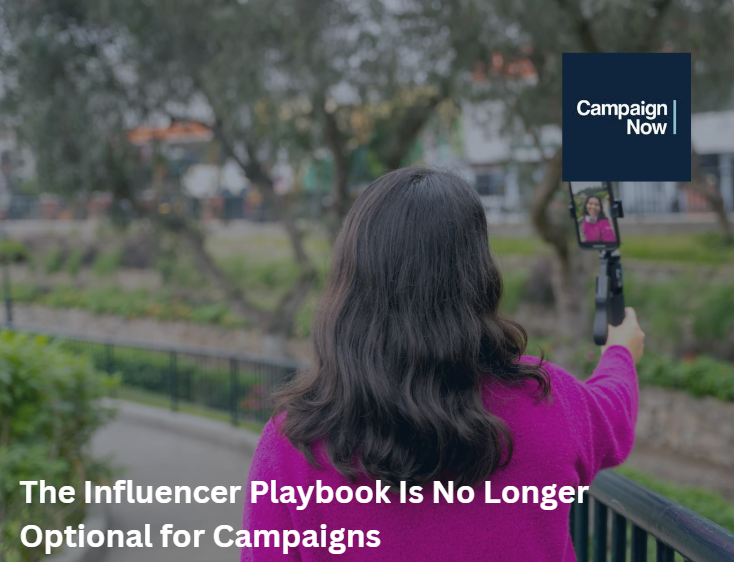
Creators have moved from fringe digital assets to core infrastructure in persuasion, turnout, and voter trust.
What to Know:
- Influencer content consistently outperforms traditional campaign ads on trust, recall, and perceived credibility, particularly among younger, working class, and low trust voters.
- Local and mid sized creators drive higher engagement and persuasion than national celebrity influencers in political contexts.
- Campaigns that integrate influencers early gain normalization and permission advantages with voters who are skeptical of formal politics.
- Influencer programs now affect turnout, volunteer recruitment, and ballot initiative performance, not just online impressions.
- Heading into 2026, campaigns that treat influencers as a late stage tactic are operating at a structural disadvantage.
Political campaigns are still spending most of their digital budgets as if voters encounter politics through paid ads first. That assumption no longer reflects how voters actually experience campaigns.
For a growing share of the electorate, especially younger voters, working class voters, and politically disengaged voters, campaigns are first encountered through creators. These are parents talking about schools and cost of living, veterans discussing foreign policy and national security, nurses explaining healthcare access, and local voices translating political decisions into everyday consequences. Paid media usually arrives later, if it breaks through at all.
This change is not cosmetic. It reshapes how persuasion works, how turnout is generated, and how trust is built. Influencer marketing in politics has moved from experimentation into infrastructure. Campaigns that fail to adapt are not simply missing an opportunity. They are ceding narrative control early in the cycle, often before they realize the race has begun.
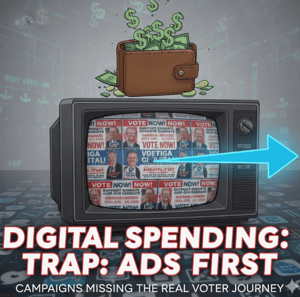
Digital Spending Trap
From Memes to Movements: Why Influencers Now Shape Persuasion
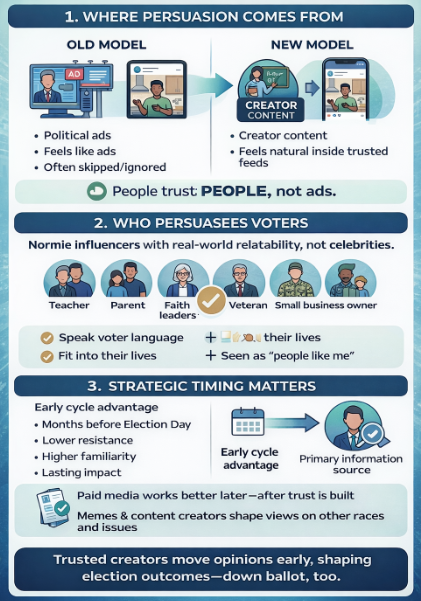
Influencers succeed in political messaging for a simple reason. Voters do not experience their content as advertising. Creator content is processed as peer communication rather than institutional persuasion. That distinction matters because voters are increasingly resistant to formal political messaging. Ads are skipped, muted, or dismissed. Creator content, by contrast, arrives inside feeds people already trust and engage with daily.
Multiple studies and campaign tests show influencer content produces higher ad recall, stronger issue comprehension, and improved candidate favorability compared with standard digital ads. The difference is not production quality or polish. It is credibility. Influencers speak in language voters recognize and situations voters live. The most effective creators are rarely celebrities. They are often what strategists describe as normie influencers. Teachers, parents, service workers, faith leaders, veterans, and small business owners with modest but loyal audiences. Their power comes from recognition and proximity, not reach. Their followers see them as people like themselves, not spokespeople.
This dynamic matters most early in the cycle. When creators introduce a candidate, issue, or ballot measure months before Election Day, they lower resistance. Voters become familiar with a name or argument before it is framed as a high stakes political choice. By the time paid media appears, the message feels familiar rather than forced. For down ballot races and ballot initiatives, where traditional media coverage is thin or nonexistent, influencers often serve as the primary information channel voters encounter.
Related article:
[Read the full article: From Memes to Movements]
Timing and how shape outcomes
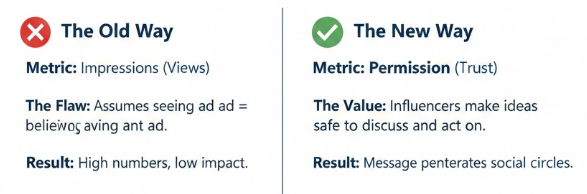
Measuring the Message Means Measuring Permission, Not Just Reach
Campaigns that judge influencer programs on impressions alone misunderstand their value. Influencers do not just deliver reach. They deliver narrative permission. They make it easier for voters to accept an idea, discuss it with peers, and act on it later. This is especially important for issues that feel complex, polarized, or abstract when delivered through ads.
The most reliable indicators of success reflect this function. These include link attribution that shows follow through, follower surveys that measure comprehension and sentiment shifts, geographic engagement lift in target areas, and organic sharing or replication by other creators. These signals capture whether a message is traveling through social networks, not just landing once. Creators who rarely post about politics often generate the highest engagement when they do. Their audiences are not conditioned to tune out political content, which reduces resistance and increases attention.
Risk management is part of measurement. In higher risk environments, campaigns increasingly run creator made content through official accounts. This preserves authenticity while ensuring compliance and message control. Reuse is where return on investment compounds. Influencer videos are routinely adapted into connected TV ads, radio scripts, canvassing materials, peer to peer texting, and direct mail. This lowers production costs while preserving the tone voters already trust.
Related coverage:
[Read the full article: Measuring the Message]
The Next Phase: Influence Architecture in the AI Era
The influencer ecosystem is now converging with conversational technology. Recent research shows conversational AI can shift voter opinions more effectively than traditional political ads. At the same time, creators increasingly use AI tools to test framing, refine scripts, and respond to audience feedback at scale.
This convergence accelerates reach while increasing risk. Persuasion delivered through conversation feels more personal and more credible, but it is also harder to monitor. Disclosure rules, platform governance, and campaign finance regulations have not kept pace with how influence now works. For campaigns, the implication is clear. Influence is moving away from broadcast messaging toward dialogue. Trust is built through familiarity rather than repetition. Campaigns that rely exclusively on ads will increasingly find themselves reacting to narratives they did not shape and conversations they do not control. Early, disciplined influencer integration becomes more important in this environment, not less.
Related coverage:
[Read the full article: Influence Architecture in the AI Era]
Case Study: When Influencers Become a Digital Field Operation
Recent campaigns have demonstrated what happens when influencer strategy is treated as infrastructure rather than branding.
In these models, creators function like a distributed digital field team. Automation routes inbound attention into volunteer pipelines. Platform native tools are used early to build momentum rather than chase it later. Digital engagement converts directly into action, including signups, donations, and turnout.
The lesson is operational. Viral moments matter less than systems that capture interest, route supporters into owned channels, and follow up until participation happens. Campaigns that build this conversion layer early gain advantages that cannot be replicated late with ads or last minute turnout spending.
This approach also reshapes how campaigns think about scale. Influence is not measured only by views, but by how efficiently attention becomes participation.
Related coverage:
[Read the case study: How Mamdani Courted Influencers]
Wrap Up
Influencer strategy is no longer optional for campaigns that want to compete in modern elections. It has become a core channel for persuasion, normalization, and turnout, particularly among voters who distrust traditional political messaging and institutional voices.
Heading into 2026, the campaigns that succeed will be those that integrate creators early, select messengers strategically, measure what actually moves voters, and manage risk with discipline. Campaigns that continue to treat influencers as a novelty or a late stage add on will increasingly find themselves locked out of the conversations that shape voter behavior long before Election Day. The question is no longer whether influencers belong in campaign strategy. The question is whether campaigns are prepared to treat them as the infrastructure they have already become.