

This is a template for Campaign Now Articles for quick delivery and setup.
What to Know
- Influencers create narrative permission by introducing and normalizing campaign messages.
- The most reliable metrics are link attribution, follower surveys, geographic engagement lift, and tracked organic shares.
- Creator-made ads perform well when run directly through campaign accounts with proper disclosures and audience targeting.
- Reusing influencer content across CTV, radio, canvassing, and direct mail extends its value and reduces production costs.
- Risk is mitigated by strong contracts, pre-screening, NDAs, and clear takedown requirements after the campaign ends.
Every campaign wants reach. Serious campaigns want results. The third pillar of an effective creator program is the ability to measure what works, address what does not, and reuse high-performing content across the entire communications ecosystem. That requires more than impression counts or anecdotal engagement. It requires analytics frameworks built for politics, not consumer marketing.
The AAPC webinar on influencer engagement reinforced that influencer ROI in political campaigns is fundamentally different from brand work. The metric is not whether the post looked good. The metric is whether it moved a voter, shifted an attitude, or strengthened narrative permission around an issue the campaign needs to win.
Understanding Influence Beyond Impressions
In political communication, impressions do not tell the full story of influence. What matters is whether a voter sees a messenger as credible, familiar and socially relevant. Research from the Center for Media Engagement shows that the most persuasive actors in the political influencer ecosystem are small-scale creators with fewer than 10,000 followers.
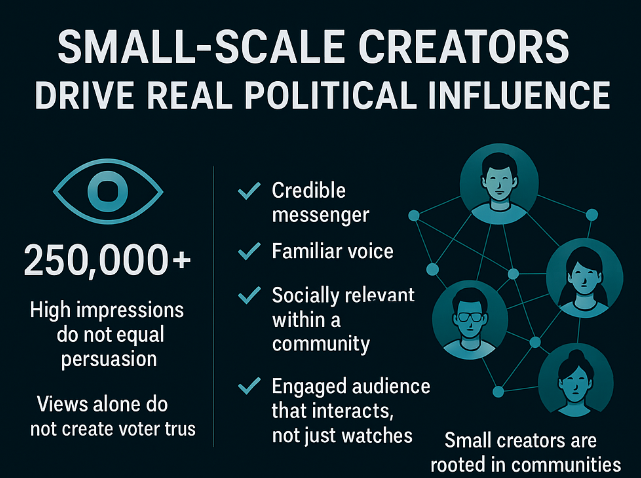
These individuals are rooted in their communities, respond directly to their audiences, and carry the kind of trust people normally reserve for friends or family. Their content feels personal rather than transactional, and that makes their political messages far more likely to be accepted and repeated.
Pew Research data reinforces this dynamic across the broader news environment. About one in five Americans now regularly gets news from social media influencers, and nearly four in ten adults under 30 do the same. These audiences are not passive. They report that influencers provide basic facts, opinions, humor and breaking news, and they view this content as meaningfully different from what they receive from traditional outlets.
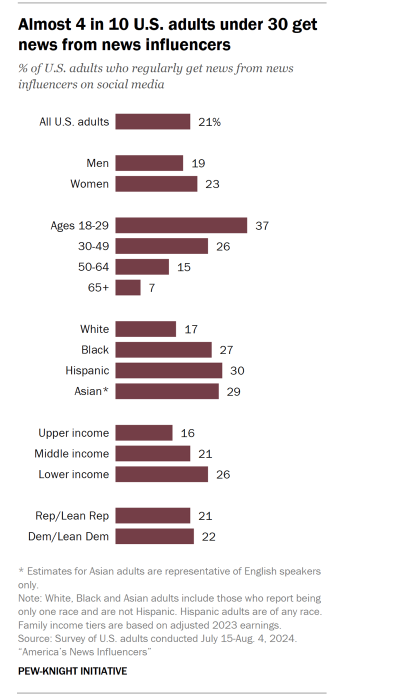
Screenshot of chart from Pew Research
65% of Americans who get news from influencers say these posts help them better understand current events and civic issues. Only 9% say influencers create confusion. Younger adults in particular are more likely to view influencer content as both helpful and unique, which makes these creators a natural point of entry for political messaging.
This helps explain why political strategists increasingly describe influencer communication as narrative permission. A message introduced by a trusted creator becomes easier for voters to talk about, easier to share with peers, and easier to accept when reinforced later through paid media. Pew’s research on podcasts shows a similar pattern. Listeners tend to say the political opinions they hear on podcasts align with their own at far higher rates than they contradict them. This alignment indicates that voters are primed to absorb information from voices they select voluntarily and follow consistently.

Narrative permission is also strengthened by demographic patterns in influencer engagement. Hispanic, Black and Asian adults report higher rates of getting news from influencers than White adults, and lower income. Americans are more likely to rely on these creators as a regular news source.
Republicans and Democrats engage with news influencers at almost identical rates, and both ideological extremes are more likely than moderates to say influencer content helps them better understand current events. The trust relationship cuts across partisan lines and reflects the social nature of influencer communication rather than a purely political one.
Because of these patterns, small and mid-sized creators regularly outperform larger accounts in political work. Their audiences see them as neighbors or peers rather than celebrities or professional advocates. When they frame an issue early in the cycle, they make the topic socially acceptable within their community. That early normalization lowers resistance when paid media arrives later, since the voter has already processed the subject through a voice they trust.
What Campaigns Should Measure
Political campaigns must overcome voter counterarguing and message reactance. Narrative persuasion is more effective when it reduces counterarguing and avoids being perceived as direct persuasion. Thus, the best influencer programs don't just maximize reach; they quietly shift attitudes by lowering resistance. Measurement should focus on this reduction of defensive processing.
The first layer is link attribution. Campaigns measure the conversion of narrative impact to action by tracking links that creators use to direct voters to resources (guides, petitions, registration, donation portals). Link attribution shows if the creator's frame overcame voter reactance and led to behavioral follow-through, capturing action even days after initial story exposure. Tracking systems ensure data accuracy by isolating untagged traffic, allowing strategists to evaluate behavioral uptake.
The second layer is follower surveys. Short pre- and post-exposure polls gauge if creator content improved comprehension or sentiment. The literature on counterarguing suggests that voters resist messages perceived as overly persuasive. Follower surveys help campaigns determine if creator messaging avoided this "reactance" and instead achieved implicit persuasion, where audiences internalize cues without active rebuttal. This is vital for ballot measures, where minor clarity gains can sway results.
The third layer is geographic lift. Narrative effects are not uniform across regions or demographic groups. Hyper-local creators function as narrative figures that audiences identify with or experience parasocial familiarity with, which narrows the likelihood of counterarguing. When platform analytics show engagement surges in the exact precincts or counties a campaign is targeting, this signals that the message is being processed without triggering the resistance that often accompanies more explicit political outreach.
The fourth layer is organic spread. When a message receives shares, comments, or is replicated by other creators (stitches, duets), it has successfully entered a community's narrative. This organic circulation signals that the message has moved from a persuasion attempt to a shared narrative, which often results in more lasting attitude changes. Transportation, identification, and familiarity with the messenger reduce counterarguing, preventing the audience from perceiving the message as a threat to their freedom of choice.
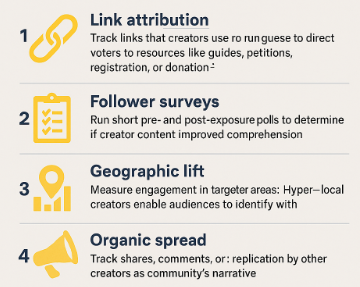
This four-layer framework allows campaigns to evaluate influence by measuring how voters process political information, moving beyond brand metrics like impressions or likes. Strong programs focus on signals of reduced counterarguing, implicit persuasion, and narrative absorption, specifically: message passage through community messengers without triggering reactance, immediate or persistent attitude change, and organic spread indicating narrative acceptance.
When to Run Creator-Made Ads Through Campaign Accounts
The panel agreed that creator-made ads can be extremely effective when run through campaign accounts. This approach blends professional targeting with authentic delivery. It also solves compliance challenges, since campaign accounts already meet disclosure and reporting standards.
Creator-made ads work best when the content has already performed well in organic form. A creator who explains an issue in simple terms, speaks in a conversational style, and resonates with local audiences provides a natural fit for paid amplification. Running these ads through campaign accounts also ensures the content reaches priority voters who may not follow the creator directly.
The key is proper coordination. Creators must know at the contracting stage whether their content may be adapted for ads. Strong contracts and detailed briefings protect both the campaign and the creator. When managed correctly, creator-made ads become a cost-efficient way to blend authenticity and reach.
Reusing Influencer Content Across the Full Campaign
A major advantage of creator content is its adaptability. The AAPC panel highlighted that campaigns routinely overspend on production when they already have high-quality material in their influencer library.
Creator videos can be repurposed for connected TV, pre-roll ads, and digital radio. Their voiceovers can be adapted for broadcast radio or phone scripts. Short clips can be used in field canvassing tablets, volunteer training materials, or relational organizing prompts. Stills and transcripts can be integrated into direct mail and peer-to-peer texting.
This repurposing increases ROI by extending the lifespan of content that has already proven it resonates with real audiences. It also preserves authenticity by ensuring campaign materials sound like the community itself, not a consultant-driven script.
Managing Risk with the Right Controls
Influencer strategy introduces reputational risk if campaigns skip the fundamentals. Every panelist stressed the importance of screening creators early. A quick review of their online presence, past posts, and community reception helps avoid last-minute surprises.
Contracts are another essential control. They must define usage rights clearly, specify what content the campaign may repurpose, and include takedown and archiving requirements once the election ends. NDAs protect sensitive strategy, and clear approval workflows prevent the wrong message from going live at the wrong time.
Another safeguard is maintaining direct communication. Creators benefit from having a campaign point of contact who provides quick responses and real-time clarity. This reduces off-message content and ensures the campaign knows exactly when posts will go live. Strong governance transforms influencer work from a risk area into a disciplined part of the campaign’s media operation.
Wrap Up
Influencers are no longer a luxury add-on. They are a measurable, trackable, and strategically essential part of modern political communication. The value they create goes far beyond likes or views. They open space for campaigns to tell their story, reduce message friction, and drive voters toward action with voices they trust.
As campaigns prepare for 2026, the teams that excel will be the ones that understand how to measure what actually matters, reuse content intelligently, and manage creators with the same discipline applied to every other part of the media plan. When campaigns measure influence correctly, they not only improve ROI. They strengthen their entire communications ecosystem and position themselves for long-term success.
-1.png)