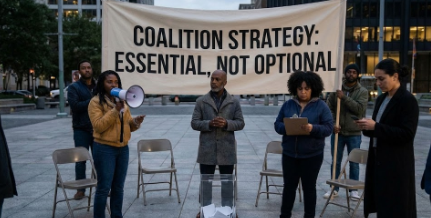

Turnout failures reveal what happens when coalition maintenance, credibility, and activist alignment are treated as optional rather than essential.
What to Know
- Democratic turnout losses are rooted in coalition breakdowns, not sudden ideological shifts.
- Activists and influencers play distinct roles and cannot replace one another.
- Credibility and shared values drive participation more than message frequency.
- Poor role clarity accelerates burnout among coalition partners.
- When coalition ecosystems weaken, messaging loses its power to mobilize.
For much of the modern era, Democratic campaigns have operated under a durable but increasingly flawed assumption: that key voting blocs would remain loyal regardless of how they were engaged. Young voters, voters of color, labor households, and progressive activists were treated as reliable components of the electoral coalition rather than constituencies requiring continuous investment.
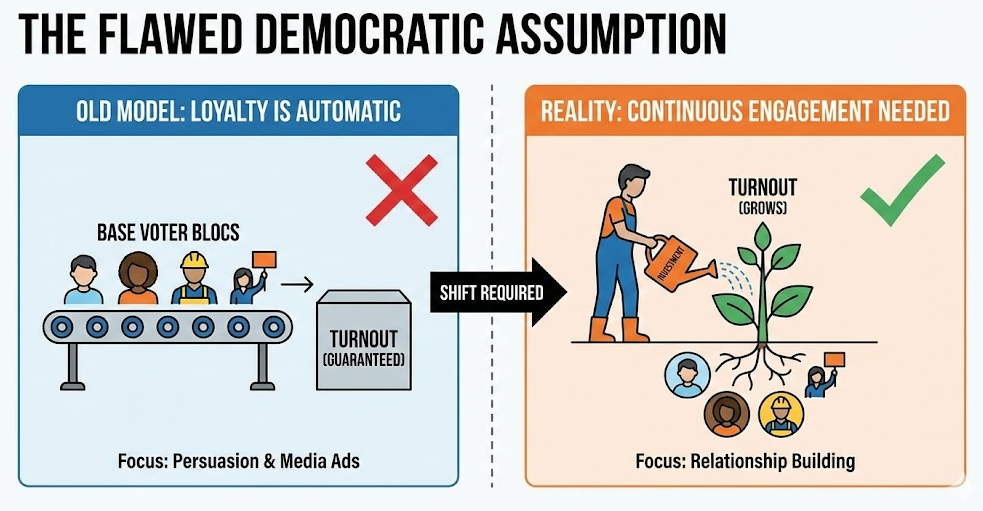
Campaign strategy reflected this mindset, prioritizing persuasion and media spending while treating base turnout as an automatic return. That assumption is now breaking down in ways that are both visible and costly. Recent election cycles have produced repeated turnout gaps among groups Democrats depend on most. These voters are not undergoing a mass ideological realignment. Many are simply opting out.
As emphasized in the AAPC discussion on coalition building, loyalty is not inherited. It is a political relationship that must be actively maintained. When campaigns fail to do that work, turnout becomes the first casualty.
Turnout Failure Is a Coalition Failure
Turnout does not collapse in a vacuum. It erodes when the networks that convert agreement into action weaken. Campaigns that assume loyalty often reduce engagement to transactional outreach rather than relationship maintenance. Activists are brought in late. Community leaders are asked to mobilize without meaningful input. Feedback flows upward only during crises, not as part of routine strategy.
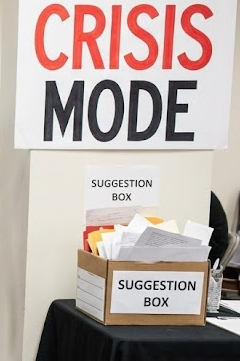
Over time, this signals to coalition partners that their role is instrumental rather than collaborative. Voters may still support policy goals, but support alone does not drive participation. Participation requires a sense of agency, respect, and shared ownership. When those elements are missing, disengagement becomes a rational response.
This dynamic poses a serious threat heading into 2026. Midterm elections already challenge the party in power. A weakened coalition infrastructure magnifies that disadvantage and forces campaigns into inefficient, last minute turnout efforts that drain resources without rebuilding trust.
Activists and Influencers Serve Different Purposes
One of the most important distinctions raised in the AAPC conversation was the difference between activists and influencers. Activists organize. Influencers persuade. Activists build durable voter contact systems and local credibility. Influencers operate through trust based networks that shape perception and legitimacy.
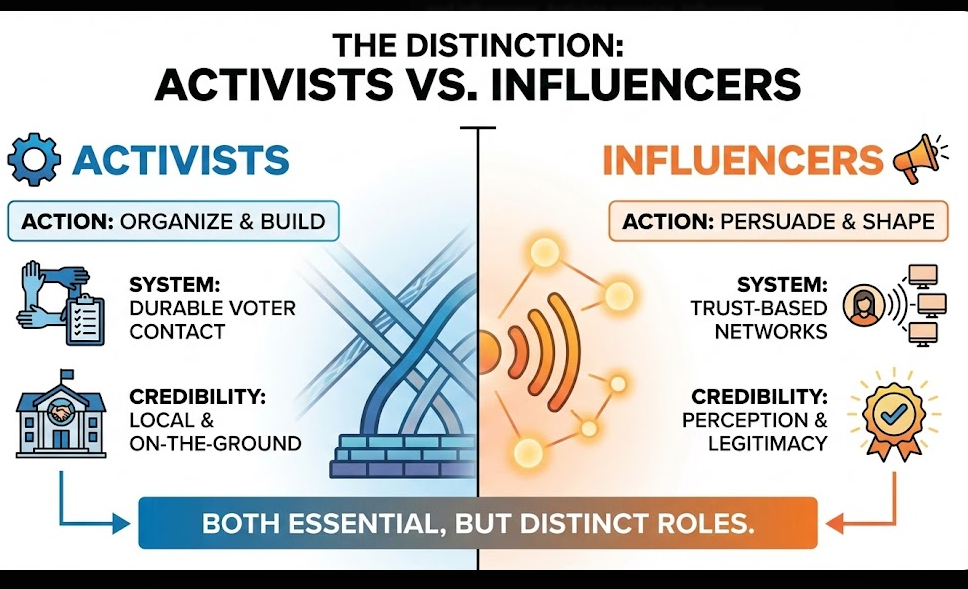
Campaigns run into trouble when they blur these roles. Influencers cannot substitute for grassroots organizers. They can amplify messages but cannot replace field infrastructure or long term mobilization. Activists, meanwhile, lose effectiveness when they are treated as content distributors rather than strategic partners with local expertise.
Healthy coalitions respect these differences. Activists are involved early and meaningfully in planning. Influencers are aligned around shared values rather than scripted talking points. When campaigns collapse these roles into a single category, they create confusion, resentment, and declining effectiveness across the coalition.
Credibility Is the Limiting Factor
In a fragmented media environment, credibility has become the scarcest campaign resource. Voters are highly sensitive to inconsistency, especially when messages appear tailored to different audiences without a coherent value framework. Campaigns that attempt to be everything to everyone often end up convincing no one.

Assumed loyalty accelerates this credibility problem. When campaigns believe their base has nowhere else to go, they tolerate contradictions that would otherwise be politically risky. But modern voters communicate across platforms and communities. What campaigns see as targeted messaging often registers as duplicity.
Once credibility erodes, mobilization stalls. Activists hesitate to advocate enthusiastically. Influencers pull back to protect their relationship with their audiences. The message may still circulate, but it loses its capacity to motivate action at the ballot box.
Burnout Reflects Structural Mismanagement
Political burnout is often misdiagnosed as apathy, oversensitivity, or cultural fatigue. Neuroscience and behavioral research suggest something more concrete: burnout is a predictable response to prolonged exposure to fear, loss of control, and unclear purpose.
As Arash Javanbakht’s analysis of political exhaustion shows, fear initially drives engagement, but sustained overload without agency leads to learned helplessness and withdrawal. In campaign ecosystems, this mirrors what happens when coalition partners operate inside opaque structures, absorb constant urgency, and are asked to perform without meaningful input. When expectations are unclear and control is centralized, burnout is not a personal failure. It is a systems failure.
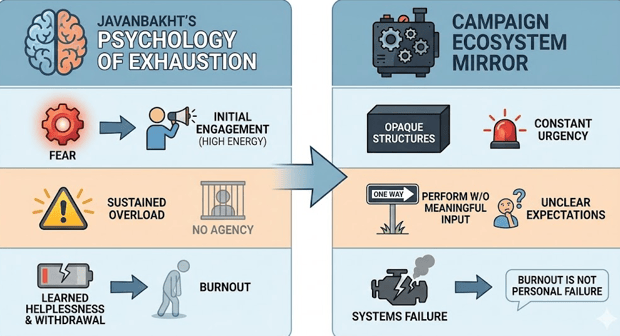
That failure shows up operationally. Activists tasked with executing strategies they did not help shape disengage over time because their effort no longer feels consequential. Influencers pushed to share content that conflicts with their values experience credibility erosion with their audiences, accelerating disengagement on both sides.
For coalitions to be sustainable, the conditions for burnout must be reversed. This is achieved through consistent communication that restores agency, transparency in decision-making, clear roles, and shared ownership. Without those structures, even aligned partners will tune out, not because they do not care, but because the system has taught them their participation does not change outcomes.
Wrap Up
Campaigns often respond to turnout shortfalls by polishing language, testing new creative, or increasing ad spend. That instinct misses the underlying failure. Messaging does not travel on its own. It moves through people and networks that either carry credibility or do not. When coalition relationships are weak, even well crafted messages fail to land. When trust is intact, imperfect messages can still mobilize. Campaigns that prioritize volume and output over ecosystem health end up amplifying content through channels that no longer have the standing to persuade, turning persuasion into background noise.
The broader lesson is structural, not tactical. Turnout problems are rarely about a single cycle or a single message. They emerge when loyalty is treated as a demographic constant rather than a relationship that requires care and reciprocity. Looking toward 2026 and beyond, the choice is straightforward. Campaigns can continue chasing turnout with late stage media and message tweaks, or they can rebuild coalitions as living systems grounded in credibility, clarity, and shared purpose. Turnout reflects how people are treated long before Election Day. Coalitions that are respected and included mobilize. Coalitions that are taken for granted fade quietly out of the system.
-May-16-2026-10-24-03-9739-PM.jpg)