
How Cygnal’s 10-region map and new minority voting patterns give Republicans a path to lock in a Southern majority—if they treat the South as ten regions, not one “Solid South.”
What to Know:
- The South now holds 193 electoral votes and more than a third of U.S. Senate seats, making it the center of gravity for national power in 2026 and beyond.
- Cygnal’s 10-region map shows why the old “Solid South” is dead and why campaigns must think in regions (Dixieland, Soulful South, Sweet Tea Suburbs, Tex-Mex Nexus, etc.), not state lines.
- Minority realignment is real: Black and Hispanic voters are moving right in key regions, driven by economic pragmatism and conservative cultural values, not just identity politics.
- Georgia and North Carolina remain the South’s decisive wild cards, where candidate quality, coalition management, affordability, and regional identity can outweigh the underlying partisan baseline.
- Republicans can build a durable multiracial coalition by surging turnout in fortress regions, locking in gains in growth zones, nibbling at the edges of gridlocked suburbs, and fighting for the four big wild cards.
This analysis builds on Cygnal’s six-part Southern Political Power series by Brent Buchanan and is supplemented with external work from ACCF, Pew Research Center, the Carolina Journal, Newsweek, Brookings, and state-level post-election surveys.
Why the South Now Decides Control
The American South is now the hinge of national power. With 193 electoral votes and more than a third of U.S. Senate seats, population growth in Texas, Florida, Georgia, Tennessee, and North Carolina is steadily shifting representation away from older blue strongholds. By 2030, Texas and Florida alone are expected to add multiple new House seats, so any party that wants to govern in the next decade has to start by getting the South right.
Population Growth Is Becoming Structural Political Power
The South’s population growth is steadily increasing its weight in Congress, presidential elections, and national policymaking. Fast-growing states such as Texas, Florida, Georgia, North Carolina, and Tennessee are gaining influence as people and representation continue moving away from slower-growing parts of the country.
That shift does not automatically produce ideological stability. Much of the growth is concentrated in metropolitan areas, expanding suburbs, and communities shaped by domestic migration. The South can become more powerful nationally while becoming more internally competitive, making coalition-building as important as the additional representation itself
The ‘Solid South’ Is Dead: Ten Regions, Not One Bloc
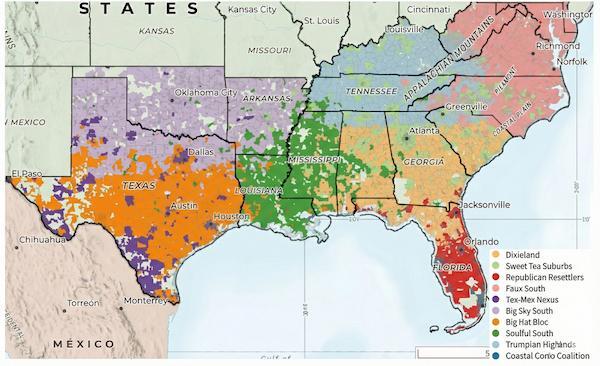
Image by Cygnal / Daily Wire – Map of the South’s 10 political regions
For decades, campaigns treated the South as a single, predictable bloc. That mental shortcut no longer works. The region still delivers 193 electoral votes and more than a third of Senate seats, but the old “Solid South” has fractured into a patchwork of places that vote, behave, and move very differently. Treating Texas, Georgia, North Carolina, and Florida as if they’re the same electorate is a fast way to misread the map and misfire on message.
Cygnal’s Southern Political Power project is valuable because it scrapes off the old state-line labels and rebuilds the map from the ground up. Instead of asking “How is Georgia doing?,” it asks, “What’s happening inside Dixieland, the Trumpian Highlands, the Sweet Tea Suburbs (outer Atlanta suburbs), the Soulful South, and the other regions that cross state borders?” Those ten regions are built around shared culture, economics, and voting history—not arbitrary lines on a map—and they explain why some areas are locked in, some are drifting, and some are truly up for grabs.
Seen through that lens, the South sorts into four strategic buckets: Base Fortress regions where Republicans already dominate, Growth Regions where conservative coalitions are expanding, Stagnation/Gridlock zones where margins barely budge, and high-risk Wild Cards that can flip control of Congress and the White House. The practical implication for 2026 is simple but brutal: campaigns that still plan around “red states” and “purple states” will leave votes on the table, while campaigns that plan around these ten regions—and their four buckets—will know exactly where to defend, where to invest, and where the whole race is truly on the line.
Where Republicans Are Strong—and Where They’re Still Growing
The GOP’s Southern foundation still comes from its Base Fortress regions — Dixieland, Big Sky South, and the Trumpian Highlands. These areas are culturally conservative, overwhelmingly Republican, and deliver eye-popping margins (Trump hits the mid-70s in parts of the Trumpian Highlands). They are the turnout engine that makes any Southern strategy possible. But they are also close to their partisan ceiling. The main risk isn’t losing them ideologically; it’s letting enthusiasm and participation sag while the rest of the map keeps changing.
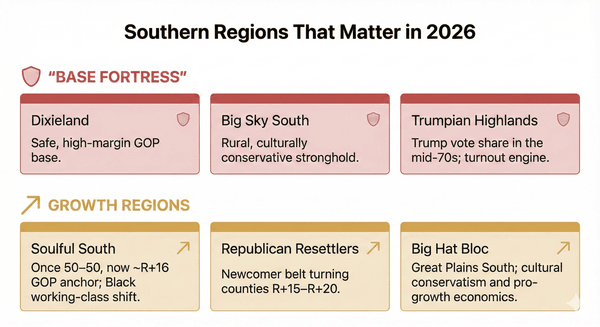
Image by DALL·E (Southern regions that matter in 2026)
The real upside for 2026 lies in Growth Regions like the Soulful South (Black rural Deep South), Republican Resettlers (GOP newcomer belt), and the Big Hat Bloc (Great Plains South). Here, population growth and voter realignment are combining in Republicans’ favor. The Soulful South — once nearly 50–50 — now functions as a GOP anchor with roughly a 16-point Republican edge, driven by working-class Black voters who are responding to economic and cultural messages, not legacy party labels. In the Republican Resettlers belt, conservative newcomers from bluer states are turning counties into R+15–R+20 territory, while the Big Hat Bloc blends cultural conservatism with pro-growth economics.
Smart 2026 campaigns treat these regions differently:
- Defend the Fortress: Run year-round organizing and digital programs in Dixieland, Big Sky South, and the Trumpian Highlands to keep turnout sky-high, not just during presidential cycles.
- Prioritize Growth Zones: Make the Soulful South, Republican Resettlers, and Big Hat Bloc the top investment targets for field, media, and candidate time.
- Build a Working-Class Coalition: Center messaging on jobs, cost of living, public safety, and cultural stability to keep attracting non-college, multiracial voters who are already drifting right.
- Measure and Adapt: Track county-level movement in these regions and adjust creative quickly, instead of treating the entire South as one generic “red” map.
Florida Has Become a Structural Republican Anchor
Florida’s statewide position has changed more dramatically than the existing regional framework suggests. Voter-registration movement, migration patterns, and repeated statewide victories have transformed the state from a recurring national toss-up into a more dependable Republican foundation.
That does not mean every part of Florida behaves the same way. South Florida’s diverse coastal communities, fast-growing suburbs, and changing congressional districts still require distinct candidates, messages, and field strategies. The Coastal Condo Coalition remains an important persuasion region, but it no longer defines the state’s overall partisan balance by itself.
The strategic lesson is to treat Florida as a strong statewide anchor with meaningful internal variation. Republicans can begin from a favorable structural position while still facing localized uncertainty created by district boundaries, candidate quality, demographic change, and regional economic concerns.
Minority Realignment: The End of Automatic Democratic Votes
For a long time, Democrats assumed that Black and Hispanic voters in the South would always be the backbone of their coalition. That assumption is breaking down. Across the region, Cygnal and outside polling show steady movement away from automatic Democratic loyalty toward a more transactional, issues-first mindset. Voters are weighing economic stability, cost of living, public safety, and cultural fit more heavily than party label or identity appeals.
The shift is sharpest in two places. In the Soulful South, the region with the highest share of Black Americans, politics has flipped from roughly even a decade ago to a double-digit GOP advantage today. Republican margins have grown as Democratic turnout has fallen and as more working-class Black voters align with conservative religious and cultural values. In Latino-heavy areas like South Texas, the story is similar: rightward movement driven by economic pragmatism and frustration with national Democrats, even if the exact margins remain volatile from cycle to cycle.
Texas Shows Why Realignment Is a Coalition Trade-Off
Texas shows why minority realignment should be understood as a coalition trade-off rather than a one-direction partisan shift. Republican gains among Latino and working-class voters are helping offset weaker support among some younger, urban, and suburban voters. The state remains Republican, but the coalition sustaining that advantage is different from the one that produced earlier victories.
The issues holding that coalition together are also changing. Border security and cultural alignment remain important, but voters increasingly judge campaigns through household costs, healthcare, housing, fuel, electricity, and economic stability. Minority gains are more likely to endure when campaigns connect shared values with the everyday financial pressures shaping family decisions.
For Republicans, this is both an opening and a warning:
- Treat minority voters as persuasion targets, not afterthoughts: Stop assuming these communities are off the board; invest in real field work and local messengers.
- Lead with economics and security: Emphasize jobs, inflation, energy costs, and safe neighborhoods ahead of abstract ideological fights.
- Respect faith and culture: Speak directly to churchgoing and family-centered voters who already share many conservative instincts.
- Do the work year-round: Gains in regions like the Soulful South and South Texas will not hold if engagement disappears between elections.
This isn’t “demographics is destiny” anymore. It’s “who shows up, who feels heard, and who is offering a serious plan” — and in 2026, that will decide whether the realignment hardens in the GOP’s favor or snaps back.
Wild Cards That Decide the Map: Georgia, North Carolina, and Beyond
The 2026 map will be decided by the wild cards — the regions that are highly volatile and offer the biggest risk and reward for Republicans. At the top of that list are Georgia and North Carolina, which will help determine control of the Senate and House and force GOP strategists to abandon one-size-fits-all messaging. Georgia, the South’s political crossroads, is a mosaic where multiple regional identities collide, producing razor-thin statewide margins: the 2024 presidential race was decided by about 50.7%–48.5%. Instability here is driven heavily by the suburbs. Atlanta’s so-called Sweet Tea Suburbs have trended sharply left, reaching roughly D+13 by 2024, with counties like Henry shifting nearly 9 points leftward — a clear warning signal for Republicans.
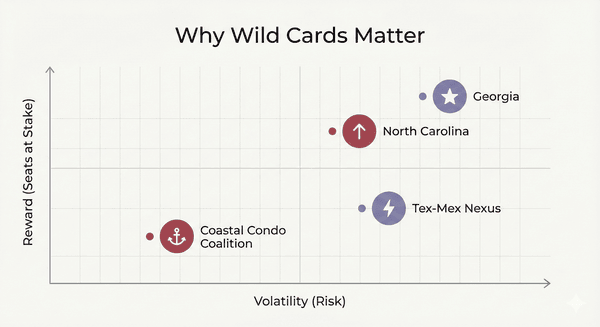
Image by DALL·E – Risk–reward view of Southern wild card regions
North Carolina presents an equally complex challenge with its “split personality”. The state combines deep-red strongholds that look like Tennessee with more moderate and suburban regions that behave like a swing state. It is highly competitive, voting only about 1.7% more Republican than the national popular vote in 2024. That means a relatively small change in turnout or persuasion can flip a Senate or statewide race. Beyond these two crucial states, other regions also fall into the wild card category. The Tex-Mex Nexus (South Texas border) saw the second-largest rightward swing in the South (about 9 points) in 2024, driven by Latino voters responding to economic and border messaging. The Coastal Condo Coalition in South Florida, traditionally Democratic, swung roughly 6.6% toward the GOP in 2024, putting high-density, diverse metros back in play.
Control of the Senate and key House seats in 2026 can flip in these zones if Republicans run disciplined, region-specific campaigns that lock in recent gains and blunt suburban losses. Treating them like generic “red” or “blue-leaning” states will miss what actually moves votes on the ground.
The Wild Cards Have Become Candidate-Quality Tests
Georgia demonstrates how party coordination and primary structure can shape a close state before the general-election campaign fully begins. A party that remains divided through competitive nominations can lose valuable time, money, and message discipline, while a unified opposition begins building a coordinated statewide operation.
North Carolina presents a related but distinct challenge. Its history of split-ticket voting means statewide candidates cannot rely on the national party label alone. Familiarity, governing credibility, fundraising strength, and the ability to localize economic concerns can matter as much as the state’s underlying partisan balance.
Together, the two states show that Southern wild cards are not decided only by regional identity. Candidate quality, party unity, campaign timing, fundraising, recognition, and organizational readiness determine whether rural strength and coalition gains can survive resistance in suburbs and competitive metropolitan regions.
Wild Card Strategy for 2026
- Georgia: Recruit candidates with genuine statewide appeal, unify party operations early, rebuild credibility in changing suburbs, and protect turnout across rural and small-town strongholds.
- North Carolina: Treat statewide contests as candidate-first races. Build name recognition, localize affordability and governing competence, and account for a split-ticket electorate where party identification alone does not determine the outcome.
- Coastal Condo Coalition (South Florida): Consolidate the ~6.6% GOP swing by emphasizing economic stability, cost of living, and anti-socialist/anti-authoritarian themes that resonate with diverse, naturalized voters in dense coastal metros.
- Tex-Mex Nexus (South Texas and border areas): Maintain year-round grassroots operations focused on conservative cultural values and economic pragmatism to secure durable gains with Latino voters and counter polling volatility that shows Trump-era support can soften between cycles.
The GOP’s Region-by-Region Playbook for 2026
If the South is now ten regions instead of one “Solid South,” the playbook has to match that reality. The point of Cygnal’s map is not to admire it — it’s to tell campaigns exactly where to defend, where to grow, and where the whole game is on the line. For 2026, that means treating each bucket — Base Fortress, Growth Regions, Stagnation/Gridlock, and Wild Cards — as a different kind of project, with different goals and different expectations.
Core moves for 2026:
- Surge Base Fortress turnout: In Dixieland, Big Sky South, and the Trumpian Highlands, the job is simple but essential: keep turnout sky-high. Invest in year-round organizing, church and community networks, and digital programs so these regions consistently deliver presidential-level margins, not just in presidential years.
- Lock in Growth Regions: Make the Soulful South, Republican Resettlers, and the Big Hat Bloc top priorities for field, candidate time, and message testing. These areas are where a multiracial, working-class conservative coalition is already emerging — and where Democrats are most at risk of permanent erosion.
- Fight smart in Wild Cards: Treat Georgia, North Carolina, the Tex-Mex border areas, and South Florida metros as custom campaigns, not generic “swing states.” Recruit candidates with real statewide appeal, tailor issues to suburban and Latino voters, and assume every point of margin has to be earned.
- Take realistic swings in Gridlock zones: In Sweet Tea-type suburbs and other stagnation areas, the goal is not to flip the entire region overnight. It’s to stop further slide, make small gains among persuadable middle-class voters, and use strong local candidates to influence nearby battlegrounds.
- Don’t coast on realignment: Minority shifts and new conservative migrants create opportunity, but they are not self-executing. Republicans still have to show up, listen, and solve concrete problems — or Democrats will eventually adjust and claw back support.
A strategy that treats every Southern county like the same kind of “red” leaves votes on the table. A strategy that follows this region-by-region playbook turns Cygnal’s map into something more powerful: a plan to decide who governs after 2026.
Wrap Up
The South is no longer just one part of the map — it is the place where the national balance of power will be set for the next decade. With 193 electoral votes, more than a third of U.S. Senate seats, and continued population gains in key states like Texas, Florida, Georgia, Tennessee, and North Carolina, any party that misreads this region is choosing to play from behind.
The ten-region framework at the heart of this analysis makes one thing clear: there is no “Solid South” anymore. There are fortress regions that must keep turning out, growth regions where a new multiracial working-class coalition is emerging, gridlocked suburbs that demand patience, and wild cards like Georgia and North Carolina that will decide control of the Senate and House. Layered on top of that is a real, measurable shift among Black and Hispanic voters who are increasingly voting their economic interests and cultural values, not old partisan habits.
For Republicans, the choice is straightforward. They can keep planning around outdated red–blue maps and hope 2016–2024 trends carry them a little further. Or they can adopt a region-by-region Southern strategy, invest where the coalition is growing, shore up where it is slipping, and fight hard in the places that truly decide control. The campaigns that treat this as a serious, data-driven project — not a nostalgia play — will be the ones setting the agenda after 2026.
Southern population growth is becoming structural national power, but that power does not automatically translate into political control. Florida provides a stronger statewide foundation, Texas requires active coalition management, and Georgia and North Carolina remain exposed to candidate, turnout, affordability, and organizational weaknesses. The party that converts regional growth into credible local campaigns will hold the advantage as the South continues to gain influence.
Sources & Credits
This playbook is built primarily on Cygnal’s Southern Political Power series by Brent Buchanan and the related materials in the shared Cygnal Google Drive folder, and is supplemented with external research and post-election analysis.
Cygnal – Southern Political Power series and related reports
- Cygnal Southern Political Power (core overview report, Nov. 14, 2025)
- The Rise of the South Is Not What You Think: Why It Holds the Keys to Political Control
- The End of Democratic Assumptions: How Minority Voters Are Reshaping Southern Politics
- Beyond the Swing: Why Southern Suburbs Refuse to Budge
- BBQ Politics? How North Carolina’s Sauce Divide Mirrors Its Voting Behavior
- What the Peach State’s Political Patchworks Mean for 2026
- The South’s Next Act: Wild Cards in 2026 and Beyond
External polling and analysis (selected)
- Pew Research Center – Voting patterns in the 2024 election
- American Council for Capital Formation (ACCF) – The American Political Realignment Is Real
- Carolina Journal – 2024 Black vote significantly under 2020 levels in NC
- University of Georgia – 2024 Georgia Post-Election Survey
- Brookings Institution – commentary on African Americans in the 2024 presidential election
- Facing South / Institute for Southern Studies – Key takeaways from the 2024 elections in the South
- Newsweek – Atlanta Suburbs Defy a National Trend, Shifting Left
- DigitalCommons @ Macalester College – New Americans and the New Right: Hispanic Voting Trends in the Trump Era of Politics
- NextDems – Redefining Battleground States: Why the South Is the Key to the Future of Democratic Politics
- University of Houston – Texas Trends 2025 – Election 2026
- AGC Advocacy – New Georgia Senate polling and 2026 race analysis
- Race to the White House – North Carolina Senate 2026 election polls and predictions
- Good Authority (John Sides) – The 2024 election story is more complex than “racial realignment”