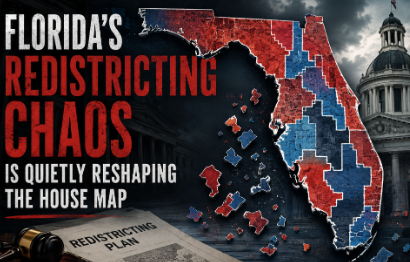

Florida’s redistricting uncertainty is forcing campaigns to prepare for an election where the map itself may not be settled until deep into the cycle.
What to Know
- Florida has transitioned from a swing state to a Republican stronghold due to a massive shift in voter registration.
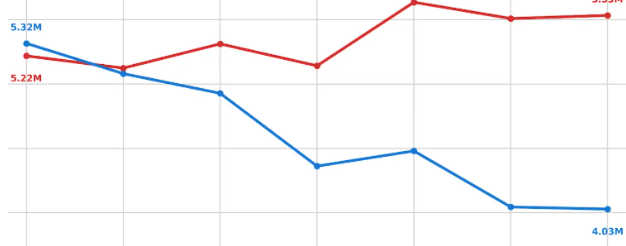
- In 2020, registered Democrats led by 100,000 voters, but by 2026, Republicans built a lead of over 1.4 million active voters.
- Republicans have expanded their voter registration share in all 67 Florida counties since the 2022 midterms, while Democrats have lost ground statewide.
- Independent and No Party Affiliation voters are out-registering Democrats in several metrics, threatening to push the Democratic Party into third place in active engagement.
- The voter registration gap provides a structural cushion that shields Republican incumbents from national wave election conditions.
Florida wore the crown of the ultimate American swing state for a long time. It was a political battlefield defined by razor thin margins, where a few thousand votes could shift the trajectory of presidential elections and statewide races. But as the 2026 election cycle hits its stride, that era feels like ancient history. Florida has undergone a dramatic structural transformation.
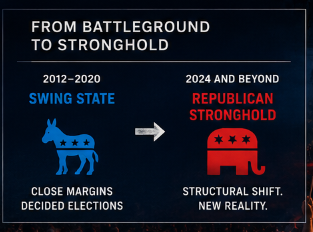
What was once America's premier swing state now operates under a fundamentally different electoral reality, with a durable Republican registration advantage reshaping the political landscape. At the heart of this shift is a massive, seemingly unyielding Republican voter registration advantage that provides a virtually impenetrable shield for GOP incumbents, even when national "wave" conditions threaten the party elsewhere.
The Math Behind the Fortress
Political scientists often refer to voter registration as a "lagging indicator", an echo of how people have already been voting. In Florida, however, the echo has become a roar. Consider the trajectory:
- In 2020: Registered Democrats held a plurality, outnumbering Republicans by roughly 100,000 active voters.
- The Inversion (2021): The GOP officially took the lead for the first time in modern state history.
- Today (2026): According to recent Florida Division of Elections and polling data, the Republican lead has skyrocketed to over 1.4 million active voters (roughly 5.5 million Republicans to 4.1 million Democrats).
This is not just a localized phenomenon. Since the 2022 midterms, Republicans have expanded their registration share in all 67 Florida counties, while Democrats have simultaneously lost ground across the board. Interestingly, No Party Affiliation (NPA) voters have begun out-registering Democrats in several metrics, pushing the state’s former majority party into a distant third-place trajectory in active engagement.
A Case Study in Structural Advantage
There is perhaps no better embodiment of this structural fortress than U.S. Attorney General of Florida, Ashley Moody.

U.S. Attorney General of Florida, Ashley Moody
Moody, the state's former Attorney General, was elevated to the federal stage in January 2025 when Governor Ron DeSantis appointed her to fill the U.S. Senate seat vacated by Marco Rubio (who resigned to serve as Secretary of State). Moving into the special election of November 2026 to defend her seat, Moody is navigating the standard pressures of an incumbent: fundraising, national policy debates, and primary challengers.


Gov. Ron DeSantis; Sen. Marco Rubio
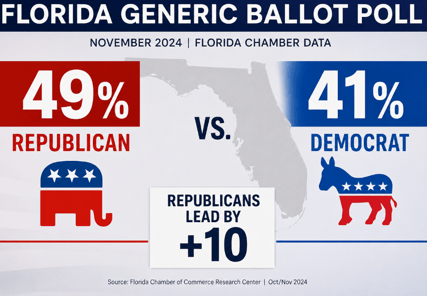
Yet, Moody operates with a mathematical luxury few federal candidates possess. In a state where generic ballot polling places Republicans at a comfortable +10 advantage (49% to 41% according to recent Florida Chamber data), a Republican candidate doesn't need to run a flawless campaign to win. They are insulated by a structural baseline.
Because of this 1.4 million voter cushion, even if a national Democratic "wave" or localized anti incumbent sentiment chips 5% or 6% off the top of GOP support, candidates like Moody remain heavily favored. Moody’s previous statewide performances winning her 2022 Attorney General reelection by over 21 percentage points demonstrate that Florida's red wall is built on both rigid partisan registration and a strong appeal to the state's remaining independent voters.
The Demographic Realignment
Florida's registration advantage did not emerge overnight. It was fueled by a combination of migration, partisan sorting, and organizational investment. Since 2020, Florida has attracted hundreds of thousands of new residents from high-tax and high-cost states.
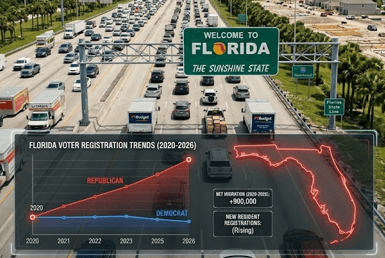
Many arrived during and after the COVID-19 pandemic, drawn by the state's lower taxes, lighter regulatory environment, and economic growth. While newcomers did not arrive with identical political views, Republicans were far more successful at identifying, registering, and integrating these voters into the state's electoral infrastructure.
Florida's political realignment extends beyond voter registration totals, creating a reinforcing cycle where consistent electoral victories generate additional registration gains. This self-sustaining dynamic has shifted the state’s electorate at nearly every level of government, suggesting that Florida's transformation is a durable structural change rather than a temporary cyclical trend.
Why Wave Elections Matter Less in Florida
Political analysts often discuss "wave elections" as national environments capable of sweeping dozens of candidates into office. Yet Florida's registration gap raises the threshold Democrats must overcome before a wave can have meaningful effects.

In a traditional battleground state, a five-point national swing can completely alter statewide outcomes. In Florida, Republicans begin with a registration advantage exceeding 1.4 million active voters before campaigns even begin. That means Democratic candidates must first erase the structural deficit before benefiting from broader national trends.
The consequence is a state that increasingly resembles Republican strongholds such as Texas or Tennessee rather than the toss-up Florida of the early 2000s. National momentum still matters, but the size of the Republican foundation makes statewide upsets substantially more difficult than they once were.
Wrap Up
For Democrats to disrupt this dynamic in 2026, they would need to achieve historic, unprecedented turnout among their diminished base while winning No Party Affiliation (NPA) voters by landslide margins. However, early 2026 polling indicates that NPA voters in Florida are currently breaking toward the GOP by a to margin, while Hispanic voters favor generic Republicans by double digits (52% to 39%).
When a political party controls the registration baseline, enjoys an advantage with independents, and boasts statewide name ID through figures like Moody, traditional "wave election" rules cease to apply. Florida isn’t just leaning red; it has re-engineered its political foundations to ensure that, for the foreseeable future, the house always wins.
-May-24-2026-10-00-02-6221-PM.jpg)