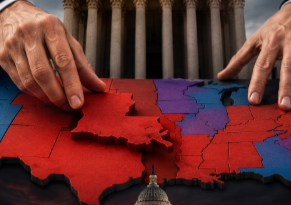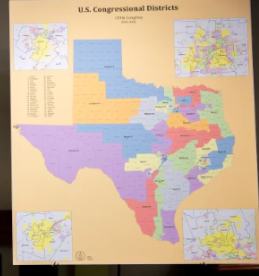
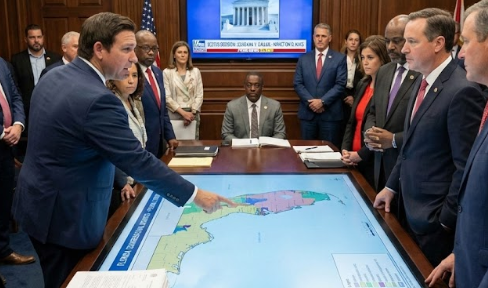

A pending Supreme Court decision on a Louisiana redistricting case could force Florida to redraw its congressional districts mid-decade, potentially deciding control of the U.S. House.
What to Know
- Louisiana v. Callais puts Section 2 of the Voting Rights Act directly before the Supreme Court.
- Florida GOP leaders are pausing redistricting decisions until the Court rules.
- A decision weakening Section 2 could end federal requirements for minority-majority districts.
- Ron DeSantis has signaled a possible special session as early as April 2026.
- Florida Republicans aim to use a favorable ruling to challenge minority-protected districts under the Equal Protection Clause.
All eyes in Florida politics are fixed on the U.S. Supreme Court, not for a homegrown case, but for a complex legal battle originating in Louisiana. The case, Louisiana v. Callais, has become the single most important variable in determining whether Florida’s Republican-led legislature will convene a special session to redraw the state's congressional maps just ahead of the 2026 midterm elections.
The outcome will have immediate and far-reaching consequences, not only for the political careers of Florida’s congressional delegation but for the broader fight for control of the U.S. House of Representatives. Governor Ron DeSantis has made his intentions clear: a favorable ruling from the court will trigger swift action from the legislature, a move that could reshape the state's political landscape for a decade.
The Louisiana Case Explained: A Challenge to the Voting Rights Act
At its core, Louisiana v. Callais examines whether the Voting Rights Act (VRA) of 1965, specifically Section 2, legally compels the creation of districts where minority voters have the opportunity to elect a candidate of their choice.
The case arose after a federal court found that Louisiana's 2022 congressional map likely violated the VRA by only including one majority-Black district out of six, despite Black residents making up nearly a third of the state's population. In response, the Louisiana legislature drew a new map in 2024 with a second majority-Black district.
|
What is the Voting Rights Act The Voting Rights Act is a 1965 federal law that enforces the Fifteenth Amendment by prohibiting racial discrimination in voting. It banned practices such as literacy tests and authorized federal oversight to protect citizens from being denied the right to vote based on race or color. |
Brennan Center and others noted that new map was immediately challenged by a group of white voters who argue that creating a district predominantly based on race is, itself, a form of unconstitutional racial gerrymandering that violates the Equal Protection Clause of the 14th Amendment. The Supreme Court has taken up the case, and its eventual ruling could dramatically reinterpret or even invalidate Section 2 of the VRA.
This matters for party strategy and voters because a ruling against the VRA's current interpretation would effectively remove the federal mandate that has protected minority voting power for generations. It would give states a legal green light to dismantle districts drawn to ensure minority representation, fundamentally altering the electoral landscape.
Florida's 'Wait-and-See' Strategy
Florida's top Republican leaders are making a calculated bet. Both Governor Ron DeSantis and Senate President Kathleen Passidomo have publicly stated they are awaiting the Supreme Court's decision in Callais before taking any action on redistricting. DeSantis has explicitly linked a potential April 2026 special session to the timeline of the court's ruling.
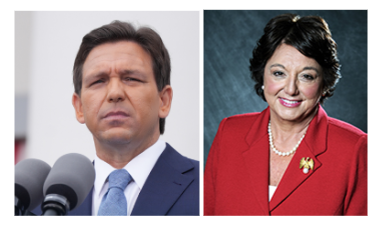
Governor Ron DeSantis (left), and Senate President Kathleen Passidomo (right)
This strategic patience is designed to provide legal and political cover. Acting before the Supreme Court rules would be a gamble; if the court upholds the VRA's current protections, any newly drawn map would be immediately vulnerable to legal challenges.
However, by waiting for the court to potentially weaken the VRA, Florida Republicans can frame their subsequent actions as merely complying with new legal precedent. An attorney advising a Florida House select committee noted that while the Louisiana ruling is only binding on that state, it would present a "judgment call" for Florida's legislature.
The clear party strategy behind this approach is to minimize legal risk while maximizing the potential for a favorable redistricting outcome. It transforms a partisan goal into a matter of constitutional necessity, orchestrated in alignment with the nation's highest court.
The Target is Minority-Protected Districts
Should the Supreme Court weaken Section 2, the next phase of the strategy in Florida would be to challenge the state's own minority-access districts. The argument would pivot from the VRA to the 14th Amendment's Equal Protection Clause. Republican strategists would contend that these districts, which were created to comply with the VRA, are now unconstitutional racial gerrymanders that improperly sort voters by race.
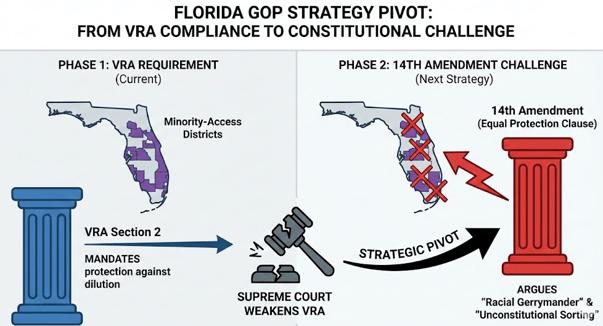
This legal maneuver would directly impact voters by threatening to dismantle districts where minority communities have been able to elect representatives who reflect their interests. The likely outcome would be the "cracking" of these districts, where minority populations are broken up and spread across several surrounding majority-white districts. This would dilute their collective voting power and make it significantly more difficult to elect their chosen candidates. For candidates, this means incumbents could suddenly find themselves in dramatically altered, and potentially unwinnable, districts.
2026 Special Session and the Race for the House
The timing of this strategy is critical. A ruling from the Supreme Court would provide a window for the Florida legislature to convene a special session in early 2026 and pass a new map in time for the midterm elections. Governor DeSantis has already floated a potential April 2026 special session.
The ultimate prize is control of the U.S. House of Representatives. Florida, with its 28 congressional seats, is a major player in national politics. Currently, the delegation is composed of 20 Republicans and 8 Democrats. Analysts suggest that an aggressive, post-VRA gerrymander could flip as many as five of those Democratic seats to the Republican column.
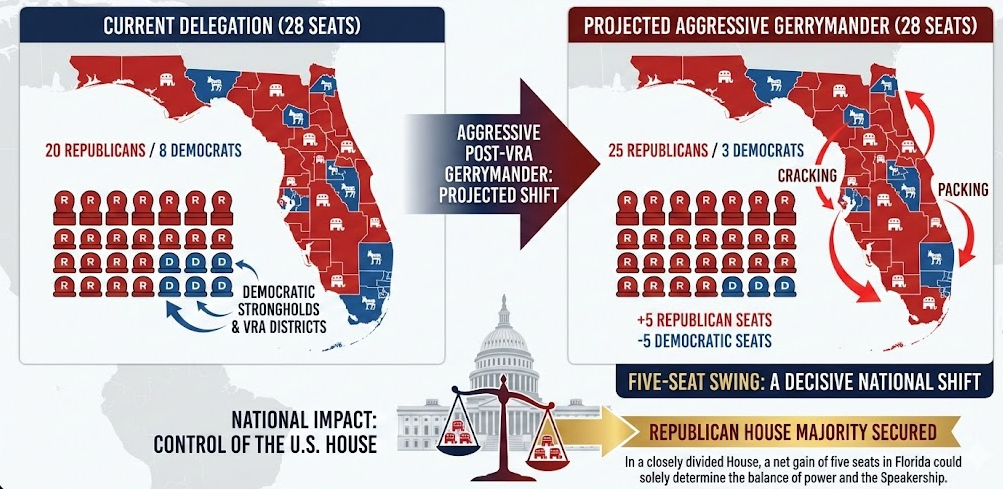
Such a shift would be a massive boost to the national Republican party's efforts to win or maintain control of the House, where majorities are often decided by just a handful of seats. This fight means that Florida would become a national political epicenter in 2026. National parties would pour vast sums of money into the state, and the newly drawn districts would become some of the most expensive and fiercely contested races in the country.
Wrap Up
The legal battle over a congressional map in Louisiana is not a distant, academic dispute; it is the starting pistol for a political and legal war in Florida. The stakes are incredibly high, involving the future of the Voting Rights Act, the partisan composition of Florida's powerful congressional delegation, and the delicate balance of power in Washington, D.C. How the Supreme Court rules in Louisiana v. Callais will directly determine whether Florida proceeds with a contentious, mid-decade redistricting effort that is certain to have national consequences.
For 2026, a ruling that weakens the VRA will plunge Florida into a chaotic and legally fraught redistricting battle, making the state a ground zero for the fight over control of Congress. Beyond 2026, such a decision would set a powerful new precedent, effectively rewriting the rules of redistricting for every state in the nation. It would signal a fundamental shift away from ensuring minority representation and toward a "race-neutral" constitutional interpretation that could dismantle decades of civil rights progress, altering the face of American democracy for years to come.