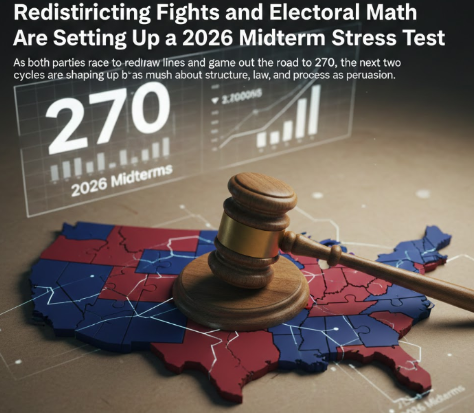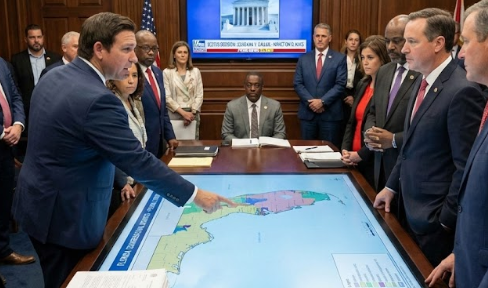


While the 2030 census and reapportionment will draw focus, judges will ultimately decide the next decade of political maps.
What to Know
- The 2019 U.S. Supreme Court decision in Rucho v. Common Cause ruled that federal courts will no longer police partisan gerrymandering claims.
- As a result, state supreme courts have become the primary venues for redistricting lawsuits under state constitutions.
- The U.S. Supreme Court still hears cases involving racial gerrymandering and Voting Rights Act violations, leaving federal judges deeply involved in map disputes.
- Judges appointed between now and 2030 will decide the next wave of redistricting cases, shaping who controls congressional delegations for the following decade.
- Legal battles are already underway in states including Utah and Virginia, signaling that the next redistricting fight has effectively begun.
The next redistricting fight will not be decided solely in state capitols. It will increasingly be fought in courtrooms. By the time the 2030 census numbers are released and states begin drafting new congressional maps, the officials with the greatest influence over the outcome may not be governors or legislative leaders, but judges who determine whether those maps survive legal scrutiny.
.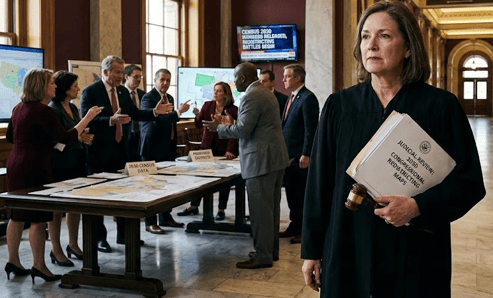
Once federal courts stopped policing partisan gerrymandering, the fight over political maps moved into state courts. State supreme courts, federal district courts, and ultimately the U.S. Supreme Court now serve as the forums where many of these battles unfold. The composition of those courts in the years ahead will shape how those cases are decided and, in turn, who holds political power across Congress, state legislatures, and governorships throughout the 2030s.
The Shifting Legal Landscape
For decades, redistricting fights followed a predictable pattern. State legislatures drew the maps, and federal courts reviewed them when someone claimed the lines were unfair. That balance changed dramatically in 2019 when the U.S. Supreme Court ruled in Rucho v. Common Cause that federal courts would no longer decide cases about partisan gerrymandering.

Former state senator Bob Rucho
That decision removed one of the most common ways political maps had been challenged. Instead of bringing cases in federal court, lawsuits now move through state courts, where judges interpret their own state constitutions. In practice, this means state supreme courts have become the main referees in many of the country’s most important redistricting disputes.
The shift has already reshaped the legal battlefield. In several states, judges have ordered legislatures to redraw congressional and legislative districts after ruling that maps violated state constitutional protections such as fair elections or equal representation. Those rulings can dramatically change which party has an advantage in future elections.

Federal courts still play a role, but in a narrower lane. They continue to hear cases involving racial discrimination in district maps under the Voting Rights Act. When courts determine that district lines dilute minority voting power, they can still require maps to be redrawn.
The result is a new redistricting landscape. Partisan fights over maps now play out primarily in state courts, while federal courts focus on racial discrimination claims. As the 2030 census approaches, that shift has made one thing clear: the judges sitting on those courts will have enormous influence over how the next decade of political power is distributed.
The Judicial Pipeline and the Ideological Stakes
The 2030 redistricting cycle will be decided in part by judicial selection decisions being made on a fixed calendar over the next several years. According to Ballotpedia, North Carolina has a Supreme Court seat on the ballot in 2026, with the term expiring on December 31, 2026. The primary is scheduled for March 3, 2026, followed by the general election in November 2026.
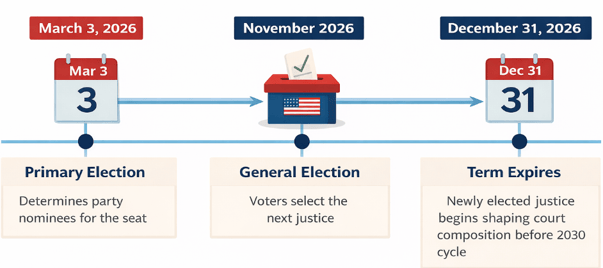
That timing could shift the ideological balance of the court just a few years before the next round of redistricting lawsuits begins after the 2030 census. North Carolina has already been a major battleground for challenges to congressional and legislative maps. In practice, that means a single seat on the state’s supreme court can shape how aggressively judges interpret election laws and constitutional protections when the next map fights arrive.
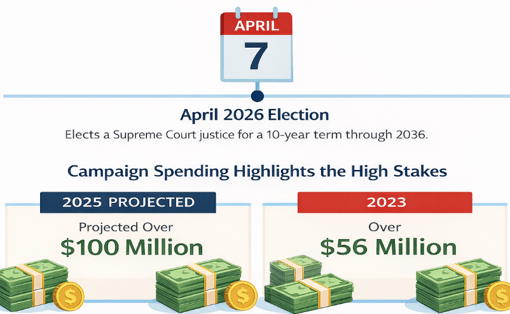
Wisconsin shows how high the stakes have become in these races. Voters will elect a state Supreme Court justice in April 2026 to a 10-year term, meaning that judge will still be on the bench when the next redistricting cycle unfolds after the 2030 census.
The spending around these elections makes clear they are no longer quiet judicial contests. Wisconsin Supreme Court races drew more than $100 million in spending in 2025 and more than $56 million in 2023, turning what used to be low-profile judicial elections into national political fights over who will ultimately decide the next generation of political maps.
In Pennsylvania, retention elections create an additional variable. Reporting by Spotlight PA details how 2025 retention votes involving three justices could trigger contested partisan elections if voters reject retention. That mechanism creates a pathway for significant ideological turnover before the 2030 census. Retention systems were historically procedural. They are now strategic inflection points.

Mandatory retirement rules add structural churn. Ballotpedia’s state-by-state data shows mandatory retirement ages of 72 in North Carolina, 75 in Pennsylvania and Texas, and 70 in Arizona. These age thresholds create forced vacancies within defined windows, allowing governors to reshape courts through appointment power prior to the next map cycle.
Put those judicial timelines together with the Supreme Court’s 2019 Rucho decision, and the picture becomes clearer. Many of the most important redistricting fights will now be decided by state courts.
As summarized by the National Conference of State Legislatures, the 2019 Supreme Court decision removed partisan gerrymandering claims from federal court review, declaring them non-justiciable in federal forums. That reallocation of authority pushed partisan map disputes into state courts interpreting their own constitutions.
The Supreme Court's Lingering Shadow
The U.S. Supreme Court still casts a long shadow over redistricting, especially when race is involved. A current case, Louisiana v. Callais, has drawn attention because the Court signaled it may revisit a much bigger question than the dispute itself. Instead of simply reviewing the map at issue, the justices asked whether Section 2 of the Voting Rights Act remains constitutional.
That matters because Section 2 has been the backbone of voting rights lawsuits for decades. The law bans election practices that weaken the voting power of racial minorities. Under the legal test established in Thornburg v. Gingles, challengers must prove several demanding conditions, including evidence that voting is racially polarized and that a reasonably drawn majority-minority district could exist. These are not easy cases to win, but the law has still been one of the main tools used to challenge maps that dilute minority votes.
There is also a recent precedent that shows how much can change when the Court rewrites the rules. In 2013, the Supreme Court’s decision in Shelby County v. Holder struck down the Voting Rights Act’s preclearance formula, which had required certain states to get federal approval before changing voting laws. Once that safeguard disappeared, states quickly implemented new election policies that had previously been blocked, and it took years of lawsuits to sort out the consequences.
That history is why legal observers are watching the Court closely now. If Section 2 is narrowed or struck down, it would reshape the rules governing racial gerrymandering cases nationwide. In other words, while state courts now handle many partisan map fights, the Supreme Court still holds enormous power over the federal rules that govern voting rights. And if those rules change before the 2030 census, the entire legal battlefield for the next redistricting cycle could change with them.
Wrap Up
By the time the 2030 census arrives and new congressional maps are drawn, the outcome will depend on more than population shifts and legislative control. It will depend on the judges who are sitting on the courts that review those maps. State supreme courts and federal courts will decide whether district lines stand, are rewritten, or are thrown out entirely.
Those judges are being elected and appointed now. Court seats coming up between 2026 and 2028 will determine who hears the next wave of redistricting lawsuits. In recent election cycles, control of the U.S. House has hinged on only a handful of seats. A court decision that changes even two or three districts in a competitive state can shift the balance of power in Washington.
The timeline is already visible. Judicial elections, mandatory retirement rules, retention votes, and term expirations over the next several years will determine who is on the bench when the next round of redistricting litigation begins. When the 2030 maps are challenged, those judges will be the ones deciding which political maps survive and which ones are redrawn.