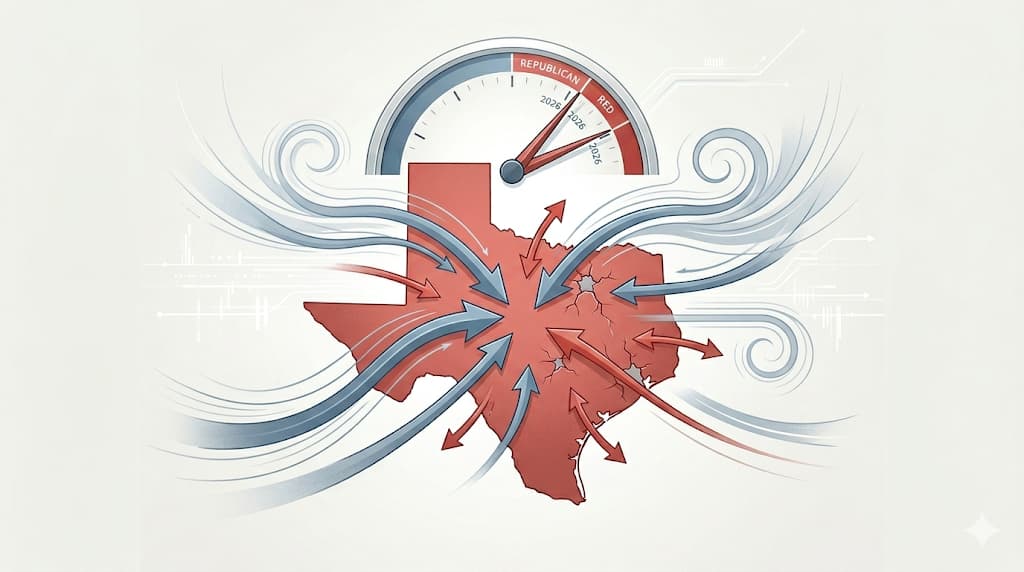

Texas is still a Republican state, but the voters holding that advantage together are changing.
What to Know
- Texas still holds a Republican advantage, but the coalition underneath it is changing.
- Younger urban and suburban Anglo voters have become less Republican, creating pressure in the state’s metro and suburban vote.
- The Texas Latino vote shifted sharply toward Donald Trump in 2024, reaching 55% in one Texas Politics Project analysis.
- The key question for 2026 is whether Latino GOP gains are durable loyalty or a more volatile response to the last political cycle.
- Texas is not simply turning blue or staying red unchanged. It is becoming a state where coalition management matters more than old labels.
Texas is still Republican-leaning, but that does not mean the Republican coalition looks the same as it did 10 or 15 years ago. The better way to read the state is not as a straight partisan flip. It is as a political trade-off, with some traditional Republican strength weakening while newer opportunities open elsewhere.
[Video still]: Texas Policy Summit panel discussion, “Numbers, Narratives & the Next Year: America & Texas in 2026.”
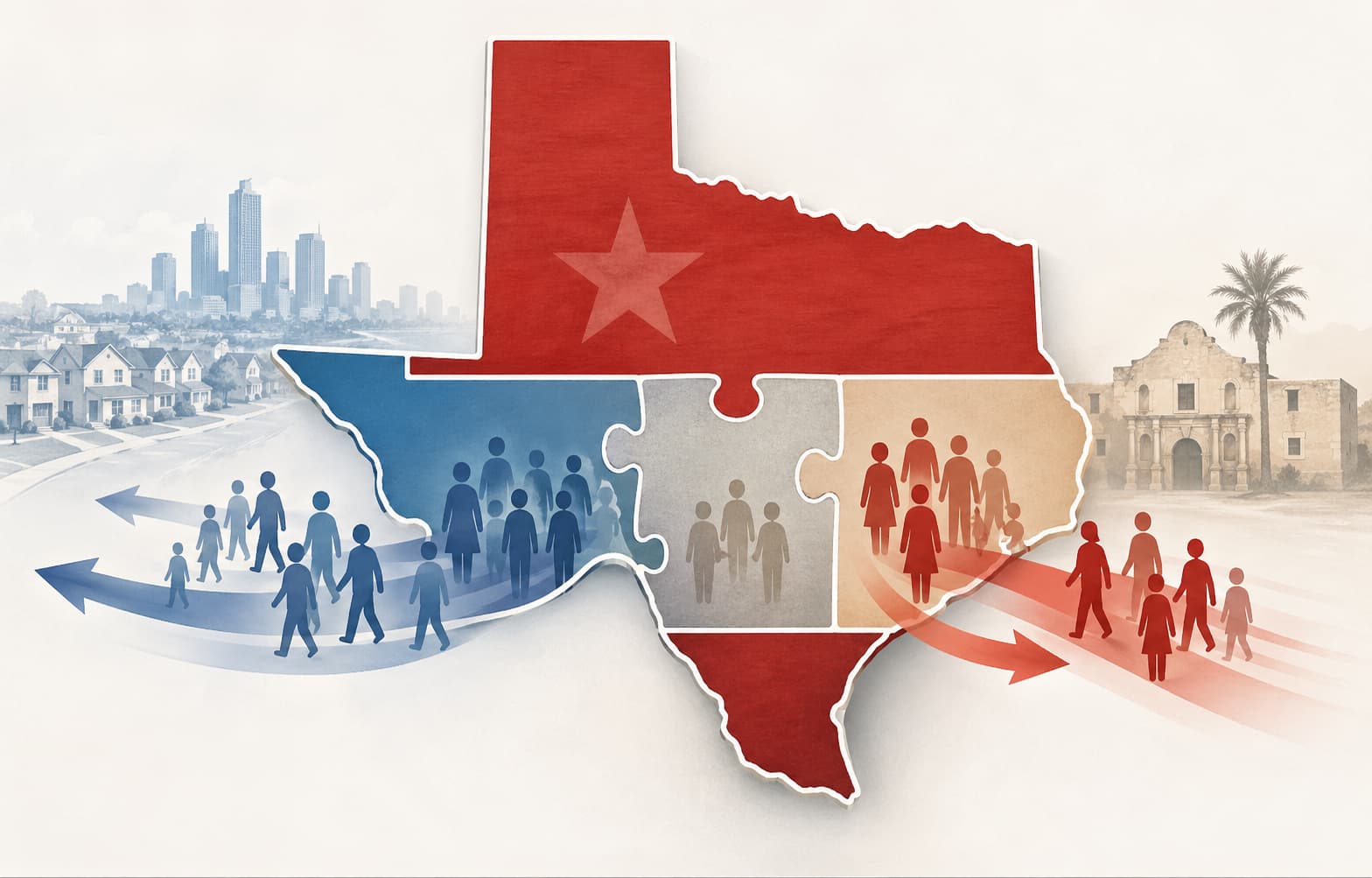
The Texas Policy Summit discussion put that trade-off in clear terms. Republicans are losing ground with some younger urban and suburban Anglo voters, while gaining ground with Latino voters who once seemed more reliably Democratic. That does not make Texas blue. It makes Texas more complicated.
The Topline Still Favors Republicans
Texas has not crossed into true purple-state territory. The state still begins with a Republican statewide advantage, and that matters. A coalition can shift internally without losing its overall partisan direction.
-jpg-May-10-2026-08-33-40-8488-PM.jpeg?width=200&height=200&name=image%20(5)-jpg-May-10-2026-08-33-40-8488-PM.jpeg)
Michael Baselice, President and CEO of Baselice & Associates
During the Texas Policy Summit, Michael Baselice argued that Texas has maintained roughly a 10-point Republican advantage for years. But he also made clear that the composition of that advantage is changing, especially as Anglo voters in urban and suburban areas have become less Republican while Latino voters have moved toward the GOP.
As Michael Baselice, President and CEO of Baselice & Associates, explained during the Texas Policy Summit:
"Texas has maintained about a 10-point Republican advantage for the last 15, 20 years."
-jpg-May-10-2026-08-33-52-9011-PM.jpeg?width=550&height=338&name=image%20(1)-jpg-May-10-2026-08-33-52-9011-PM.jpeg)
Campaign Now (Gemini), based on Texas Policy Summit, Texas GOP advantage and changing voter blocs
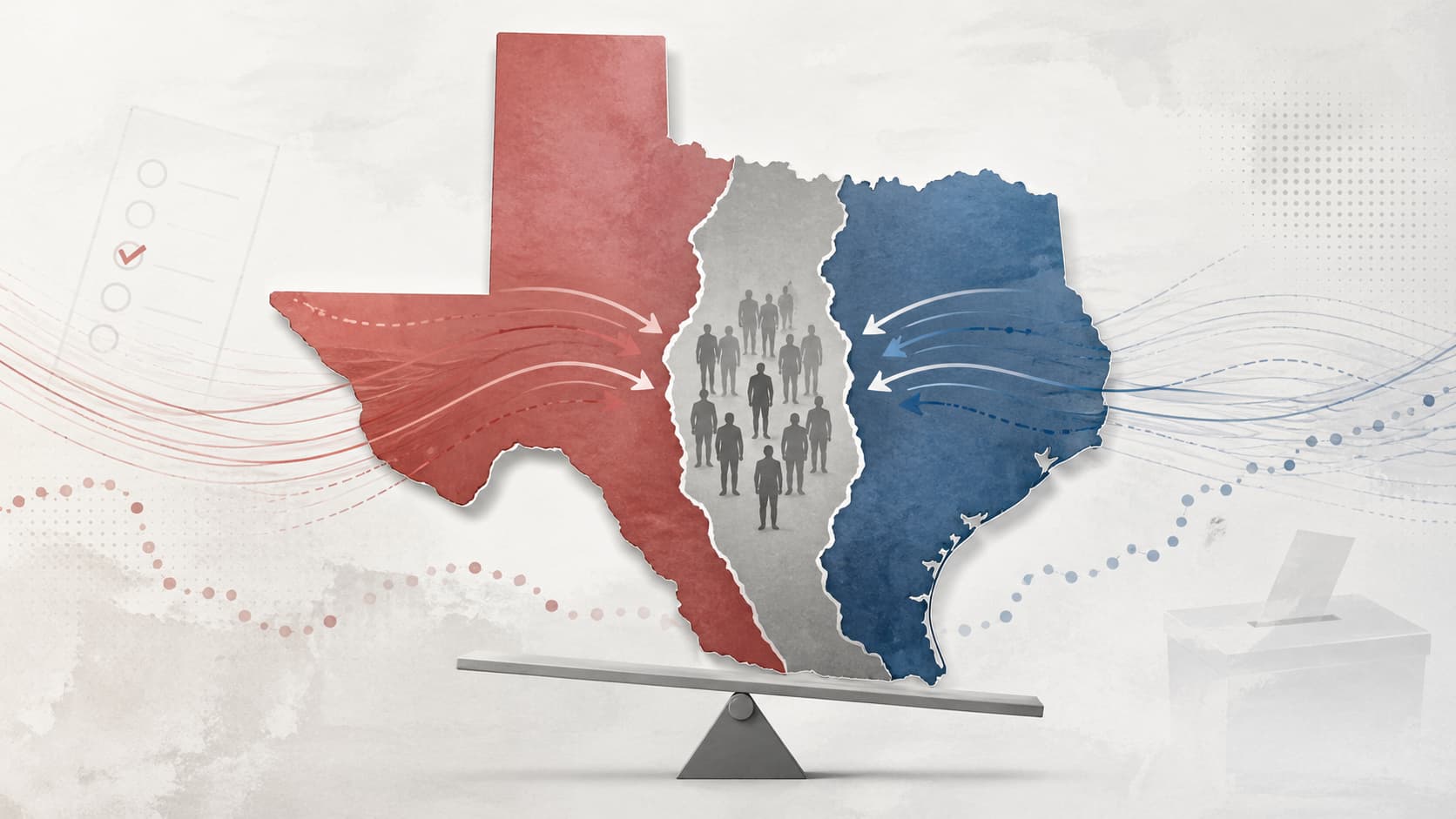
That is the starting point, not the whole story. A 10-point edge can still be powerful, but it becomes harder to protect when the voters producing that edge are no longer the same voters in the same places. The question is not whether Texas is still red. The question is what kind of red coalition it now takes to keep it there.
The Suburban Pressure Is Real
The most important pressure point is not a sudden Democratic takeover of Texas. It is the long-term erosion of Republican strength in the places where Texas keeps growing.
At the summit, Baselice pointed to younger Anglo voters in urban and suburban Texas as a group that has moved away from Republicans over time. He described a shift from a roughly 50/50 split in 2010 to a more Democratic-leaning 40/60 split by 2022 among urban and suburban Anglo voters under 55. That is not enough by itself to flip Texas. It is enough to make the old Republican formula less automatic.
-jpg-May-10-2026-08-34-06-9527-PM.jpeg?width=603&height=372&name=image%20(2)-jpg-May-10-2026-08-34-06-9527-PM.jpeg)
Campaign Now (Gemini), based on Texas Policy Summit, urban and suburban Anglo voter shift from 2010 to 2022
The outside trend is visible too. Spectrum News noted after 2020 that Texas suburbs were still moving more Democratic even without a statewide blue wave. That is the pressure Republicans have to offset somewhere else.
Latino Movement Is the New Republican Opportunity
The biggest counterweight to suburban erosion is Latino movement toward Republicans.
-jpg-May-10-2026-08-34-17-4747-PM.jpeg?width=422&height=281&name=image%20(6)-jpg-May-10-2026-08-34-17-4747-PM.jpeg)
Donald Trump, President of the United States
A Texas Politics Project analysis noted that exit polls suggested Donald Trump won 55% of the Latino vote in Texas in 2024, up 13 points from 2020 and 27 points from 2016. That is a major shift, and it explains why Texas Republicans can lose some suburban ground without automatically losing the statewide map.
-jpg-May-10-2026-08-34-28-1468-PM.jpeg?width=145&height=181&name=image%20(7)-jpg-May-10-2026-08-34-28-1468-PM.jpeg)
Jim Henson, Director of the Texas Politics Project
According to Jim Henson of the Texas Politics Project:
"Trump received 55% of the Latino vote in Texas in 2024, a 13 point increase from 2020, and a 27 point increase from 2016."
-jpg-May-10-2026-08-34-42-2707-PM.jpeg?width=591&height=330&name=image%20(3)-jpg-May-10-2026-08-34-42-2707-PM.jpeg)
Campaign Now (Gemini), data from Texas Politics Project, Texas Latino vote movement from 2016 to 2024
The Texas Tribune has also reported that Republican gains with Latino voters are not limited to the Rio Grande Valley. That matters because the largest number of Latino voters live in urban and suburban areas away from the border. If Republican gains spread beyond South Texas, the coalition math changes statewide.
Movement Is Not the Same as Loyalty
Republicans face a real risk if they assume Latino gains are already locked in. A voter can move right in one cycle without becoming a permanent Republican voter.
Tracking from the Texas Politics Project is useful here because it separates party identity from vote choice. Latino voters can lean, shift, or split depending on the issue environment, candidate contrast, and economic mood. That makes the Republican opportunity real, but far from automatic.
Reporting from The Texas Tribune shows young South Texas Republicans actively working to register and mobilize Latino voters after Trump-era gains. That is the right frame for understanding what comes next. The GOP’s task is not merely to benefit from a shift that already happened, but to convert that movement into durable organization, repeated voter contact, and a governing message that remains relevant after Trump is no longer the central driver.
-jpg-3.jpeg?width=240&height=240&name=image%20(8)-jpg-3.jpeg)
Pooja Salhotra, Reporter at The Texas Tribune
As Pooja Salhotra of The Texas Tribune reported:
"Young conservatives in South Texas are trying to turn President Donald Trump’s gains with Latino voters into a lasting Republican advantage."
That is the coalition-building challenge in one sentence. The new Republican coalition is possible, but it has to be built. It cannot be assumed.
The Redistricting Bet Shows the Stakes
Republicans are already treating Latino movement as a strategic reality, not just a polling curiosity.
-jpg-2.jpeg?width=400&height=300&name=image%20(9)-jpg-2.jpeg)
Greg Abbott, Governor of Texas
A Texas Tribune analysis of the GOP’s congressional map strategy reported that Republicans increased the Hispanic voter share in several targeted districts, betting that enough of those voters would continue voting Republican even without Trump on the ballot. That is not just demographic observation. It is a governing-party wager.
That wager may prove smart, but it carries risk. A later Texas Tribune report noted Democratic arguments that mapmakers added Hispanic Texans who are less likely to vote, which points to the core uncertainty. Latino Republican gains matter most when they become repeated turnout, not just improved margins in one high-attention cycle.
-jpg-May-10-2026-08-35-12-8781-PM.jpeg?width=561&height=309&name=image%20(4)-jpg-May-10-2026-08-35-12-8781-PM.jpeg)
Campaign Now (Gemini), data from Texas Tribune, GOP coalition bet on Latino gains
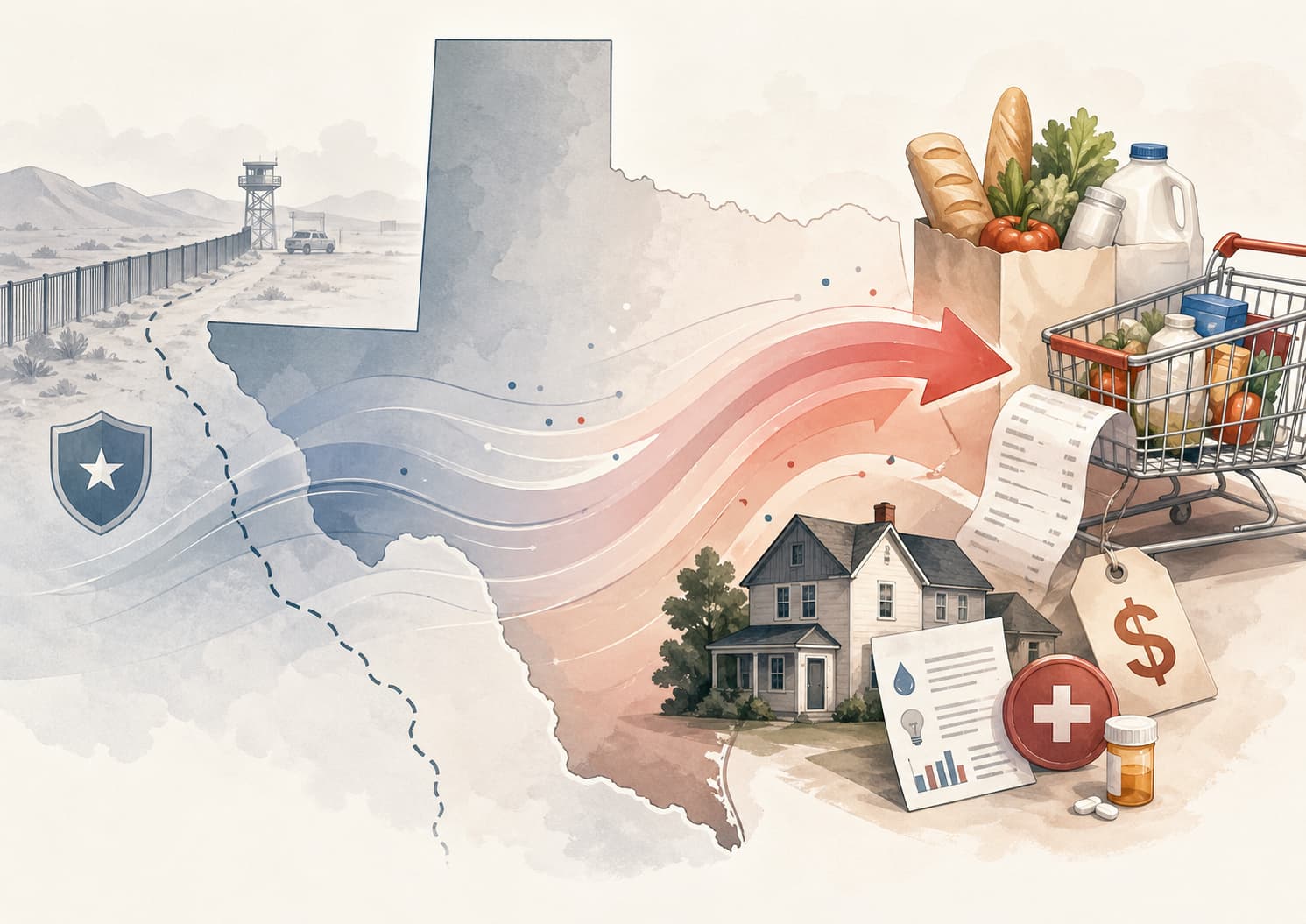
This is why the Texas story is not just about party registration or statewide margin. It is about whether the Republican coalition can be reassembled with enough reliability to withstand suburban pressure, turnout risk, and national headwinds at the same time.
Wrap Up
Texas is not changing parties in a simple leftward march. It is rebuilding its coalition. The state remains Republican-leaning, but the balance underneath that label is moving.
For Republicans, the opportunity is clear: Latino gains can help offset suburban and younger Anglo erosion. The warning is just as clear: movement has to become loyalty, and loyalty has to become turnout. In 2026, Texas may stay red not because nothing changed, but because Republicans successfully rebuild the coalition before the old one weakens too far.