


A five-point lead in the generic ballot would historically signal a coming wave election, but structural factors and a complex political landscape suggest a more competitive reality in 2026.
What to Know
- A 5-point Democratic lead in the polls hints at a wave, but is it just a mirage?
- A GOP "redistricting firewall" has created a map that might be wave-proof.
- A Democratic surge is naturally constrained because midterm elections activate a distinct and more conservative electorate.
- The ultimate wild card: voter anxiety over the economy could short-circuit any Democratic momentum.
- It's the national mood vs. the electoral map, and a 5-point lead may not be enough for Democrats to win.
In the world of political forecasting, the generic congressional ballot is often seen as a North Star, a reliable indicator of the direction of the political winds. And with Democrats currently holding a five-point advantage in the polls, many are beginning to whisper the word "wave."
But in the turbulent currents of the 2026 midterm elections, that number may be more of a mirage than a clear signal of a coming political tsunami. While a D+5 lead is undoubtedly good news for the Democratic Party, a confluence of structural factors, from partisan redistricting to the unique dynamics of a midterm electorate, suggests that the fight for control of the House of Representatives will be a far more granular, district-by-district affair than the national numbers might suggest.
What a D+5 Lead Actually Means
A Democratic +5 advantage on the generic congressional ballot means Democrats are polling five points ahead nationally when voters are asked which party they want controlling the House. As aggregated by RealClearPolling, current averages in early 2026 place Democrats roughly in the D+4 to D+5 range. That confirms a favorable national environment, but it does not resolve the central question of House control.
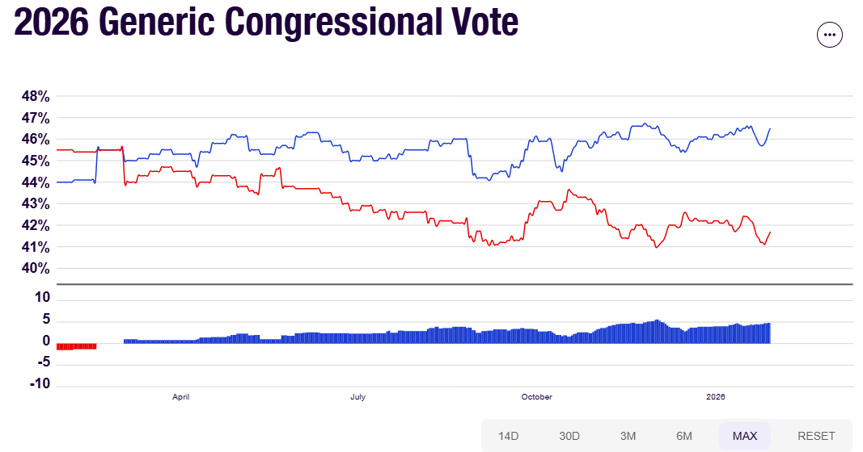
Screenshot of data chart from RealClearPolling
The generic ballot is best understood as a snapshot of national mood, not a seat projection. Political analysts have long treated it as a reliable indicator of the national popular vote, but its ability to predict House outcomes weakens when margins are modest and maps are highly engineered. A D+5 lead suggests momentum and enthusiasm, not inevitability.
That distinction matters more today than at any point in the modern era. As research from the Brennan Center for Justice has shown, aggressive partisan gerrymandering has reduced the House’s responsiveness to shifts in national opinion. District lines drawn after the 2020 census have insulated large numbers of seats from competitive pressure, meaning changes in the popular vote no longer translate proportionally into changes in representation.
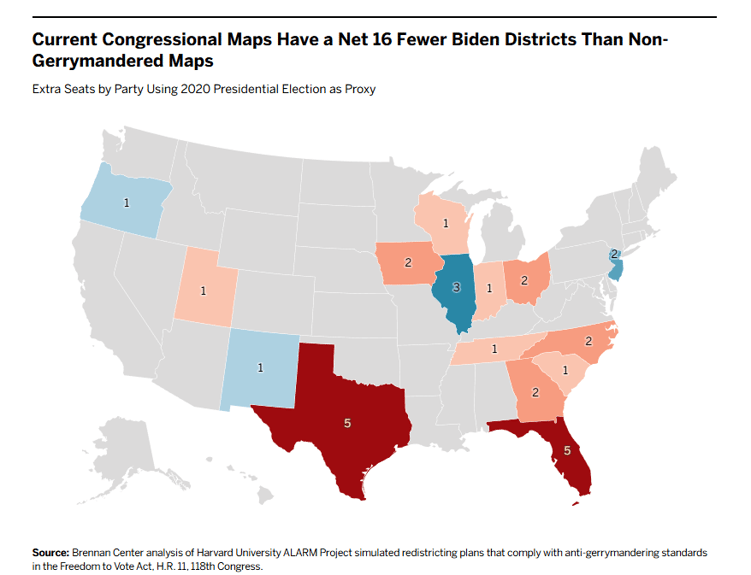
Screenshot of chart from Brennan Center for Justice
In practical terms, this creates a structural bias. Multiple Brennan Center analyses have found that Democrats must often win the national popular vote by several points just to approach parity in House seats. Even when both parties gerrymander, the net effect still tilts toward Republicans because of how Democratic voters are geographically concentrated and how efficiently Republican voters are distributed across districts.
There is also a composition problem embedded in the D+5 number itself. National leads are frequently driven by overwhelming Democratic margins in deep-blue districts rather than meaningful movement in the smaller set of swing seats that actually decide House control. Democrats can expand their popular vote advantage without expanding the battlefield.
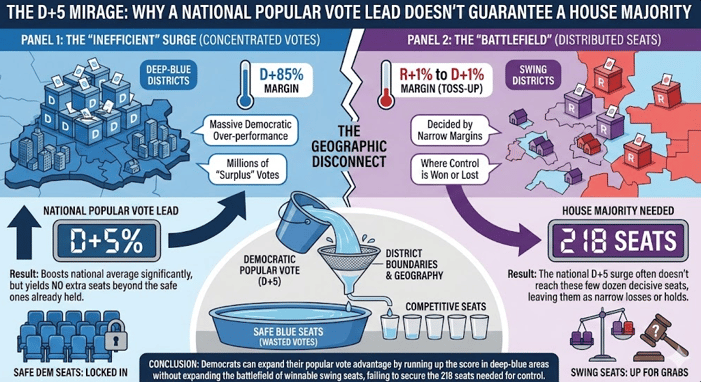
This is why a D+5 environment in 2026 should be read as encouraging but not decisive. It signals a favorable climate and potential Republican vulnerability, but it does not guarantee a wave. In today’s House, a five-point national edge is closer to the threshold for competitiveness than a margin of safety. The generic ballot says Democrats are winning the argument nationally. The map determines whether that argument converts into power.
The Allure of the Generic Ballot
The generic congressional ballot has become one of the most closely watched indicators in modern campaign analysis, not because it predicts seat outcomes directly, but because it offers a high-level read on national mood. By stripping away candidate-specific variables, the generic ballot captures something more elemental: which party voters trust more, in the abstract, to govern Congress.
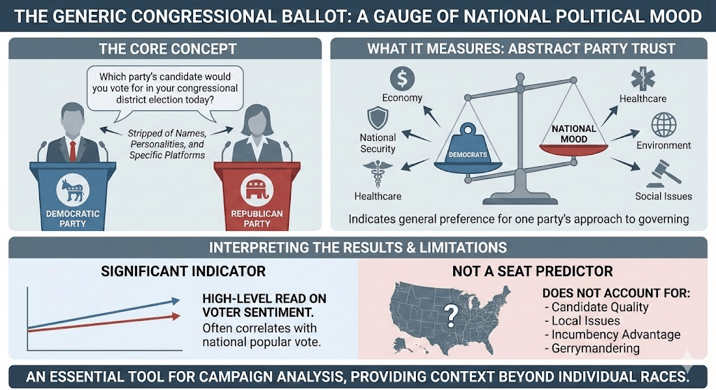
As aggregators like Race to the White House have shown, generic ballot averages tend to track closely with the eventual national House popular vote, making them a useful early warning system for wave conditions. When one party sustains a multi-point advantage over time, it signals not just enthusiasm gaps but broader structural headwinds for the opposition.
“The Generic Ballot polling average tracks whether voters prefer a ‘generic’ Democrat or a ‘generic’ Republican. It’s often treated as a rough snapshot of the national popular vote in congressional elections.”
— Race to the White House, All Polls Average
That framing explains why campaigns, donors, and analysts fixate on even small movements in the generic ballot. A one- or two-point shift can reflect meaningful changes in voter confidence, especially among independents and low-information voters who ultimately decide close House races.
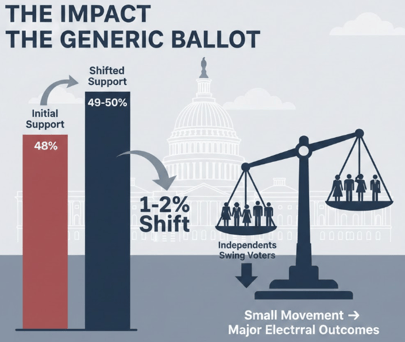
While the metric cannot account for district-level variation, incumbency effects, or map-specific distortions, its enduring appeal lies in its simplicity: it measures which party has the wind at its back before the hard realities of geography and turnout intervene.
The Redistricting Firewall
The single greatest obstacle to a Democratic wave in 2026 is the “redistricting firewall” that has been constructed in a number of key states. Following the 2020 census, both parties engaged in a fierce battle to draw congressional district lines in their favor.
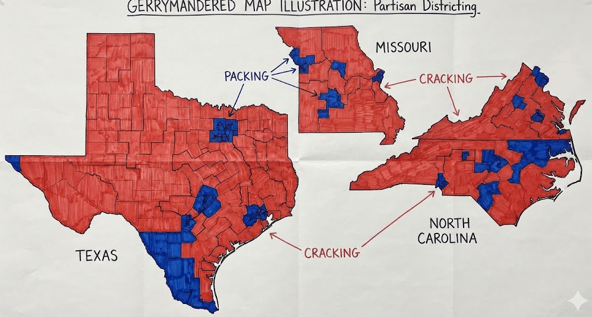
In states like Texas, North Carolina, and Missouri, Republicans have been aggressive in creating maps that pack Democratic voters into a small number of districts, while spreading Republican voters out across a larger number of districts, making them more likely to win a majority of the seats even if they lose the statewide popular vote.
“Redistricting has evolved from an ignoble art into a data-driven science designed to predetermine outcomes, dramatically reducing the number of competitive House seats.”
— Houston Chronicle editorial board
While Democrats have engaged in their own redistricting efforts in states like California, New York, and Maryland, the net effect of the national redistricting battle appears to favor the Republican Party. This means that even if Democrats win the national popular vote by a significant margin, they may not be able to translate that into a majority of House seats. The GOP has, in effect, built a structural advantage into the map that can withstand a national swing of several points.
The Midterm Electorate and Economic Realities
Another key factor to consider is the nature of the midterm electorate. Midterm electorates are consistently smaller, older, whiter, and more educated than presidential-year electorates. This demographic profile tends to favor the Republican party, as older and white voters are more likely to vote Republican. This "turnout differential" can act as a natural brake on a Democratic wave, even in a favorable national environment.
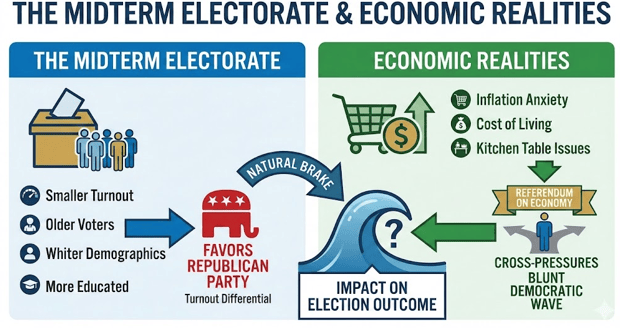
The economy remains a potent wildcard. Despite President Trump's declining approval, voter anxiety over inflation and the cost of living is high. These "kitchen table" issues can create cross-pressures for voters who may be dissatisfied with the president but are also worried about their own financial security. Republicans will undoubtedly seek to make the election a referendum on the economy, and if they are successful, they may be able to blunt the force of a Democratic wave.
Wrap Up
The D+5 generic ballot is a significant data point that should not be ignored. It reflects a real and growing dissatisfaction with the current political trajectory and provides a powerful tailwind for Democratic candidates across the country. However, it is not a guarantee of a wave election. The structural realities of the modern political map, combined with the unique dynamics of a midterm election, mean that the battle for control of the House will be a hard-fought, district-by-district struggle.
For Democrats, the challenge will be to translate a national mood into victories in a small number of highly competitive districts. This will require a combination of strong candidates, effective messaging, and a massive get-out-the-vote effort. For Republicans, the key will be to leverage their structural advantages and keep the focus on the economy. In the end, the 2026 midterms are likely to be less of a wave and more of a knife fight on the map, with control of the House hanging in the balance.

-4.jpg)