
The intense battle for House control is a district-by-district fight, driven by the narrow Republican majority, historical trends, and limited competitive districts this cycle.
What to Know
- History favors the out party, with the president’s party averaging a 26 seat House loss since 1932, putting the GOP at a structural disadvantage.
- Fewer than 40 true swing districts will decide control of the House, concentrating spending, risk, and strategic pressure into a very narrow map.
- Trump’s direct involvement and roughly 40% approval rating nationalize most competitive races and complicate positioning for Republican candidates.
- Democratic overperformance in 2025 special elections mirrors patterns seen before the 2018 blue wave and signals a challenging environment for Republicans.
- Redistricting court fights and a high number of retirements add instability and uncertainty for campaign planning on both sides.
The contest for the House of Representatives in 2026 is a pure study in structural political science. On one side, Republicans are defending a threadbare majority, a fragile hold on power they are desperate to maintain. On the other side, Democrats are propelled by the powerful weight of what analysts call "midterm gravity," the historical pattern that almost always pulls the president’s party down in a midterm election.
This intense involvement nationalizes the election, yet control will not be decided by a single, monolithic wave. Instead, the majority will be forged in a series of brutal, district-level skirmishes playing out on the narrowest and most unforgiving battlefield in modern American history. In this environment, the core fundamentals of campaigning, such as candidate quality, fundraising prowess, and precise resource allocation, will be the decisive factors.
The Unrelenting Weight of Midterm Gravity
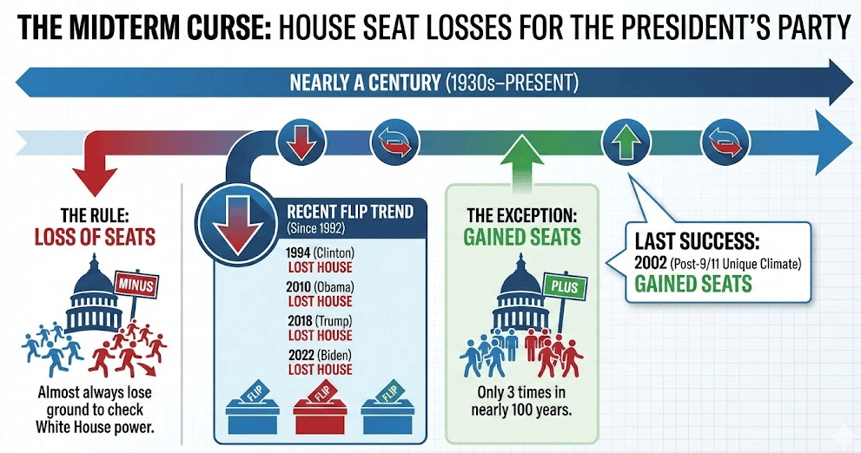
Campaign strategists in both parties understand the historical odds stacked against the party in power. As detailed in a recent Associated Press analysis on the fight for House control, the party holding the White House has lost an average of 26 House seats in midterm elections since 1932. This phenomenon has been remarkably consistent.
The president’s party has gained seats only three times in that nearly century-long span, with the last instance occurring in the unique post-9/11 political environment of 2002. Every other president since 1992, including Trump himself in 2018, has seen House control flip to the opposition in the first midterm election after winning the presidency. The losses are often steep, as seen in the "Republican Revolution" of 1994 and the GOP wave of 2010.
While President Trump is in a non-consecutive second term, creating a dynamic without a perfect historical parallel, the core principle remains. A midterm election almost always acts as a referendum on the occupant of the White House. This historical context frames the entire strategic landscape for 2026. For Republican campaigns, the objective is not to gain ground but to defy political gravity itself, a monumental task. For Democrats, the strategy is simpler in concept. They must harness the inevitable voter discontent that builds against a president and let history run its well-worn course.
The Trump Factor: A Double-Edged Sword
In 2018, President Trump was a more distant figure in the midterms. In 2026, he is the central character. He is involving himself directly in candidate recruitment, doling out strategic messaging advice, and promising not to let history repeat itself. This direct involvement is a complicated, double-edged sword for Republican campaign managers. On one hand, it guarantees an energized and motivated base.
As the GOP’s chief candidate recruiter, Congressman Brian Jack, noted, many new candidates are "very inspired by President Trump" and plan to run on his successes.

Congressman Brian Jack
On the other hand, it lashes every swing-district Republican to a president with a stubbornly low approval rating, which stood at just 40 percent in January. Past midterm results show a strong correlation between a president’s job approval and his party’s performance. This reality forces GOP candidates into a difficult strategic box.
They cannot afford to alienate the MAGA base that is essential for their primary and general election turnout. Yet, aligning too closely with Trump risks repelling the moderate and independent voters who are the kingmakers in these marginal districts. This dilemma will force campaigns to make difficult, district-specific decisions on how closely to embrace the president’s brand and message.
The Incredible Shrinking Battlefield
The days of a wide-open House map with dozens of potential pickup opportunities are a relic of the past. Decades of aggressive partisan gerrymandering and deep demographic sorting have whittled the number of truly competitive seats down to a handful. Both the Democratic and Republican campaign committees are targeting a similar, overlapping list of fewer than 40 districts.
This means the entire battle for the speakership gavel is concentrated in these select areas, turning them into political pressure cookers of intense spending and media attention. This structural reality dramatically elevates the importance of candidate quality and flawless campaign execution. There is simply no margin for error.
The retirement of a moderate Democrat like Representative Jared Golden, who represents a rural Maine district that Trump won, is a gut punch to Democratic retention efforts. That loss is compounded by the fact that popular former Governor Paul LePage is the likely GOP nominee.

Representative Jared Golden (left), Governor Paul LePage (right)
Conversely, Democrats are energized by the comeback bid of former Representative Elaine Luria, a military veteran running to reclaim her competitive Virginia district.

For campaign professionals, this narrow map means every dollar, every advertisement, and every door knock in these key districts carries outsized, majority-making importance.
The Unwritten Map and Retirement Wave
Adding to the complexity are two significant variables that inject further instability into the 2026 cycle. The first is the final congressional map, and the second is a surge in retirements. Redistricting battles are still being fought in courtrooms in several states.
Although Republicans pursued aggressive gerrymanders in states such as Texas, the net partisan outcome of the post census redistricting process remains unresolved. Several district lines are still being finalized or litigated, leaving the overall House battlefield fluid. That uncertainty complicates targeting decisions, voter outreach, and resource allocation for both parties as they plan for 2026.
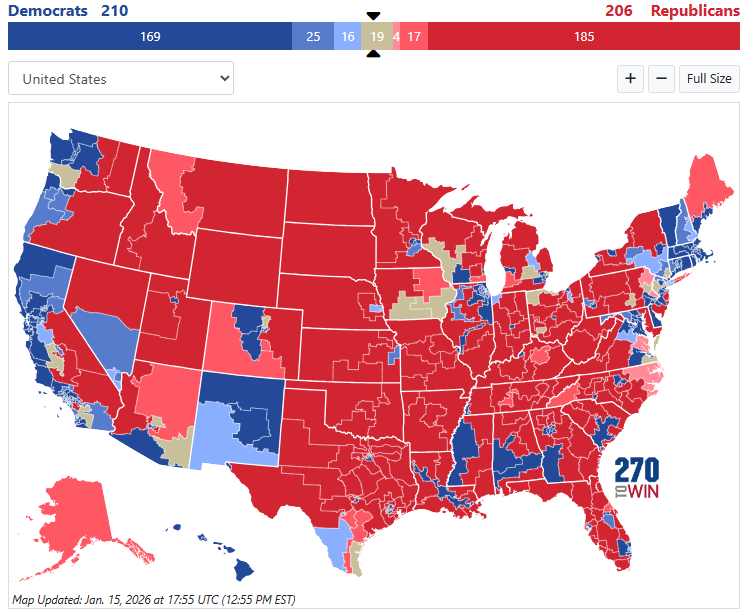
Screenshot from 270toWin consensus map, 2026
Additional court action, including a possible Supreme Court ruling that further weakens the Voting Rights Act, could disrupt even more maps and prolong instability. Current projections reflect this volatility rather than a settled end state, as reflected in consensus modeling from 270 to Win.
Simultaneously, a record number of House members have announced they will not seek reelection. This retirement wave creates a host of open seats, which are inherently more competitive and expensive to defend than incumbent-held districts. While some retirements open up offensive opportunities for the opposing party, others, like Representative Golden's, create major defensive headaches.
This constant churn of veteran lawmakers leaving office also results in a loss of institutional knowledge. It forces campaign committees to remain nimble, constantly re-evaluating their target lists and strategies as the landscape shifts beneath their feet.
Wrap Up
The convergence of these powerful forces guarantees that the fight for House control in 2026 will be a volatile, expensive, and brutally close affair. Unforgiving midterm history, a polarizing president, a shrinking battlefield, and deep structural uncertainty all point to the same conclusion. Neither party enters the cycle with anything close to a durable advantage.
Republicans have the razor-thin incumbency of a majority, but Democrats have the powerful tide of history at their backs. The result is a political stalemate where the balance of power will not be decided by a national landslide. It will be determined by superior strategy, stronger candidates, and flawless execution in a few dozen key races scattered across the country.
Looking beyond 2026, this dynamic represents the new paradigm of American congressional politics. The high-stakes, high-cost battle for a narrow House majority is not an anomaly. It is a permanent feature of our deeply polarized landscape. It ensures that every election cycle will be a grinding war of attrition fought on the margins. In this new reality, small shifts in the political environment or minor campaign missteps can have monumental consequences for control of the chamber and the future direction of the nation.