
A new legal challenge targets the April referendum that could reshape Virginia’s congressional map and influence the national fight for House control in 2026.
What to Know
- A new lawsuit aims to block Virginia’s April redistricting referendum, escalating the legal war over the state's congressional map.
- The suit argues the referendum is unconstitutional, citing a lower court ruling that found the enabling legislation was "void from the start."
- Virginia’s Supreme Court is allowing the vote to proceed but will rule on the case afterward, leaving the election's outcome in legal limbo.
- The challenge also contests the referendum's timing and ballot language, claiming it misleads voters about its true partisan purpose.
- At stake is a proposed map that could flip Virginia's congressional delegation from a 6–5 Democratic lean to a 10–1 Democratic stronghold, with major implications for the 2026 midterms.
A lawsuit seeking to halt a statewide referendum on redistricting has pushed Virginia’s political map fight into a critical new phase. The legal challenge targets an April special election that would empower lawmakers to redraw congressional districts before the 2026 midterm elections, igniting a battle over the legality of the process and the timing of the vote.
The stakes extend far beyond Virginia. This dispute has become a proxy war for control of the U.S. House, where razor-thin majorities mean a map change in one state could alter the national balance of power.
The Lawsuit Challenging the Referendum
Virginia Scope reports that the lawsuit was filed by Washington County voter Joshua Shiver. It argues the referendum was improperly passed and cannot legally proceed. The complaint targets state and local election officials responsible for the vote.

Screenshot of legal documents found here
The suit's central claim is that House Joint Resolution 6007, the legislation behind the referendum, violates constitutional procedure. Virginia’s Constitution requires proposed amendments to pass the General Assembly twice, with an election in between, before going to voters. The lawsuit contends the process used for the resolution failed to meet this standard, making the entire referendum invalid.
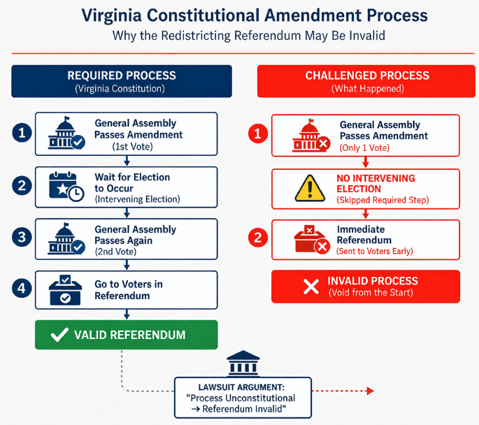
The argument relies on a January 27 ruling from the Tazewell County Circuit Court. That court declared the resolution “void ab initio,” or invalid from the start. The decision, which Democrats immediately appealed, set the stage for the current legal fight.
Virginia Supreme Court Allows Vote to Proceed
The Virginia Supreme Court has allowed the April referendum to proceed despite the pending lawsuit. The decision separates the election from the legal challenge, permitting voters to cast ballots while the referendum's legitimacy remains in question. The court has not dismissed the case. It will rule on the lawsuit’s merits only after the election concludes.
This unusual timeline creates significant uncertainty. Voters could approve the amendment, only to see it nullified by a court ruling later. That outcome would likely trigger a protracted legal battle over any new congressional map, complicating strategic planning for campaigns preparing for the 2026 midterm elections. Parties may now have to prepare for multiple map scenarios as the legal fight continues.
Timing Disputes and Early Voting Concerns
Beyond the constitutional argument, the lawsuit also challenges the timing of the referendum and the administration of early voting. Early voting began on March 6, but the complaint argues that the state constitution requires a 90-day waiting period between final legislative approval of a constitutional amendment and the start of voting. Under that interpretation, voting should not begin until April 16.
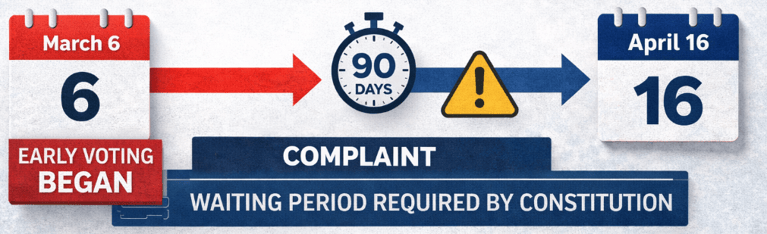
If the court ultimately agrees with this interpretation, the lawsuit argues, the early voting period could be ruled invalid. Election administrators have rejected that claim and proceeded with the vote, but the dispute adds another layer of legal risk to an already contentious referendum.
Ballot Language and Accusations of Partisanship
The lawsuit’s sharpest attack targets the ballot language itself, which asks voters if they support a constitutional amendment to “restore fairness.” The complaint argues this word is deceptive, masking a partisan effort to dismantle Virginia’s independent redistricting commission and hand map-drawing power to the Democratic-controlled General Assembly.
This dispute over the word “fairness” has defined the public conflict. A WSET report captured voter skepticism, with one resident, Karen Tanphill, asking, “Fairness for who? It’s not fair for Republicans.” Another voter acknowledged the proposed map might not be fair to Virginia, but could “restore fairness nationally” by fighting back against Republican gerrymandering in other states.
That sentiment captures the core of the Democratic defense: that their actions are a necessary response in a national political war. As one Democratic voter told reporters, “I think it’s fair because I think the red states are not playing fair, and so therefore, you know, we've got to do what they're doing.” The lawsuit claims that the simple language on the ballot hides a complicated "fight fire with fire" scenario for voters.
The Stakes for Virginia’s Congressional Map
The referendum's impact would be substantial. Virginia’s current congressional delegation is split between six Democrats and five Republicans, a competitive balance that makes the state a national bellwether. According to the Virginia Political Newsletter, the map proposal discussed by Democratic leaders would dismantle this balance, creating a congressional map with a staggering 10–1 Democratic advantage.
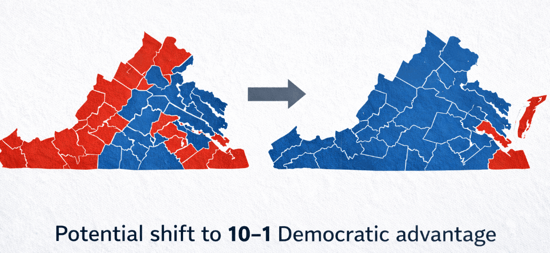
Such a change would represent one of the most significant mid-decade map shifts in Virginia’s modern history and could reshape the state's role in the national landscape. With control of the U.S. House often hinging on a few seats, both parties view map-drawing as a critical tool in the battle for a majority.
Democratic leaders argue this push is a necessary response to similar redistricting efforts in Republican-controlled states. In a joint letter published in the Virginia Political Newsletter, the state’s Democratic members of Congress defended the plan as a countermeasure.
“This is not business as usual,” they wrote. “Mid-decade redistricting at the direction of a president is unprecedented in modern American politics... Doing nothing is not neutrality. It is surrendering the voice of Virginians to decisions made elsewhere.”
Republicans and other opponents, however, frame the effort as a partisan power grab. They argue it is an attempt to override Virginia’s existing redistricting framework simply to engineer a favorable outcome through legislative control.
The Independent Commission: A Reform Under Fire
The current legal battle is not just about a single map; it is also a referendum on the independent redistricting commission that Virginia voters approved by a wide margin in 2020. That commission, composed of eight legislators and eight citizens, was created through a constitutional amendment specifically to end partisan gerrymandering, where the party in power draws maps to protect their own incumbents.
The reform was hailed as a bipartisan victory for good governance, promising to take the map-drawing process out of the hands of self-interested politicians. However, in its first test following the 2020 census, the commission deadlocked and failed to produce new congressional or legislative maps. The political appointees, split evenly between Democrats and Republicans, could not reach a consensus.
They argue that because the commission failed once, returning power to the General Assembly is a more direct and accountable method. Opponents claim the effort aims to reverse a voter-approved reform that worked as intended by stopping either party from controlling the process.
Wrap Up
The lawsuit challenging Virginia’s redistricting referendum has transformed a contentious political debate into a complex legal battle. With the state Supreme Court allowing the April election to proceed while the legal challenge looms, the state is heading to the polls under a cloud of profound uncertainty. This case now illustrates how high-stakes political fights are increasingly waged in courtrooms as well as at the ballot box.
The two potential outcomes carry dramatic consequences. If the referendum passes and the courts uphold it, Virginia will enter the 2026 midterms with a congressional map that could lock in a nearly insurmountable Democratic majority for a decade. Such a shift would radically alter candidate recruitment, campaign spending, and party strategy within the state. If the courts strike down the amendment, the existing competitive map will remain, preserving the state’s role as a national battleground.
Either result will ripple far beyond Virginia, impacting the tight struggle for control of the U.S. House. For this reason, political strategists in both parties are monitoring the situation closely as a model for future disputes in other states. The fight over Virginia’s districts makes one thing clear: in modern American politics, the rules that govern elections are now contested just as fiercely as the elections themselves.