

Governor Spanberger's early term, marked by a redistricting referendum and a data center budget fight, sparked a power struggle that will define Virginia's 2026 political landscape.
What to Know
- A new Roanoke College poll shows Virginians are split on a controversial redistricting referendum, with 52% favoring the current system and 44% supporting a temporary change.
- Gov. Abigail Spanberger begins her term with a 53% approval rating, giving her early political capital as major legislative fights emerge.
- A battle between the state Senate and House centers on a data center tax exemption worth more than $1 billion.
- The proposed congressional map could shift Virginia’s 11-seat delegation from a 6-5 split to a 10-1 Democratic advantage.
- The April 21 referendum will determine whether lawmakers gain temporary authority to redraw congressional maps before the 2030 census.
Governor Abigail Spanberger entered office in January with momentum and a unified Democratic government in Richmond. Early polling gives her an approval rating of 53%, a strong starting position for a first-term governor confronting multiple high-profile policy battles.

Governor Abigail Spanberger; image via website
Within weeks of taking office, however, two issues have converged to test the new administration’s political strength. The first is a statewide referendum that could dramatically reshape Virginia’s congressional districts ahead of the 2026 midterm elections. The second is a high-stakes budget dispute over tax incentives for the state’s rapidly expanding data center industry.
Taken together, these two conflicts represent more than routine policy debates. They are structural decisions that will shape political power, economic priorities, and congressional representation for the remainder of the decade.
The Redistricting Referendum: Control of the Map
Virginia voters will begin early voting Friday on a statewide redistricting referendum, with the final vote scheduled for April 21. The measure would amend the state constitution to temporarily allow the General Assembly to adopt new congressional districts before the 2030 census.
The referendum follows a series of legal challenges from Republicans, who filed 5 lawsuits targeting the legislative process and the ballot language. One lower court initially ruled the legislature’s first vote advancing the amendment was invalid, while another court ordered election officials in Tazewell County to halt preparations. The Virginia Supreme Court intervened twice and ruled the referendum must appear on ballots statewide. The court determined the lower court order blocking the vote went too far, allowing election officials to proceed with the statewide referendum.
|
Category |
Current Status / Status Quo Support |
Proposed Change / Amendment Support |
|
U.S. House Delegation |
11 members (6 Democrats, 5 Republicans) |
11 members (10 Democrats, 1 Republican) |
|
Campaign Spending |
~$300,000 (Opposing amendment) |
>$20,000,000 (Supporting amendment) |
|
Voter Polling (Feb 2025) |
52% (Prefer current system) |
44% (Support change) |
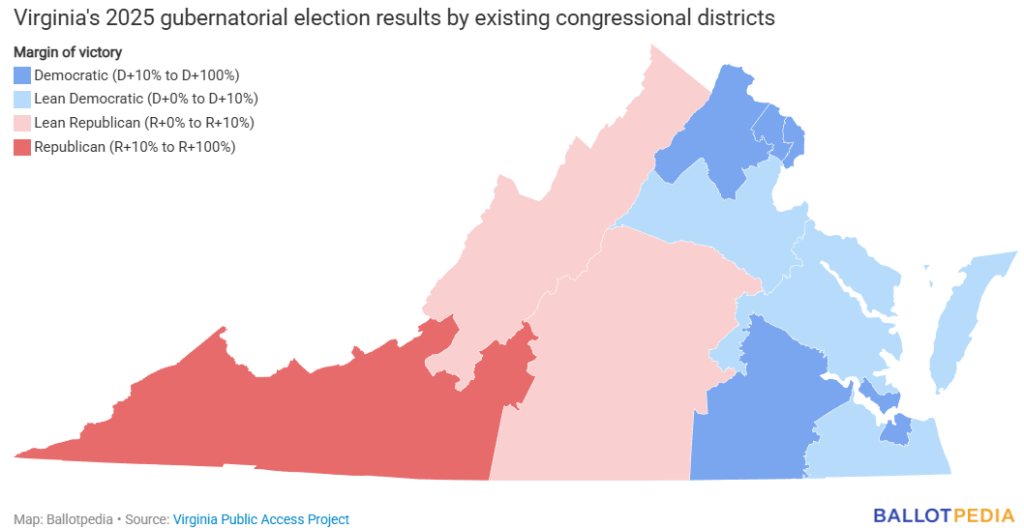
Virginia currently sends 11 members to the U.S. House, split 6 Democrats to 5 Republicans. If voters approve the amendment, lawmakers could adopt a new map that analysts say could add 4 Democratic seats, shifting the delegation toward a 10-1 Democratic advantage ahead of the 2026 midterms. The referendum is part of a broader national redistricting fight. Democrats argue the change is necessary to counter mid-decade Republican map changes in states such as Texas, Missouri, and North Carolina.

Screenshot of map from Ballotpedia
Campaign spending reflects the stakes. Democratic-aligned groups have invested more than $20 million supporting the amendment, while Republican-aligned groups have raised about $300,000 opposing it. Polling suggests voters remain divided. A February Roanoke College survey found 62% of Virginians support the bipartisan redistricting system adopted in 2020. When asked about the referendum, 52% said they would keep the current system while 44% supported the proposed change.
Messaging and Ballot Language
Campaign messaging around the referendum reflects the political sensitivity of the issue. Supporters of the measure describe it as a corrective step designed to “restore fairness” in congressional elections. The official ballot language frames the amendment as a temporary adjustment to protect electoral balance during the current decade. Opponents argue the referendum undermines the bipartisan commission approved by voters only a few years earlier.
The wording of the ballot question itself may prove decisive. Polling questions that mention potential partisan outcomes show lower support for the proposal. When framed without partisan details, the measure appears more competitive. Spending on the campaign also highlights the stakes. Democratic-aligned groups have already invested more than $20 million supporting the referendum, signaling that national organizations view Virginia as a critical battleground for congressional control.
National Figures Enter the Debate
Virginia’s senior political leadership has also taken public positions on the referendum. U.S. Senators Tim Kaine and Mark Warner have endorsed the amendment, describing it as a necessary step in response to redistricting strategies emerging in other states.
Their argument reflects a broader national context. State legislatures across the country are increasingly engaged in legal and political fights over congressional maps. Court decisions and legislative changes are shaping how districts are drawn ahead of the next census cycle.
Legal disputes over district boundaries are already becoming central to the next decade of elections, with courts expected to play a major role in determining which maps survive challenges. For Virginia, the referendum represents an early test of how aggressively the state’s leadership is willing to engage in that national contest
The Data Center Economy
While the redistricting referendum captures headlines, another major policy fight is unfolding within Virginia’s state budget negotiations. Northern Virginia has become the global epicenter of the data center industry. Massive server farms supporting cloud computing, artificial intelligence, and digital infrastructure cluster across the region.
Industry growth has been fueled in part by a sales and use tax exemption for data center equipment, an incentive designed to attract investment and jobs. The financial scale of that exemption has become a major point of contention in Richmond. Virginia’s Senate leadership has proposed eliminating the tax break, arguing the state would gain more than $1 billion in additional revenue over time. That funding could be redirected toward tax rebates, infrastructure projects, and public services.
Supporters of the proposal argue the data center sector has matured and no longer requires large subsidies. Critics warn the move could undermine Virginia’s competitive advantage in an industry that generates thousands of construction jobs and billions in economic activity.
Senate vs. House: A Democratic Divide
The disagreement over data center policy has exposed a significant divide inside Virginia’s Democratic majority. The state Senate, led by Finance and Appropriations Chair Louise Lucas, favors eliminating the tax exemption to generate new revenue streams. The House of Delegates has taken a different position, choosing to preserve the tax incentive in its version of the state budget.

Finance and Appropriations Chair Louise Lucas; official image
This disagreement creates a high-stakes negotiation between the two chambers. Labor unions, technology companies, and local governments have all entered the debate. Some construction unions support maintaining the incentive, arguing that data center projects sustain high-paying skilled labor jobs.
Environmental advocates and fiscal reform groups counter that the industry places heavy demands on Virginia’s electrical grid and infrastructure, costs they argue should be reflected in tax policy. Ultimately, the final decision will likely land on Governor Spanberger’s desk, placing the new administration at the center of a billion-dollar policy choice.
Economic Stakes and Energy Demand
Data centers are not simply an economic development issue. They also represent one of the fastest-growing sources of electricity demand in the United States. Large server facilities operate around the clock, consuming enormous amounts of power to support digital services. Northern Virginia’s concentration of these facilities has raised questions about long-term energy capacity and infrastructure planning.

Some policymakers argue that ending tax incentives could slow development and reduce strain on the electrical grid. Others warn that discouraging investment could push future projects to competing states. This debate highlights a broader question facing technology-driven economies: how to balance economic growth with infrastructure sustainability.
Strategic Implications for 2026
The redistricting referendum and the data center tax fight matter for the same reason: both decisions determine where political power and economic influence will sit in Virginia over the next decade. If the April 21 referendum passes, lawmakers could redraw congressional districts before the 2030 census. Virginia’s current 11-seat delegation is split 6–5 between Democrats and Republicans. A new map could add as many as 4 Democratic seats, shifting the balance toward a 10–1 advantage.

That change would immediately affect the national fight for control of the U.S. House in 2026. In recent cycles, the House majority has been decided by only a handful of seats. A four-seat shift from a single state would give Democrats a structural advantage in future midterm elections. The controversy surrounding the state's data center tax exemption, which is valued at over a billion dollars, represents a struggle for economic influence.
Northern Virginia hosts the largest concentration of data centers in the world. Whether the state continues offering major tax incentives or redirects that revenue will signal how Virginia plans to balance economic growth, infrastructure demands, and taxpayer priorities. Together, these two issues answer a central question facing the new administration: who controls Virginia’s political map and who benefits from its fastest-growing industry.
Wrap Up
Governor Spanberger’s early months in office have quickly evolved into a defining test of leadership. With an approval rating of 53%, she begins her tenure with a solid foundation of public support. Yet the decisions unfolding now will shape both her administration and Virginia’s political structure for the rest of the decade.
The redistricting referendum scheduled for April 21 will determine who controls the congressional map ahead of the 2026 midterm elections. At the same time, the dispute over a tax exemption worth more than $1 billion will reveal how the state intends to manage its booming technology sector.
These debates are about more than policy details. They represent the intersection of political power, economic strategy, and electoral control. How Virginia resolves them will define the next chapter of its political landscape and signal where the balance of power may lie as the nation moves toward the 2030 census and the next era of congressional redistricting.

.png)