


Abigail Spanberger won the Virginia governor’s race with a disciplined, economic message that turned Trump’s federal workforce cuts into a liability for Republicans.
What to Know
- Abigail Spanberger defeated Winsome Earle Sears and will become Virginia’s first woman governor.
- Her campaign centered on federal job losses, rising costs, and the economic fallout from Trump-era policies.
- Trump endorsed Earle Sears but invested little support or visibility in the race.
- Democrats swept all statewide offices in Virginia.
- Spanberger’s strategy provides a replicable model for 2026 races focused on economic stability rather than culture-war battles.
Virginia delivered Democrats a decisive win at a time when the national party is under intense pressure to rebuild after setbacks during Trump’s second term. Abigail Spanberger, a former CIA officer and three-term congresswoman, won the governor’s race by a comfortable margin. The Associated Press called the race shortly after polls closed, confirming what internal Democratic polling had projected for weeks. Spanberger will be the first woman to govern Virginia, and her victory breaks a 74-man streak that dates back to the founding era.

Spanberger did not spend the campaign talking about historic firsts. She focused on the economic consequences of Trump’s reorganization of the federal workforce, the government shutdown, and the disruptions that federal families felt throughout the Washington region.
For Virginians who rely on federal jobs and contracting work, these issues were not distant national debates. They were household problems affecting income and stability. The campaign built its message around that reality and rarely veered off course.
An Economic Campaign in a Polarized State
Spanberger ran a methodical campaign built around cost of living, public sector employment, and stability. At nearly every event, she highlighted the layoffs and furloughs triggered by the Trump administration’s efforts to shrink the federal workforce. She reminded audiences that Virginia is home to tens of thousands of federal workers who live in communities from Fairfax to Hampton Roads. The argument was straightforward. Economic policy decisions in Washington do not stay in Washington. They show up in lost wages, delayed paychecks, and local economic strain.
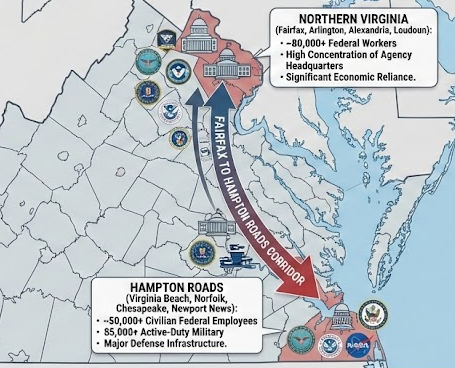
Her general election strategy avoided the temptation to turn the race into a referendum on Trump’s personality. She spoke instead about the consequences of Trump-era choices. When she addressed a crowd in Norfolk alongside former President Obama, she committed to defending Virginia workers from what she described as careless policy shifts in the capital. Those remarks echoed throughout the campaign and became the backbone of her closing argument.
Republicans attempted to run a Youngkin-style culture-war strategy, but the environment was different from 2021. Earle Sears focused heavily on transgender policies, parental rights rhetoric, and school culture fights. Spanberger largely refused to engage. By keeping attention on jobs, costs, energy prices, and the effects of federal policy upheaval, she pulled the conversation back to ground where she had a clear advantage.
A Broader Coalition Than Expected
Spanberger’s largest margins came from Northern Virginia, Richmond, and the urban crescent, but the campaign also showed signs of renewed Democratic competitiveness in parts of rural and exurban Virginia. Early analyses suggest she reduced Republican margins in several rural counties that have been trending heavily red for over a decade.
|
Area / Precinct Type |
Locality Example |
Spanberger Retention Rate (of Harris '24 Vote) |
Earle-Sears Retention Rate (of Trump '24 Vote) |
Retention Rate Difference (Spanberger Lead) |
|
Statewide |
Virginia |
83.20% |
69.30% |
13.9 pts |
|
Affluent / White-Collar |
South Roanoke Precinct (Roanoke) |
84.10% |
83.70% |
0.4 pts |
|
Affluent / White-Collar |
Crystal Spring Precinct (Roanoke) |
76.60% |
72.70% |
3.9 pts |
|
Affluent / White-Collar |
Deyerle Precinct (Roanoke) |
88.30% |
81.90% |
6.4 pts |
|
Well-to-Do Suburb |
Goochland County |
92.60% |
83.90% |
8.7 pts |
|
Working-Class / White |
East Gate Precinct (Roanoke) |
84.40% |
65.10% |
19.3 pts |
|
Working-Class / White |
Garden City Precinct (Roanoke) |
79.00% |
58.80% |
20.2 pts |
|
Working-Class / White |
Preston Park Precinct (Roanoke) |
80.30% |
58.70% |
21.6 pts |
|
Working-Class / White |
Southeast Precinct (Roanoke) |
77.90% |
54.40% |
23.5 pts |
|
Working-Class / Black |
Eureka Park Precinct (Roanoke) |
76.00% |
60.50% |
15.5 pts |
|
Working-Class / Black |
Forest Park Precinct (Roanoke) |
73.30% |
50.60% |
22.7 pts |
|
Rural / Generally Working-Class |
Buchanan County |
71.20% |
53.40% |
17.8 pts |
Her biography as a former intelligence officer and federal agent likely played a role in reaching voters who may be skeptical of national Democrats but are responsive to security-oriented messaging.
Her coalition also included Latino voters concerned about immigration enforcement practices and African American voters who remained energized by Obama’s presence in the race’s final days. Spanberger held events in multiple languages, including Spanish, and presented herself as a pragmatic law-and-order Democrat who opposed fear-based policies. These choices strengthened her appeal in communities that felt threatened by Trump’s immigration crackdowns.
Republicans Could Not Recreate the Youngkin Playbook
Winsome Earle Sears struggled to bridge the gap between Trump loyalists and suburban professionals. She tried to capture the tone of Glenn Youngkin’s 2021 campaign but did not offer an economic message strong enough to counter Spanberger’s focus on federal employment and rising costs.
Trump did not invest time or resources in her race, a sign that national Republicans did not expect to win the contest. His tepid support left her trapped between a hard-right base and a suburban electorate that has moved steadily away from the GOP during his presidency.
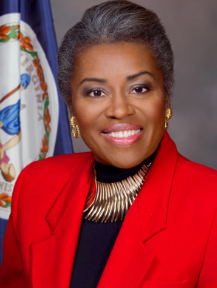
Lieutenant Governor of Virginia Winsome Earl Sears
The Republican ticket also carried the burden of a high-profile scandal involving the Democratic attorney general nominee, yet even that storyline could not slow Spanberger’s lead. Her campaign’s discipline, fundraising strength, and early organization made it difficult for Republicans to identify a credible path to victory.
Wrap Up
Spanberger’s win gives Democrats an actionable model heading into the 2026 midterms. Instead of relying on broad arguments about institutional stability or democracy, she centered her campaign on the specific economic consequences of Trump’s decisions. That approach allowed her to speak to independent voters, suburban moderates, and even some traditionally conservative households that experienced direct economic harm from federal workforce reductions.
Democrats looking to compete in governorships and congressional races across Pennsylvania, Michigan, Arizona, and Nevada are already studying Virginia. The argument is less about ideological contrast and more about stability, competence, and direct economic harm under Trump. Virginia demonstrates that Democrats can regain ground in competitive states when they ground their message in jobs, wages, and steady governance rather than partisan confrontation.
For Republicans, the race raises questions about the long-term viability of culture-first strategies in states with large federal populations or growing suburban blocs. If the GOP cannot offer a compelling economic counterargument, especially when tied to Trump’s record, it risks underperforming in states where economic stability is closely tied to federal employment and contracting.
Spanberger will take office in January with a clear mandate to counteract federal disruptions and protect Virginia’s workforce. Her governing agenda will signal whether Democrats can sustain this coalition beyond one cycle. For now, the message is unmistakable. A disciplined economic campaign can beat a Trump-aligned candidate in a polarized environment, and that fact will shape strategic decisions across the country as 2026 approaches.
.png)

.jpg)