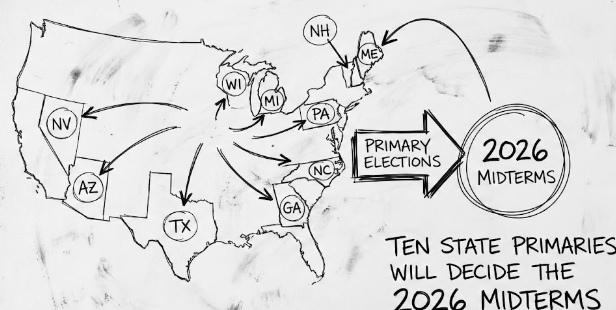

New data reveals the 2026 midterm elections will be won or lost not in November, but in the distinct and demanding primaries of ten key states.
What to Know
- The 2026 midterms are already being shaped by distinct primary electorates across key states, including AZ, GA, MI, PA, TX, and others.
- Voter priorities vary sharply by state, from immigration in Arizona to abortion rights and climate in New Hampshire.
- Candidate character matters, with integrity emphasized in Maine and North Carolina, and “common sense” prized in Michigan and Arizona.
- Threat perceptions are localized, ranging from progressive liberals or Biden in GOP primaries to Trump, extremism, or environmental risks elsewhere.
- Candidates who clear ideologically rigid primaries often face constraints in appealing to general-election moderates.
- In this fragmented environment, local media and personal networks frequently outweigh national messaging.
The 2026 midterm elections may seem distant, but the battlefield is already being defined. The lines are being drawn not by party strategists in Washington D.C., but by primary voters in ten high-impact states.
A new report from Resonate, “Winning Over Voters in 10 High-Impact Primary States,” reveals that ideologically unique primary electorates in Arizona, Georgia, Iowa, Maine, Michigan, New Hampshire, North Carolina, Ohio, Pennsylvania, and Texas are forcing candidates to adopt firm and often inflexible positions long before the general election.
With crowded primaries for open seats and fierce challenges to incumbents creating a volatile environment, the candidates who survive will be those who master the specific demands of their state’s primary voters. This process comes with a significant risk because it can lock candidates into niche messages, limiting their appeal in the general election and ultimately determining control of Congress and key governorships.
A Patchwork of Priorities
Forget a single, national playbook. The road to power in 2026 is a state-by-state gauntlet where the cost of entry is paid in ideological purity. The Resonate data reveals a political landscape so fractured that a winning message in one primary is poison in another. Candidates are being forced to choose a side long before the general election even begins, and voters are drawing hard lines in the sand.
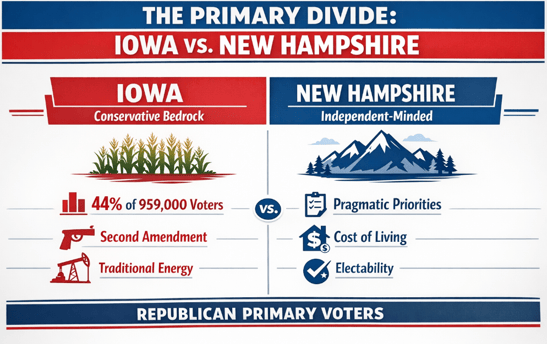
The journey from Iowa to New Hampshire illustrates this divide. In the Hawkeye State, where 44% of the 959,000 key primary voters lean Republican, the conversation is dominated by conservative bedrock issues.
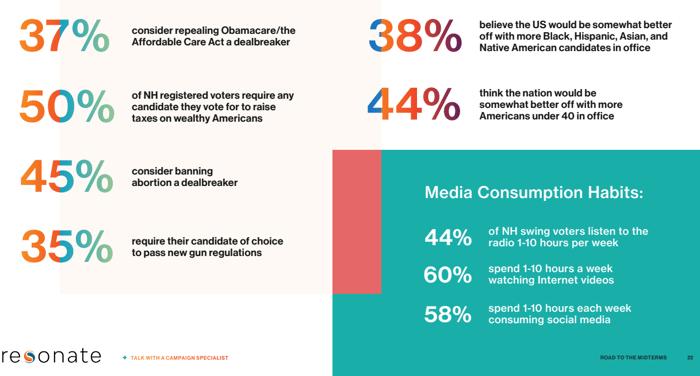
New Hampshire stats; Resonate
A candidate for office doesn’t just need a firm handshake; they need a firm stance on the Second Amendment and a promise to protect traditional energy. As the Resonate report highlights, the demand is specific and unyielding:
“In Iowa, 31% of registered primary voters require any candidate they vote for to agree to increase fossil fuel production or new oil/gas pipelines.” – Resonate – Top 10 Primaries to Watch
Travel east to the granite hills of New Hampshire, and the political universe flips. Here, primary swing voters lean Democratic, and their demands are a mirror image of Iowa's.
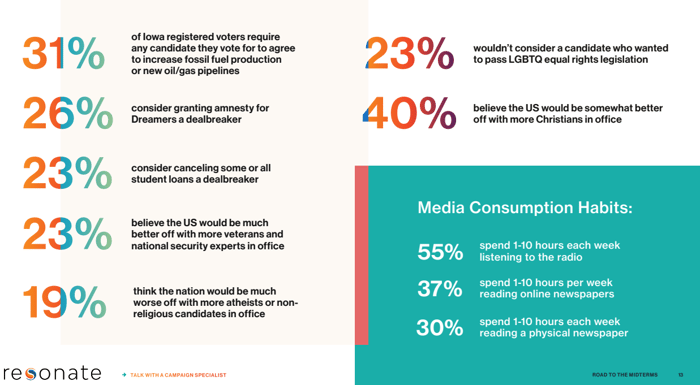
Iowa stats; Resonate
The focus shifts from oil fields to climate change and from gun rights to abortion access. To even get in the door with these voters, a candidate must be prepared to take a very different pledge on economic fairness.
“In New Hampshire, 50% of registered voters require any candidate they vote for to raise taxes on wealthy Americans.” – Resonate – Top 10 Primaries to Watch
This dynamic creates a series of non-negotiable litmus tests across the map. These are not mere preferences; they are dealbreakers that can end a campaign before it starts. A candidate trying to build a broad coalition is immediately confronted with stark, binary choices. In Georgia, a critical swing state where the margins are razor-thin, abortion remains a powerful dividing line that defines the choice for nearly half the electorate.
“43% of primary swing voters in Georgia consider banning abortion a dealbreaker for a candidate.” – Resonate – Top 10 Primaries to Watch
Meanwhile, in the key battlegrounds of Arizona and Ohio, the crisis at the border is the dominant issue, a concern that cuts through all other noise and unites a majority of the primary electorate. These mandates act as an ideological filter, weeding out anyone attempting nuance.
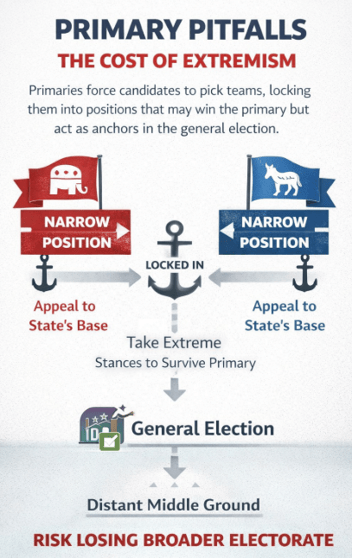
They force candidates to pick a team, locking them into positions that may win a primary but prove to be an anchor in the general election. The price of survival is to become a specialist in a state's anxieties, a master of its specific demands, leaving the broad middle ground of November a distant and often unreachable shore.
Character and Threats Frame the Choice
Policy positions matter in theory, but primary voters rarely treat them as binding commitments. Across competitive states, Resonate’s report shows that voters first decide whether a candidate seems credible, grounded, and worth listening to. Only after that do they weigh policy specifics. In primaries, trust acts as the entry fee. Candidates who fail that test do not get a second look.
In Maine and North Carolina, swing voters show a clear preference for candidates they believe are honest and personally reliable. This is not about idealism. It reflects fatigue with political messaging and skepticism toward campaign promises. In Maine, where a strong majority of swing voters say honesty and integrity make them more likely to support a candidate, trust acts as a basic filter. If voters do not believe a candidate is straightforward, policy details rarely matter.
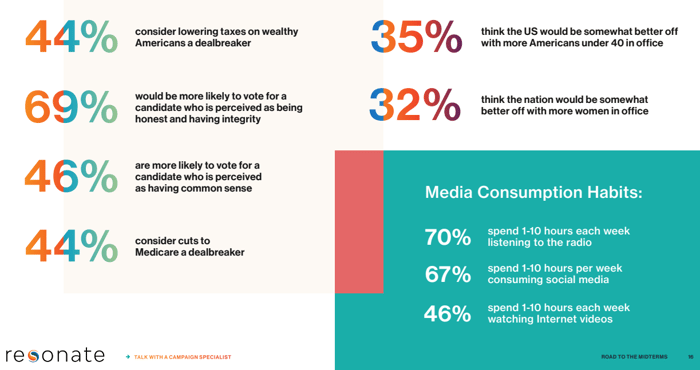
Maine stats; Resonate
It reflects fatigue with political messaging and skepticism toward campaign promises. Voters want signals that a candidate will act predictably and transparently once in office.
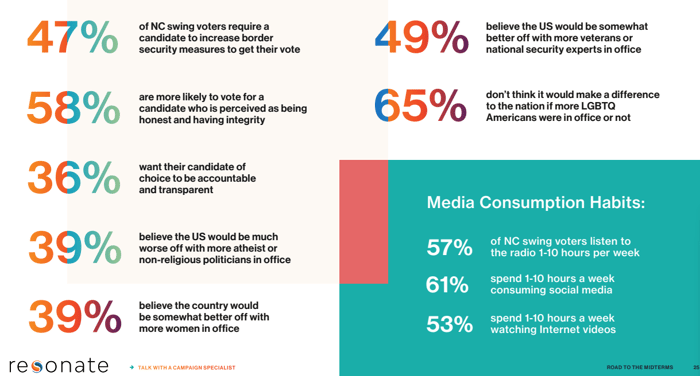
North Carolnia stats; Resonate
North Carolina’s data reinforces this dynamic while adding nuance. A majority of swing voters prioritize honesty and integrity, and more than a third explicitly want their candidate to be accountable and transparent. These voters are looking for clarity and follow-through, not rhetorical alignment. Integrity becomes a proxy for competence and restraint, signaling how a candidate is likely to govern once in office rather than what they promise during the campaign.
In Michigan and Arizona, voters emphasize what they describe as common sense. This preference reflects frustration with ideological rigidity, performative politics, and candidates who appear to speak primarily to national activists rather than local voters.
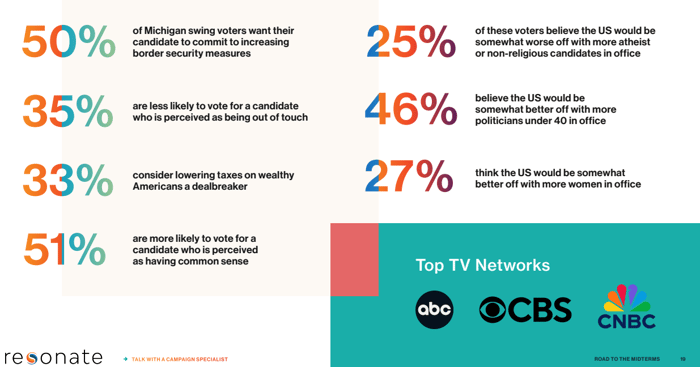
Michigan stats; Resonate
Common sense, in this context, means sounding practical, avoiding extreme rhetoric, and demonstrating familiarity with everyday concerns. Voters are not demanding moderation as an ideology. They are demanding it as a governing style.
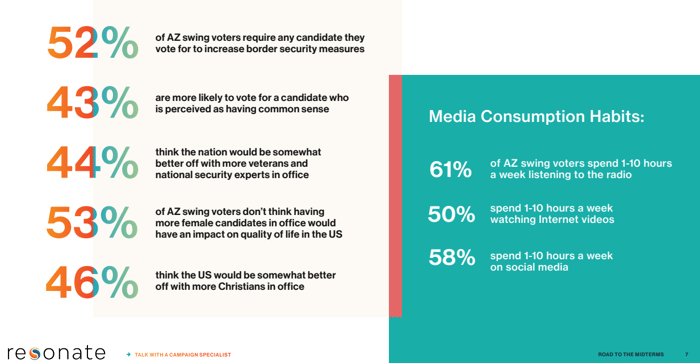
Arizona stats; Resonate
For campaigns, persuasion starts before policy is discussed. Voters judge candidates on biography, tone, and credibility, and those who sound scripted or overly ideological often fail to connect even when their policies align with voter preferences. Many primary voters are also motivated more by opposition than by advancing an agenda, voting to block figures or movements they see as threatening.
Republican primaries in states like Iowa, Texas, and Pennsylvania tend to frame races around resistance to national Democrats, while Democratic primaries in Georgia and Maine center on opposition to Donald Trump. North Carolina stands out for its broader mix of concerns, which forces candidates to respond to multiple anxieties rather than focus on a single target.
How Early Messaging Can Win a Battle but Lose the War
The tactics that help candidates survive a bruising primary often become liabilities in a general election. The primary process rewards ideological clarity and aggressive messaging, not flexibility or broad appeal. In crowded races, especially in states like Ohio or Texas, candidates advance by catering to highly motivated partisan voters who dominate turnout.
A Republican candidate in Ohio, for example, might win a primary by aligning closely with former President Trump. That strategy can secure a nomination, but it leaves little room to pivot for the general election. To win in November, a candidate must appeal to the state's 1.1 million non-presidential primary swing voters, a group with a unique political profile.
- 50% of these voters align with Independent platforms, while only 25% align with the Republican Party.
- 47% require a candidate to agree to increase border security measures.
- 45% consider cuts to Social Security a dealbreaker.
- They also prioritize developing alternative energy and improving prescription drug access.
A candidate who ignores these complexities in favor of a rigid, base-focused message will struggle. What reads as conviction in a primary can look extreme in a general election.
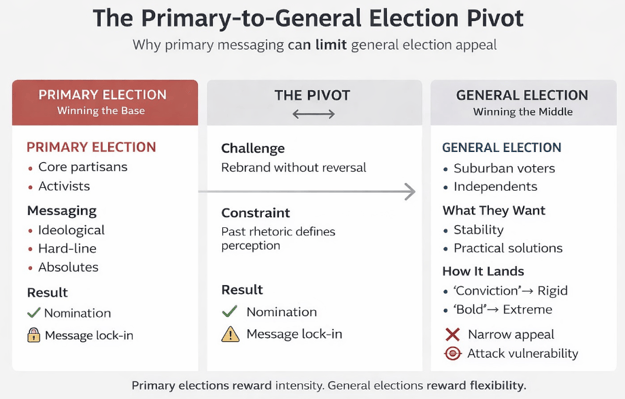
The same dynamic applies on the Democratic side. In New Hampshire, a candidate who wins by emphasizing higher taxes on the wealthy and aggressive climate policies may struggle to reposition themselves for a broader electorate. Those positions, effective in a primary, give opponents an easy way to frame the candidate as out of step with everyday voters.
This tension is strongest in open-seat races, where crowded fields push candidates to adopt sharper positions simply to stand out. The primary rewards those who run hardest to the base. The general election rewards those who can reach the middle. Too often, the candidate best suited to win the first contest is the least prepared for the second.
Navigating a Fractured Information Landscape
Campaigns also face the immense challenge of reaching these distinct voter segments through an increasingly fragmented media landscape. While televised debates remain a consistently influential source of information across almost every key state, the day-to-day media consumption habits of primary voters vary significantly, demanding a localized communications strategy. Banking on a single national cable news appearance is a recipe for failure.
Radio, for example, remains a surprisingly powerful tool. A majority of swing voters in key states report listening for 1 to 10 hours per week, making local talk radio and news broadcasts a critical channel. This includes:
- 70% of swing voters in Maine
- 61% in Arizona
- 57% in North Carolina
- 55% in Iowa
Cable news is still influential, but its power is specific and partisan. FOX News is a top network for swing voters in Ohio, Pennsylvania, and Texas, while in Michigan and Georgia, mainstream networks like ABC and CBS hold more sway. In Pennsylvania, for example, "cable news/programming" is a major source of election information, but in Michigan, it doesn't even make the top three.
Perhaps most importantly, the data reveals that personal connections and trusted sources matter immensely. In several key states, voters list their social circles and intuition as top influences, often ranking them higher than traditional media.
- In Arizona, Michigan, and Ohio, "friends/family" is a major source of election information.
- In North Carolina and Texas, a voter's own "gut instinct" is one of the most influential factors in their decision-making.
Genuine community trust and grassroots organizing remain crucially important. It suggests that the most effective campaign messages are those reinforced by a voter's own social network, not just beamed in from a national studio. For campaigns, investing in a strong field organization is not an option but a necessity.
Wrap Up
The key takeaway from the Resonate report is that the 2026 midterms will not be a single national election. Instead, they will be a series of ten distinct, state-level contests that will set the terms of the national debate. The candidates who emerge from these primaries will have been molded by the specific issue priorities, character tests, and perceived threats of a demanding electorate. This grueling process will create a slate of general election candidates who are less flexible and more ideologically defined than ever before, setting the stage for a series of stark, high-stakes choices for voters in November.
For party strategists, this means a one-size-fits-all national message is doomed to fail. Victory in 2026 will depend on recruiting the right candidates for each unique state and empowering them to navigate the complexities of their specific primaries. The party that best understands and adapts to the unique political terrain of these ten critical states will be the one best positioned to control the House, Senate, and key statehouses for years to come. The road to 2026 is being paved now, one primary voter at a time.

-Aug-01-2026-11-56-55-1279-AM.jpg)