
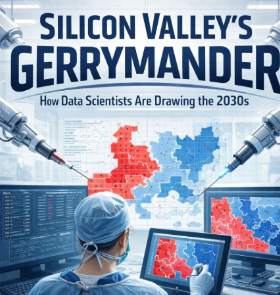

The battle for Congress is no longer about votes; it's about the code that draws the lines.
What to Know
- Redistricting is now done with sophisticated software, not paper maps.
- Voter registration, election results, and consumer data are used to predict household voting behavior.
- Artificial intelligence generates millions of potential maps to find the one that mathematically maximizes partisan advantage.
- This technology is also used by reform groups to design fair maps and legally challenge biased ones.
- The high cost of this technology creates an imbalance favoring better-funded parties.
The image of political bosses in a smoke-filled room is a relic; today’s maps are drawn by data scientists in the sterile glow of a server farm. The manual craft of gerrymandering is now a high-tech science, driven by a relentless technological arms race between the parties. What was once a political art has become a cold, mathematical process of securing power.
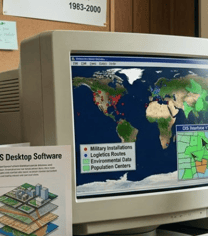
The first major leap in this arms race came with Geographic Information System (GIS) software, which, as Tracy Horgan and Stewart Berry of Caliper note, revolutionized the field. Platforms like their Maptitude software replaced hours of manual work with the click of a mouse. This shift dramatically increased the speed and precision with which maps could be drawn.
With this new power, map-drawers could instantly see the political DNA of any potential district, from racial makeup to past voting performance. What was once guesswork became simple data visualization, allowing for a level of partisan fine-tuning previously thought impossible. This was the first step in turning redistricting from a blunt instrument into a surgeon's scalpel.
The Fuel f0or the Fire: The Granular Data Explosion
If GIS software is the engine of the modern gerrymander, then data is its rocket fuel. The census provides the basic chassis, but the real power comes from fusing population counts with a vast universe of other information. This is where the political battlefield moves from geography to data science.
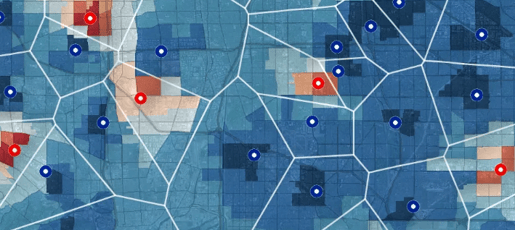
Screenshot from Maptitude
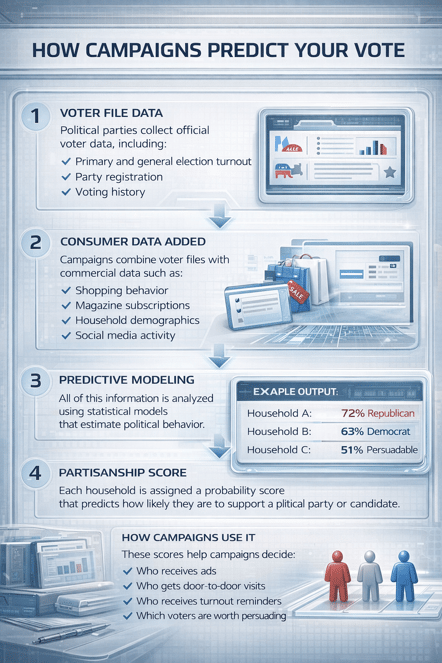
Party committees have spent billions building voter files containing your entire political history, from primary turnout to party registration. This is then layered with commercial data: your magazine subscriptions, your shopping habits, and your social media activity. All of this is fed into a predictive model that assigns your household a "partisanship score," a stark percentage probability of how you will vote.
This granularity is the key to the surgical precision of the modern gerrymander. Map-drawers are no longer just packing demographics; they are cracking a suburban cul-de-sac down the middle of the street to isolate specific households. This micro-targeting allows partisans to waste as few of their own voters as possible, creating seemingly fair districts that are, in reality, engineered for a decade of dominance.
The Ultimate Weapon: AI and the Age of Infinite Gerrymanders
The latest and most powerful escalation in the redistricting arms race is the introduction of artificial intelligence and machine learning. As Caliper, the maker of Maptitude, notes, these technologies are "revolutionizing" the field. For partisan map-drawers, AI is the ultimate weapon.
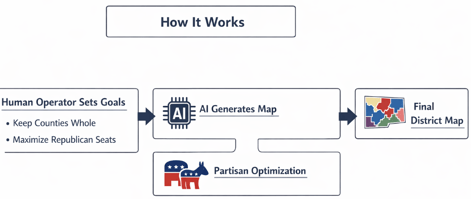
Here’s how it works: A human operator gives the AI a set of goals. These can include neutral criteria, like keeping counties whole or making districts compact. But they also include a partisan directive, such as creating the maximum possible number of Republican-leaning seats or designing a map with eight safe Democratic seats while ensuring a specific incumbent’s district becomes 2% more Democratic.
The AI quickly tests millions or billions of map configurations, a volume far beyond human capability, in minutes or hours. It runs a massive number of simulations to find the maps that best achieve the designated goals. This allows partisans to push the boundaries of their advantage to their absolute mathematical limit.

It also provides them with political cover. A legislative leader can present an incredibly biased map to the public and claim with a straight face that it was generated by a computer based on "neutral principles," conveniently omitting the partisan directive that was programmed into the algorithm.
The Black Box Battlefield
This new war isn’t just being fought with powerful weapons; it’s being fought in the dark. The algorithms and datasets used by partisan operatives are proprietary secrets, locked away in a digital "black box." When a legislative committee unveils a new map, they can claim it was drawn using "objective criteria," but there is no way for the public to verify it. Since the code is proprietary, its source is private. The exact formula for variable weighting, including how factors like "compactness" and "partisan advantage" are prioritized, is also unknown.
This intentional opacity is a core feature of the strategy. It forces opponents and courts to reverse-engineer the gerrymander. They have to prove a negative: that there is no plausible way the map could have been drawn without overwhelming partisan intent.
Lawmakers can hide behind the complexity of their own tools, feigning ignorance and blaming the machine. It creates a battlefield where one side fights with a secret weapon, and the other is forced to guess how it was built, all while the clock is ticking.
The Rise of the Quants: From Wall Street to the Beltway
The old ward boss who knew every street corner has been replaced by a different kind of political operator: the quant. Campaigns now recruit data scientists and statisticians from Silicon Valley, Wall Street, and major tech firms to design the maps that determine political power. These operatives do not think in terms of neighborhoods or communities. They work with datasets, turnout models, and voter probability scores.
To them, redistricting is not a political craft. It is a math exercise. The objective is simple: concentrate the opposition’s voters into as few districts as possible while spreading your own voters efficiently across the rest. The goal is to maximize the number of seats your party can hold with the smallest margin of wasted votes.
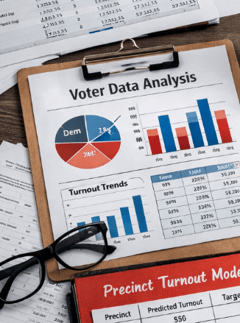
This mindset changes how maps are built. The process is no longer guided primarily by local knowledge or political instinct. It is driven by simulations, predictive modeling, and statistical optimization. Millions of potential map combinations can be tested to identify the configuration that delivers the most reliable partisan advantage for the next decade.
The result is a new class of political power brokers. These analysts rarely appear on the campaign trail or in party meetings, but their models determine the structure of political competition long before voters step into a booth. In modern redistricting, the algorithm often matters more than the candidate.
The Counter-Insurgency: Fighting Fire with Fire
The same technology that allows partisan actors to push redistricting to its limits is also being used by academics, watchdog organizations, and citizen-led commissions to challenge those maps. Using modern computing tools, analysts can generate alternative district plans built strictly on neutral standards such as compactness, equal population, and preserving communities of interest. These benchmark maps allow observers to compare what a politically neutral map would likely look like against the map produced by a legislature.
Researchers described in AI and Redistricting: Useful Tool for the Courts or Another Source of Obfuscation? note that recent advances in computing and statistical modeling now make it possible to generate large samples of legally valid district maps and analyze how they perform electorally. These simulations allow experts to examine the full range of outcomes that would occur if districts were drawn using neutral criteria rather than partisan goals.
This capability has become particularly important in court challenges. Analysts can simulate thousands of alternative district plans and measure how the legislature’s map compares to the broader distribution of possible outcomes. If the enacted map produces a partisan advantage that falls far outside the range produced by neutral simulations, it can serve as statistical evidence that the outcome was unlikely to occur without intentional manipulation. These algorithmic comparisons give courts a clearer factual record when evaluating whether a map reflects ordinary geographic patterns or deliberate partisan engineering.
In effect, the same computational power that allows political actors to optimize maps is also giving courts and watchdog groups new tools to measure when the process has gone too far. In the modern redistricting era, the battle over maps increasingly unfolds through competing datasets, simulations, and expert testimony as much as through traditional political negotiation.
Wrap Up
The battle for control in the 2030s will not just be fought on the campaign trail; it will be fought on the servers and in the software of a handful of political tech consultants. The technology of redistricting has evolved from a blunt instrument into a surgeon's scalpel, capable of carving up the electorate with terrifying precision. This arms race has created a paradox: the same technology that enables the most extreme and durable gerrymanders in history also provides the tools necessary to expose and defeat them.
The future of fair representation, therefore, does not depend on smashing the machines. It depends on who controls them and what values are programmed into their algorithms. As we head toward the next redistricting cycle, the most important question will be whether this powerful technology is used to empower voters or to entrench politicians. The outcome of that technological and ethical struggle will define the landscape of American power for a decade to come.