Establishing authentic trust with rural voters requires understanding their deep desire for cultural respect rather than simply offering material policy solutions.
What to Know
- The voting gap between rural and urban counties nationwide surged from just 2 percentage points in 1992 to 20 percentage points in 2024.
- In recent elections, Donald Trump won an overwhelming 93 % of all rural counties across the United States.
- Nearly 70 % of rural voters supported Donald Trump in the 2024 presidential election, driven by a profound feeling that urban America ignores their daily problems.
- Statistical models reveal that the 2 symbolic dimensions of rural consciousness, which are way of life and representation, positively predict conservative voting, while material resource concerns do not.
- Despite facing high poverty and unemployment, rural residents prioritize candidates who validate their cultural identity over those who promise strictly economic redistribution.
This analysis draws heavily on insights from the primary book "The Politics of Resentment" by Katherine J. Cramer. It is additionally supported by the book "White Rural Rage" by Tom Schaller and Paul Waldman, as well as peer reviewed research including "Symbolic versus material concerns of rural consciousness in the United States and "The rural-urban cleavage in US presidential elections".
The Primacy of Symbolic Recognition over Material Needs
When political strategists approach rural voters, they often assume that economic hardship is the primary driver of voting behavior. Because many rural areas suffer from job losses, population decline, and shrinking tax bases, candidates frequently attempt to win votes by promising material resources or economic revitalization programs.

Kristin Lunz Trujillo, Assistant Professor of Political Science
However, Kristin Lunz Trujillo and Zack Crowley found in the journal Political Geography that this material approach fundamentally misunderstands rural consciousness. By breaking down rural consciousness into three subdimensions, Kristin Lunz Trujillo and Zack Crowley tested whether a lack of resources, a lack of representation, or a perceived disrespect for the rural way of life best predicted political behavior.
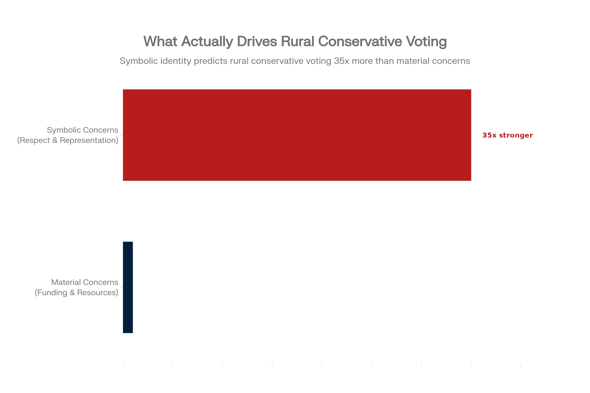
Symbolic respect drives votes 35x more. created by campaign now with gemini , data from Symbolic versus material concerns
Their findings are striking. Kristin Lunz Trujillo and Zack Crowley discovered that the material subdimension, which measures concerns over government funding and tangible resources, does not significantly predict support for anti establishment conservative candidates. Instead, the two symbolic subdimensions, which measure feelings of political underrepresentation and the belief that urbanites disrespect rural lifestyles, serve as massive predictors of conservative voting. Voters who feel their way of life is disrespected are vastly more likely to support candidates who promise cultural validation over those who promise economic redistribution.
"What the rural voters I observed wanted in their politicians are people who understand and respect the way rural folks live and their daily concerns and desires." — Katherine J. Cramer, The Politics of Resentment
This means that when candidates visit rural communities armed with complex policy white papers detailing infrastructure investments, they often miss the mark entirely. Voters are evaluating whether the candidate respects their community identity before they ever consider the math behind a policy proposal. Candidates must learn to speak the language of cultural respect to even be heard on matters of policy. Valentin Pautonnier details in Electoral Studies that the rural and urban divide remained stable for decades but suddenly widened in recent elections, proving that political entrepreneurs who actively validate these symbolic grievances can rapidly mobilize the rural electorate.
📖 Read Next: How to Win Rural Wisconsin by Understanding What Matters Most
The Moral Hierarchy of Hard Work and Deservingness
Understanding the symbolic nature of rural consciousness requires examining how rural residents define moral value. Katherine J. Cramer details in The Politics of Resentment how rural Wisconsinites consistently use a specific definition of hard work to draw boundaries between themselves and urban residents. In the rural worldview, true hard work is defined by physical labor and tangible effort. This perspective inherently elevates manual laborers, farmers, and tradespeople while casting doubt on the value of office workers, bureaucrats, and public employees located in distant urban centers.
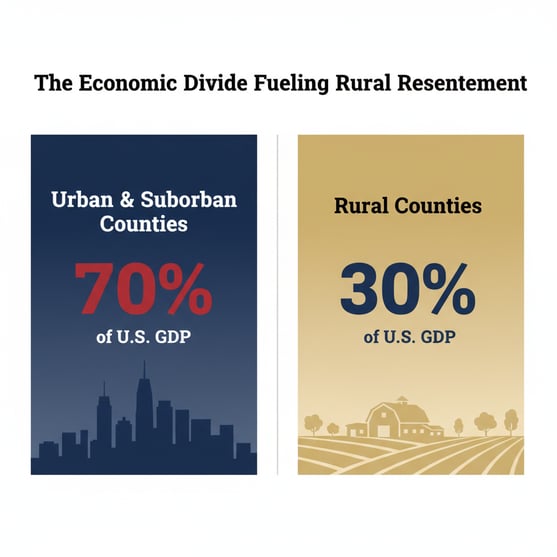
Urban counties produce 70% of GDP. created by campaign now with gemini , data from White Rural Rage
Because rural voters intuitively assign greater moral worth to physical labor, they view the distribution of taxpayer dollars through a deeply moral lens. When urban professionals or government employees receive higher salaries and better benefits than rural workers, rural citizens perceive this as a profound distributive injustice. They do not just see an economic disparity. They see a system that rewards the wrong type of work and punishes the people who actually build and sustain the country. Trevor Brown and Suzanne Mettler explain in Rural Politics in the United States how this worldview naturally leads to a distrust of government expansion.
Trevor Brown and Suzanne Mettler note in Rural Politics in the United States:
"As people used this place-based lens to interpret the world, they became resentful and viewed government and public employees as the product of antirural forces."
Political candidates who understand this dynamic must actively validate the physical work ethic of rural communities. Acknowledging the dignity of rural labor builds the foundational trust necessary to discuss broader policy agendas.
-png-2.png?width=180&height=180&name=image%20(1)-png-2.png)
Joshua M. Jansa: Co-author of 2025 rural political efficacy study.
-png-1.png?width=180&height=180&name=image%20(2)-png-1.png)
Eve M. Ringsmuth: Co-author of 2025 rural political efficacy study.
When a candidate demonstrates genuine respect for the daily physical realities of rural life, they bridge the cultural gap that usually prevents meaningful political communication. Joshua M. Jansa and Eve M. Ringsmuth found in American Politics Research that place based resentment remains completely unchanged by exposure to basic civic education, highlighting just how deeply ingrained these moral frameworks are within rural identities.
📖 Read Next: A Common-Sense Agenda Matching Conservative Policies with Rural Needs
The Deep Roots of the American Recognition Gap
The feeling of being culturally ignored and disrespected is a defining feature of the American heartland. This profound recognition gap, which is the difference in the degree to which people feel respected by their government, is deeply rooted in the physical and cultural realities of living outside centers of geographic power.
-png-1.png?width=170&height=230&name=image%20(3)-png-1.png)
Kayla Gabehart: Assistant Professor
When decision making is concentrated in distant cities, rural residents naturally develop a defensive identity. Kayla Gabehart explains in The Conversation that many rural Americans, especially in agricultural communities, feel actively looked down upon by their urban counterparts. One cattle rancher summarized the prevailing urban attitude toward rural citizens simply as treating them like idiots who do not really matter.
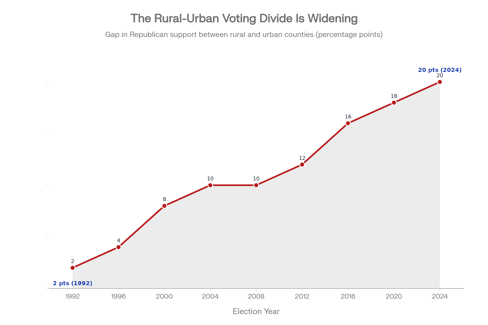
Rural-urban voting gap hits 20 points. created by campaign now with gemini , data from Rural Politics in the United States
Observing that statewide policies frequently feel like symptoms of an ever urbanizing world that intentionally leaves agricultural citizens behind, Kayla Gabehart notes that rural voters often view conservative politicians as their last hope for representation. This dynamic underscores why traditional outreach methods repeatedly fail in outstate areas. Candidates cannot simply offer tax credits or farm subsidies to alleviate this deeply ingrained cultural wound. They must first acknowledge the profound disrespect that rural communities have endured.
"Rural communities have the distinct feeling that urban America doesn't care whether they fail or flourish." — Kayla Gabehart, The Conversation
Candidates who recognize this domestic dynamic can position themselves as champions of rural dignity. By explicitly addressing the American recognition gap, politicians can prove they are not just another urban elite attempting to dictate terms to a forgotten community. Acknowledging that rural voices are systematically marginalized is the most effective way to begin building an authentic political coalition.
📖 Read Next: Why Rural Wisconsin Has Outsized Political Influence and What That Means for Representation
The Consequences of Ignoring Cultural Respect
When politicians ignore the symbolic needs of rural voters, they leave a vacuum. Instead, conservative leaders have earned rural trust by genuinely listening, validating their identity, and speaking plainly about cultural respect. This strategy works precisely because it directly addresses the symbolic disrespect rural voters feel on a daily basis.
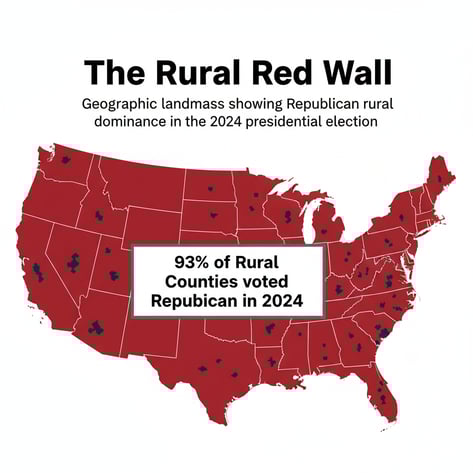
93% of rural counties back Trump. created by campaign now with gemini , data from White Rural Rage
Furthermore, Suzanne Mettler and Trevor Brown note in Rural Versus Urban that the consolidation of agricultural industries and the decline of manufacturing have devastated rural economies. Yet, because rural consciousness filters these economic realities through a cultural lens, voters often direct their frustration toward urban cultural elites.
Tevfik Murat Yildirim: Co-author of 2025 rural policy priorities study
Tevfik Murat Yildirim and Knut M. Solvig discovered in Political Science Research and Methods that partisan cues heavily influence how these voters prioritize issues, meaning that a candidate who respects the rural way of life can shape the entire local policy agenda. If candidates want to move beyond frustration and toward solutions, they must lead with cultural respect. They must speak the language of rural pride before they can effectively introduce economic or structural solutions.
Wrap Up
Earning the trust of rural voters requires a fundamental shift in how political campaigns communicate. While proposing strong economic policies is important, those proposals will inevitably fall on deaf ears if they are not packaged in genuine cultural respect. Rural voters possess a distinct identity forged by geographic isolation, a rigorous physical work ethic, and a persistent feeling that urban decision makers look down upon their way of life.
To win in rural areas, leaders must prioritize symbolic validation. They must demonstrate that they understand the moral value of rural labor and acknowledge the deep recognition gap that plagues small towns. By leading with respect and validating the rural identity, candidates can forge authentic connections that matter far more to these voters than any isolated policy promise. Building this authentic trust is the only sustainable way to bridge the geographic divide and secure lasting electoral success.
Sources
- "The Politics of Resentment" by Katherine J. Cramer
- "White Rural Rage" by Tom Schaller and Paul Waldman
- "Symbolic versus material concerns of rural consciousness in the United States" (Political Geography)
- "The rural-urban cleavage in US presidential elections: Stability and sudden change" (Electoral Studies)
- "Rural Politics in the United States" (Annual Review of Political Science)
- "Why rural Coloradans feel ignored: A resentment as old as America itself" (The Conversation)
- "Resentment or Empowerment? Civic Education and the Political Efficacy of Rural Individuals" (American Politics Research):
- "Rural Versus Urban" by Suzanne Mettler and Trevor Brown
- "The urban-rural divide in policy priorities across time and space" (Political Science Research and Methods)