
Winning a lasting rural majority means framing limited government as a defense of local autonomy and delivering concrete economic solutions for small towns.
What to Know
- A comprehensive study of 850 national surveys from 1939 to 2020 reveals that rural and urban voters consistently differ on only a few specific political priorities.
- The top 4 distinct policy priorities for rural voters diverge from urban populations by focusing heavily on agriculture, moral values, budget deficits, and the economy.
- Despite deep geographic sorting, public opinion gaps between rural and urban voters remain remarkably small on many major spending issues, often differing by just 2 to 10 percentage points.
- Between 2008 and 2020, employment grew nearly 10 times as much in urban areas compared to rural areas, creating a dire need for localized economic growth.
- Nearly 78 % of rural White voters believe other rural citizens share their exact values, highlighting a highly unified cultural electorate.
This analysis draws heavily on insights from the primary book "The Politics of Resentment" by Katherine J. Cramer. It is additionally supported by peer-reviewed research from journals including "Political Science Research and Methods" and "The ANNALS of the American Academy of Political and Social Science".
To build a resilient conservative majority, political leaders must seamlessly integrate traditional cultural validation with targeted, substantive economic policies that address the unique realities of outstate communities. By framing limited government not merely as an abstract principle but as a vital defense of local autonomy, candidates can demonstrate genuine respect for the rural way of life. Ultimately, matching this cultural alignment with common-sense solutions for localized job growth and infrastructure will transform temporary electoral support into a lasting governing coalition.
The Overlap of Partisanship and Geographic Priorities
Developing a winning conservative agenda requires understanding exactly how rural communities process political information and prioritize issues. Tevfik Murat Yildirim and Knut M. Solvig outline in Political Science Research and Methods how policy priorities vary across geographic lines over extended periods. Analyzing massive datasets spanning eight decades, the authors discover that rural populations consistently prioritize agricultural concerns, traditional moral values, budget deficits, and the broader economy differently than their urban counterparts. The data indicates that rural voters naturally gravitate toward policies that emphasize fiscal responsibility and cultural stability.
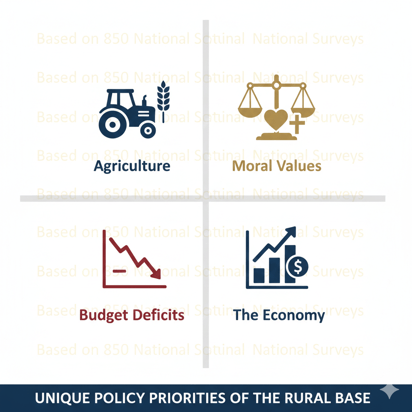
Four top rural priorities identified. created by Campaign Now with gemini , data from Political Science Research and Methods
However, the same study in Political Science Research and Methods also concludes that partisan affiliation significantly outweighs place-based identities in shaping these specific policy priorities. This means that rural and urban conservatives often process political cues in highly similar ways, relying heavily on unified party platforms to determine which issues matter most.
Because policy preferences are driven predominantly by partisanship rather than isolated geography, political leaders have a distinct advantage. They do not need to invent entirely new policy frameworks to win the rural vote. Instead, they must frame existing conservative policies in ways that directly speak to the unique daily realities of small-town voters.
When conservative candidates articulate a clear, unified message on the economy and government spending, rural voters respond positively. The key is ensuring that national party platforms are communicated using localized language. By emphasizing how national economic policies protect local industries and preserve community autonomy, campaigns can seamlessly connect broad conservative ideals with the specific priorities of outstate citizens.
📖 Read Next: How to Win Rural Wisconsin by Understanding What Matters Most
Framing Small Government as Local Protection
Rural citizens frequently express a strong preference for limited government. Yet this preference is rarely born out of abstract libertarian philosophy. Trevor Brown and Suzanne Mettler detail in The ANNALS of the American Academy of Political and Social Science how the shift of rural voters toward the Republican party is deeply tied to how these citizens perceive government expansion. The authors observe that while actual public opinion on many specific policy issues remains relatively undivided by geography, rural citizens filter these policies through a highly protective lens. Because state and federal bureaucracies are frequently viewed as distant and detached from local realities, rural voters naturally view the expansion of public programs as a direct threat to their autonomy.
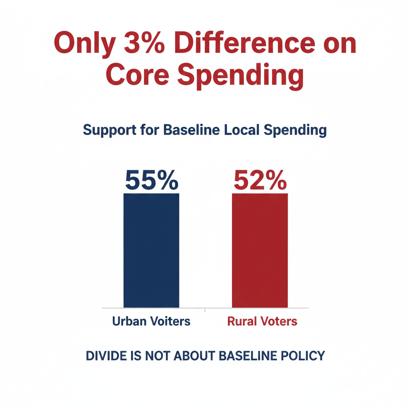
Policy opinion gaps remain remarkably small. created by campaign now with gemini , data from The ANNALS
"In these narratives, people are telling each other that there are people that do not value what we value, do not work as hard as we do, and are actively sucking away the livelihoods we have worked so hard to create." — Katherine J. Cramer, The Politics of Resentment
To effectively match conservative policies with rural needs, political leaders must frame deregulation and lower taxes as mechanisms for community defense. When conservative candidates promote policies aimed at reducing state overreach, they successfully tap into a deep-seated preference for community stewardship over bureaucratic management. Rural residents strongly prefer to manage their own schools, lands, and businesses without the heavy hand of distant administrators dictating unworkable rules.
This dynamic provides a clear roadmap for conservative messaging. Policies focused on reducing the tax burden should be presented as a way to keep resources within the local community rather than surrendering those funds to distant state capitals. By translating the conservative principle of small government into the practical language of local control, campaigns can demonstrate that they genuinely understand the defensive posture many small towns are forced to adopt.
📖 Read Next: Why Respect for the Rural Way of Life Matters More Than Policy Promises
Navigating Cultural Values and Economic Realities
Winning the rural electorate requires an agenda that honors traditional cultural values while directly addressing everyday economic needs.
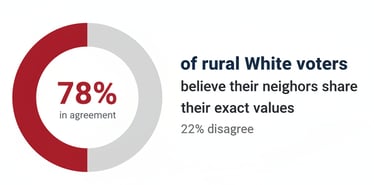
78% share exact same cultural values. created by campaign now with gemini , data from Pew Research Center
The rural electorate is heavily motivated by cultural issues and traditional values. A survey from the Pew Research Center documents that Americans in urban and rural communities hold widely different views when it comes to highly visible social issues. Rural citizens are significantly more likely to favor traditional social structures and express skepticism toward rapid cultural changes championed by urban centers. When conservative candidates unapologetically defend traditional values, they validate the rural worldview and build the trust required to pass broader economic agendas.
Linking cultural conservatism with economic policy creates a highly durable political coalition. Rural citizens want policies that protect the family unit, support local agriculture, and foster an environment where hard work translates directly into stability. By championing a platform that integrates moral traditionalism with robust support for small businesses and local industry, conservative campaigns can present a holistic agenda that perfectly matches the comprehensive needs of the rural electorate.
"What the rural voters I observed wanted in their politicians are people who understand and respect the way rural folks live and their daily concerns and desires." — Katherine J. Cramer, The Politics of Resentment
To build a lasting, governing majority, campaigns must pair robust cultural alignment with genuine policy delivery. An effective strategy goes beyond validating rural identity by actively championing a substantive agenda to revitalize shrinking local economies. A common-sense agenda must bridge the gap between shared traditional values and tangible policies that promote local economic growth, ensuring that rural communities experience genuine prosperity.
📖 Read Next: Why Rural Wisconsin Has Outsized Political Influence and What That Means for Representation
Delivering Real Results for Rural Economies
Cultural respect wins rural votes; delivering real economic results secures a lasting rural majority.
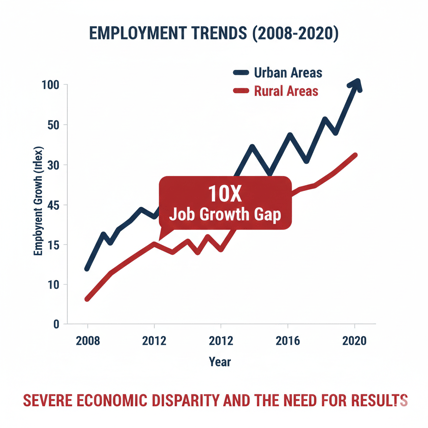
Urban job growth outpaces rural 10x. created by campaign now with gemini , data from The ANNALS
While cultural alignment secures votes, delivering long-term prosperity requires a concrete focus on the material realities facing outstate communities. Valentin Pautonnier details in Electoral Studies that job loss, industrial decline, and economic stagnation are deeply felt across rural regions. Recognizing these material needs is essential for passing effective legislation that strengthens the conservative base.
By focusing on impactful economic initiatives, conservative leaders can maximize their legislative success and deliver for the heartland. Expanding rural broadband, supporting technical education, and protecting local healthcare facilities are common-sense policies that appeal directly to the rural base while remaining palatable to a broader statewide electorate.
"As polarized politicians focus on distinguishing themselves from each other, it undermines opportunities for collective action that could benefit low- and middle-income Americans who live in both areas." — Suzanne Mettler and Trevor Brown, The ANNALS of the American Academy of Political and Social Science
When campaigns take the time to map their policy proposals directly onto the lived realities of small towns, they offer more than just a political platform. They offer a vision for the future that honors and protects the rural way of life while actively fighting against the economic forces that threaten to leave these communities behind.
Wrap Up
Developing a winning agenda for outstate communities does not require abandoning core conservative principles. In fact, the foundational tenets of the conservative movement align perfectly with the everyday desires of rural citizens. The key lies in effective translation and strategic framing.
By presenting small government as a defense of local autonomy, and by fiercely defending traditional cultural values alongside actionable economic plans, political leaders can forge an unbreakable bond with rural voters. An agenda that marries symbolic respect with concrete commitments to local prosperity is the ultimate key to transforming geographic momentum into a powerful, governing coalition.