
Party control doesn't predict the score; process does. Here's what the Scorecard actually rewards—and how campaigns can use it to hold the line on accountability.
Part of the series: Federalism Scorecard 2025 (Series Overview).
What to Know
- Federal money often arrives with conditions. Someone has to turn those conditions into state policy. The Federalism Scorecard tracks the guardrails that keep big decisions visible and accountable to elected leaders. In short, it’s an index of vulnerability to federal pressure—stronger guardrails score higher; weaker guardrails score lower.
- The scorecard looks at how much authority stays with elected state leaders versus being driven by unelected agencies and federal conditions.
- Four structural guardrails consistently separate stronger from weaker systems: legislative oversight of big grants, transparency around federal guidance, review of high-impact rules, and clear remedies for citizens and businesses when agencies overstep.
- The Scorecard’s own rankings show party control doesn’t neatly predict performance: the top 10 and bottom 10 include a mix of Republican- and Democratic-controlled states.
- Recent movers like Oklahoma, Nebraska, and North Carolina climbed the rankings not by shrinking government, but by adding practical checks—such as REINS-style review, contingency planning, and clearer grant visibility—that put elected officials back in charge.
Why this Scorecard exists
Federal programs do not just send checks. They can also send terms, timelines, reporting rules, matching requirements, staffing burdens, IT buildouts, and ongoing maintenance costs that states inherit after the “yes.” The practical question is not whether a state participates—it’s whether elected leaders and the public can see (and weigh) the strings before commitments are locked in.
That is what the Federalism Scorecard 2025 is designed to measure: visibility and enforceable guardrails around how grants, guidance, and rules shape state policy.
What the Scorecard measures
The Scorecard organizes its signals into two broad buckets:
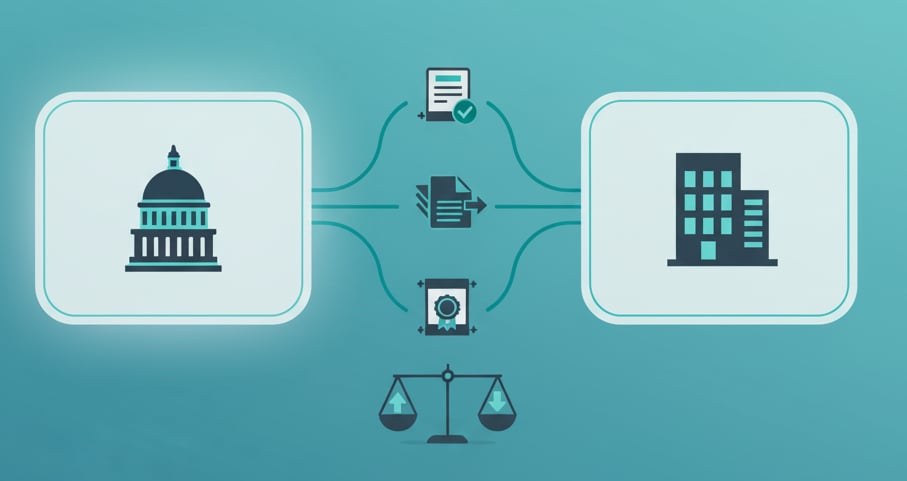
Internal guardrails (inside state government): tools that limit agency drift and keep major decisions anchored to law—for example, meaningful rule review, limits on deference, and citizen remedies (including injunctive relief) that allow courts to halt unlawful agency action.
External guardrails (state–federal interface): tools that make federal influence visible—for example, oversight of federal grant acceptance, cost visibility, contingency planning, and transparency when agencies rely on federal guidance.
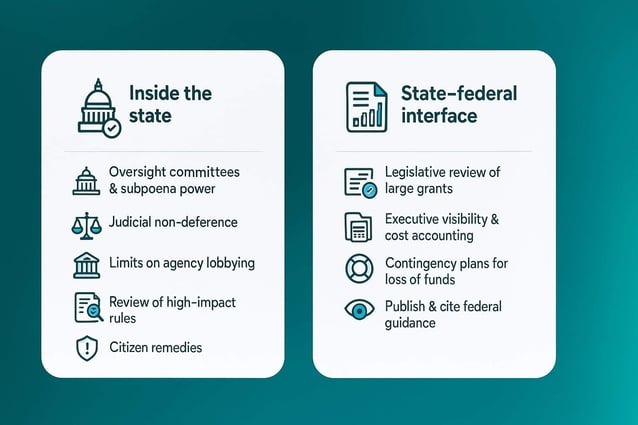
Image generated by DALL-E
Put plainly: the Scorecard rewards states that “show their work” before acting.
Party control doesn’t “explain” the rankings
It is easy to assume “red states score higher, blue states score lower.” The Scorecard’s own discussion cuts against that shortcut. It notes that, within the top ten, most states are Republican-trifecta, but not all—and the bottom ten is evenly split between Republican-trifecta and Democratic-trifecta states.
“Considering the top 10 states overall, seven have Republican governors…” — Federalism Scorecard 2025
“The 10 lowest-ranked states are evenly split…” — Federalism Scorecard 2025
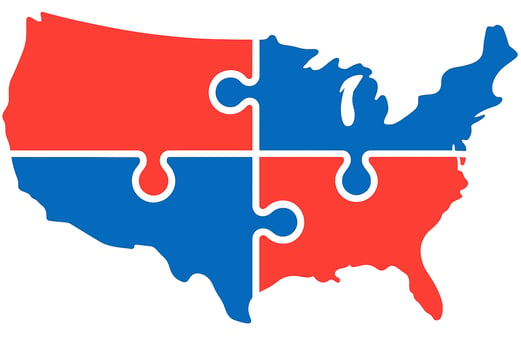
Image generated by DALL-E, illustrating the U.S. split red/blue
That is the point: process design (what must be disclosed, reviewed, costed, and voted on) explains more than party label.
2025: Highest and Lowest Scores (and why)
Highest-scoring in 2025: Tennessee (67.18), Utah (66.34), Idaho (57.85), Wisconsin (51.10).
Lowest-scoring: Illinois (–4.55), California (–6.12), Mississippi (–9.95), Alabama (–10.62), Montana (–13.56).
High scores come from a bundle of simple steps that force clarity before commitments are locked in:
- Tennessee (67.18): strengthened oversight in areas the Scorecard highlights, including reforms to its federal grants process.
- Utah (66.34): stands out for all-agency federal guidance disclosure—a transparency rule the Scorecard emphasizes.
- Idaho (57.85) and Wisconsin (51.10): remain in the top tier because the Scorecard credits them with stronger “guardrail” structures than most states.
Lower scores reflect thinner guardrails and less consistent visibility into the terms and downstream costs attached to federal decisions.
Key point: High-scoring states are not necessarily taking fewer federal dollars—they are more likely to review big commitments in the open: scrutinizing major grants, disclosing relied-upon guidance, and checking high-impact rules before implementation.
Who Moved — and what actually moved them
The Scorecard highlights several large jumps that came from targeted, practical reforms:
- Oklahoma (#40 → #14): adopted a REINS statute and required agencies to notify the legislature about certain federal guidance they receive.
- Nebraska (#35 → #12): adopted reforms including REINS and contingency planning for the loss of federal funds.
- North Carolina (#32 → #19): adopted a REINS statute, improving legislative oversight over major rules.
These changes are not flashy. They work because they change incentives: when agencies must disclose, cost, and justify decisions earlier, elected leaders can steer policy before commitments harden into obligations.
What to take from this (practically)
The Scorecard is most useful when it turns into one clear question: Which guardrail is missing?
Common moves that repeatedly show up in stronger systems include:
- Publishing relied-upon federal guidance (so policy isn’t driven by unseen memos).
- Triggering legislative review or public notice for large/novel grants (so terms and costs are visible before acceptance).
- Routing high-impact rules through a meaningful checkpoint (so legality and costs are weighed before rollout).
- Maintaining workable citizen remedies where procedure is ignored (so shortcuts have consequences).
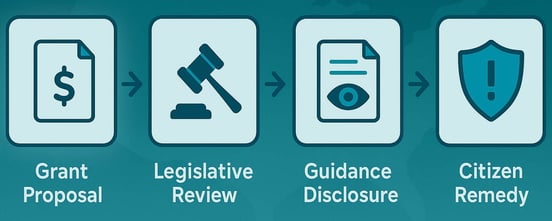
Together, these practices turn the Scorecard from a theoretical index into a practical roadmap: states that strengthen any one of these guardrails tend to climb the rankings over time.
Wrap Up
The Federalism Scorecard 2025 is not about partisan identity or “who spends more.” It is a governance test: whether states keep major decisions tied to elected leadership, visible processes, and enforceable guardrails—especially when federal money and federal conditions are moving fast.