
In swing states, close margins leave no room for surprise costs or mid-year policy whiplash. The states that avoid both share one habit: they publish the paperwork before agencies commit.
Part of the series: Federalism Scorecard 2025 (Series Overview).
What to Know
- The Federalism Scorecard looks at whether states keep federal money and federal direction visible—through grant oversight, guidance publication, and review of major rules.
- In swing states, these guardrails often decide whether policy shifts feel predictable or chaotic to schools, local governments, and regulated industries.
- The point here is not party labels; it’s the practical steps legislatures can take to reduce “surprise costs” and keep big commitments closer to elected decision-makers.
Why this lens
Federal dollars rarely arrive as “just money.” They arrive with timelines, reporting rules, match requirements, staffing burdens, IT buildouts, and downstream obligations that can land on counties, school districts, and businesses. When those commitments are made quickly—without early visibility—states end up doing cleanup mid-year: budget patches, rushed compliance deadlines, and angry stakeholders asking why no one saw it coming.
Swing states are where this matters most politically and operationally. Close elections mean low tolerance for confusion. When voters and local institutions feel whiplash—sudden rule changes, unclear grant conditions, or unexplained costs—confidence drops. The states that reduce friction aren’t necessarily spending less; they are showing their work before locking in commitments.
What the score is (and isn’t)
The score is a dashboard, not a moral verdict and not a “how much a state takes” ranking. Higher scores generally reflect visible processes—grant votes/notice, guidance publication, rule review, cost accounting, and workable remedies for citizens. Lower scores point to thinner visibility, where agencies can accept terms or implement changes before legislators and the public see the details.
A useful way to think about it: federal influence shows up through three pathways, and each pathway has a simple guardrail.
- Grants: Is there a trigger for a vote or public notice when a grant is large, novel, or creates ongoing costs?
- Guidance: Do agencies publish and cite the federal memos they rely on, so everyone reads the same document?
- Rules: Do high-impact rules hit a checkpoint before adoption, so costs and authority are checked early?
A quick look ahead to 2026: across many states (including swing states), the next wave of reforms is likely to focus on making these steps routine—agency-wide guidance pages, grant thresholds paired with a one-page cost sheet, REINS-style checkpoints for costly rules, and tighter oversight tools that force early disclosure rather than late explanations.
State fixes that matter next
Below is a practical “fix list” for swing states—small, concrete moves that reduce surprises and make tradeoffs explainable.
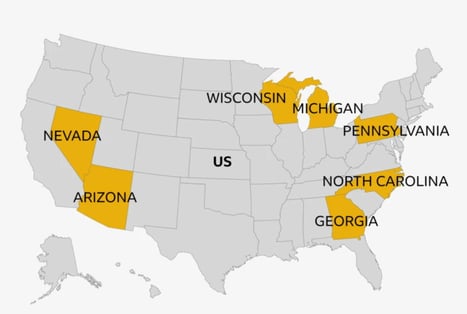
Screenshot from BBC News
Wisconsin
Where it stands: Strong internal legal tools exist in parts of the system (e.g., checks on agency interpretation and rule review structures), but federal-facing visibility can still be uneven—especially for big grants and broad guidance publication.
Quick fix: Require a public vote/notice on large or new federal grants and publish relied-upon federal guidance before it is used.
Why it helps: It reduces mid-stream surprises for schools, cities, and employers by getting the terms out early—before timelines and budgets get trapped.
Michigan
Where it stands: Committees can be active, but key “daylight” steps around grants and guidance are often inconsistent.
Quick fix: Set a clear grant vote/notice threshold and require agencies to publish the federal guidance they rely on (one page per agency is enough to start).
Why it helps: It stabilizes budgets and delivery timelines. Stakeholders can plan around what’s actually required, not what they hear secondhand.
Pennsylvania
Where it stands: Rule review capacity can be a meaningful anchor, but federal-facing checks (grant visibility and guidance transparency) are often thinner than the internal mechanics.
Quick fix: Pair a grant vote/notice rule with simple checkpoints for high-cost plan changes (where federal terms can drive state obligations).
Why it helps: It reduces “hidden strings” and lets lawmakers explain costs and constraints in daylight, before agencies commit.
North Carolina
Where it stands: A REINS-style discipline exists for major rules, which is a strong foundation—but federal-facing visibility (big grants and broad guidance publication) can still lag.
Quick fix: Add a grant vote/notice threshold and publish relied-upon federal guidance before agencies act on it.
Why it helps: It extends the state’s rule-discipline mindset to federal dollars, which is often where surprise costs originate.
Georgia
Where it stands: Oversight tools can be strong on paper, but grant and guidance transparency can be spotty in practice.
Quick fix: Require a one-page grant cost sheet (match, staffing, IT, maintenance) for large/novel grants, and expand guidance publication beyond narrow program areas.
Why it helps: Clear paperwork lowers friction with local governments, permit holders, and service providers who end up absorbing implementation burdens.
Arizona
Where it stands: Some internal guardrails and review tools can be present, but federal-facing visibility—grant triggers and guidance publication—often needs strengthening.
Quick fix: Add a grant vote/notice trigger and require basic contingency planning for major programs where federal terms can change quickly.
Why it helps: High-growth sectors get steadier timelines and fewer “rule changes by surprise memo” when federal conditions shift.
Nevada
Where it stands: Legislative tools can exist, but several visibility steps around grants and broad guidance publication are often missing or uneven.
Quick fix: Require committee review for large/novel grants and attach a one-page cost sheet to each; add a basic guidance-publication requirement.
Why it helps: Tourism-driven budgets and local governments get fewer shocks because obligations are surfaced earlier—when adjustment is still possible.
How to use this list
For each swing state on the radar, run this quick read. It keeps the focus on mechanics voters can feel: predictability, timeline clarity, and cost transparency.
- Guidance: Do agencies publish and cite the federal guidance they rely on?
- Grants: Is there a vote/notice threshold for large or unusual grants?
- Rules: Do major rules hit a checkpoint before adoption?
- Costs: Are the full life-cycle costs visible up front (match, staffing, IT, maintenance)?
- Remedies: Can citizens and businesses get timely relief if agencies skip steps?
If any answer is “not yet,” that is a clean coalition ask. One fix at a time moves confidence fastest—because it improves the exact friction point stakeholders experience: surprise policy shifts, unclear timelines, or unexplained costs.
Wrap Up
Swing states do not need sweeping rewrites to reduce whiplash. They need daylight: publish the guidance, vote or publicly notice big grants, review high-impact rules before rollout, price the strings up front, and keep a workable backstop when process is skipped. Those steps make policy delivery more predictable—and in close contests, predictability is often the edge.