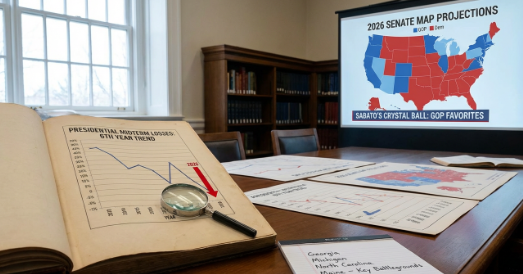

Historical "sixth-year itch" suggests a 2026 "blue wave," yet Sabato's Crystal Ball favors the GOP to keep Senate control.
What to Know:
- The "sixth-year itch" is a historical trend where the president's party suffers significant losses in the sixth year of their presidency.
- This trend, combined with other factors, suggests that 2026 could be a big year for Democrats.
- However, the structure of the 2026 Senate map favors the GOP, with Democrats defending more vulnerable seats.
- Sabato's Crystal Ball has made a couple of rating changes in favor of the Democrats, but still considers the GOP the favorites to hold the Senate.
- The key battlegrounds for Senate control will be in states like Georgia, Michigan, North Carolina, and Maine.
History is not on the side of President Trump and the Republican Party heading into the 2026 midterm elections. A well-documented phenomenon in American politics, the "sixth-year itch," has historically seen the president's party suffer significant losses in the sixth year of their presidency. As Bob Loevy of Colorado Politics notes, this pattern has been consistent throughout modern American history.
"It is a well-established long-range pattern in U.S. elections that the incumbent president's political party loses large numbers of congressional seats in a sixth-year general election."
Loevy cites several historical examples to back up this claim. In 1958, during the sixth year of Dwight D. Eisenhower's presidency, a severe economic recession led to heavy Republican losses in the House and Senate. Similarly, in 1974, in the wake of the Watergate scandal and Richard Nixon's resignation, Democrats made large gains in both chambers of Congress.

|
Midterm penalty: A general term for the tendency of the president’s party to lose seats in Congress during midterm elections, especially when the president is not on the ballot. |
This historical pattern, often referred to as the sixth year itch, suggests that 2026 could produce a blue wave election in which Democrats gain seats in both the House and the Senate. At the same time, electoral outcomes are shaped by current conditions as much as by precedent, and shifting political dynamics could soften or even offset the typical impact of the sixth year itch.
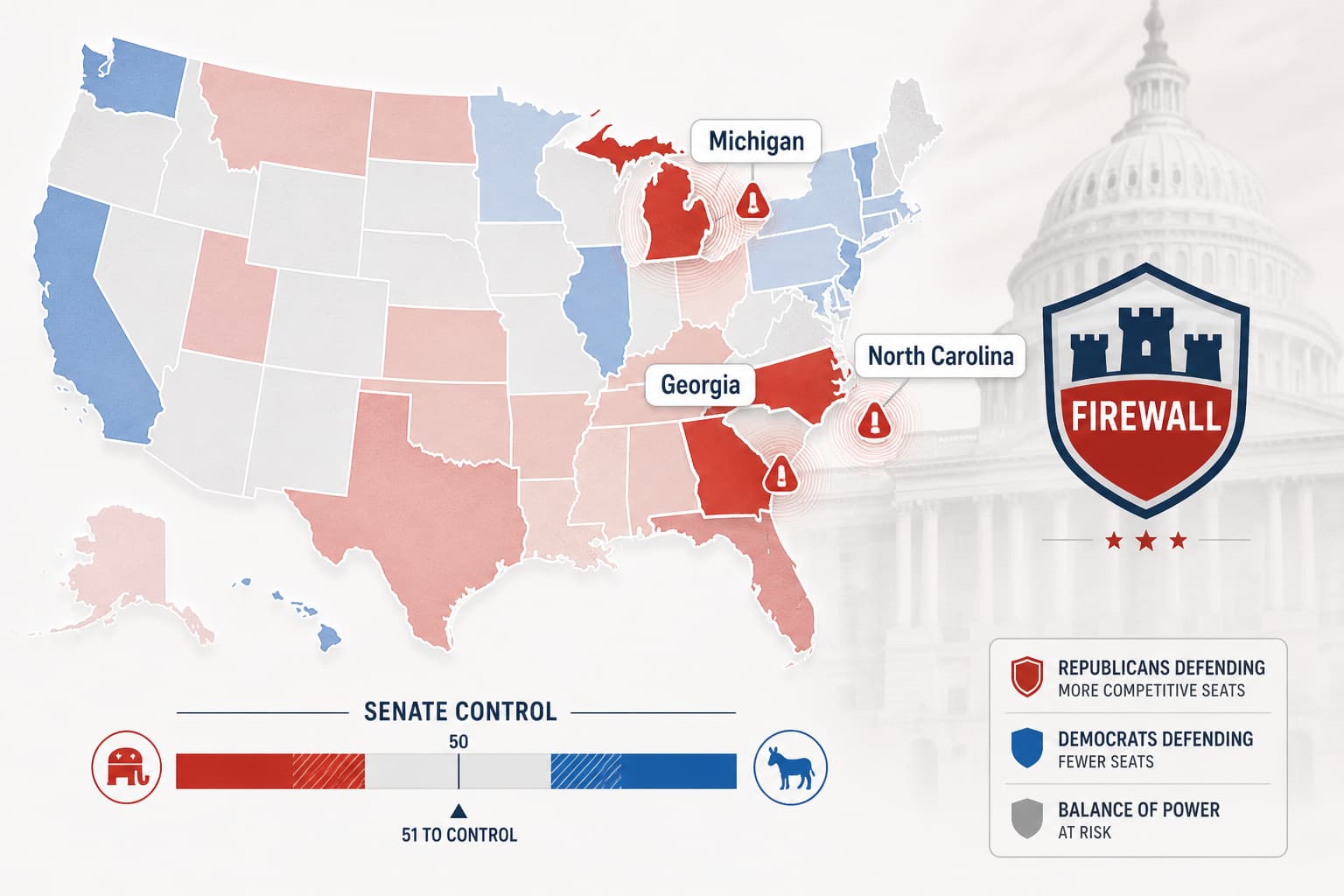
The Senate Map: A GOP Firewall?
While national political history may suggest a difficult midterm for the party in the White House, the 2026 Senate map presents Democrats with a structural challenge that cannot be ignored. Even if the broader political climate tilts against Republicans, the geographic distribution of seats up for election gives the GOP a built in advantage.
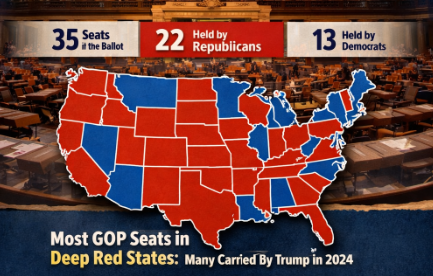
Of the 35 Senate seats on the ballot in 2026, 22 are currently held by Republicans and 13 by Democrats. On the surface, that larger number of Republican defenses might look like an opportunity for Democratic gains. In practice, most of those Republican seats are located in states that have moved decisively to the right in recent years. Many are states that Donald Trump carried comfortably in 2024. That reality sharply limits the number of viable Democratic pickup targets.
The most competitive Republican held seats are in Maine and North Carolina. Maine is a Democratic leaning state at the presidential level but continues to elect Republican Senator Susan Collins, who has built a cross party brand. North Carolina is slightly red at the presidential level but frequently competitive in statewide races.

Republican Senator Susan Collins; image via official website
Outside of those two states, Democrats would likely need to compete seriously in places like Ohio, Alaska, or Iowa to reach a majority. All three have trended Republican at the federal level, making them difficult terrain even in a favorable national environment.
At the same time, Democrats face their own defensive pressures. Georgia remains highly competitive, even though recent rating changes suggest a slight Democratic edge. Michigan features an open Democratic seat and an unsettled primary, adding uncertainty to a state that has delivered close results in recent cycles. Democrats cannot afford to lose ground in either state if they hope to gain seats elsewhere.
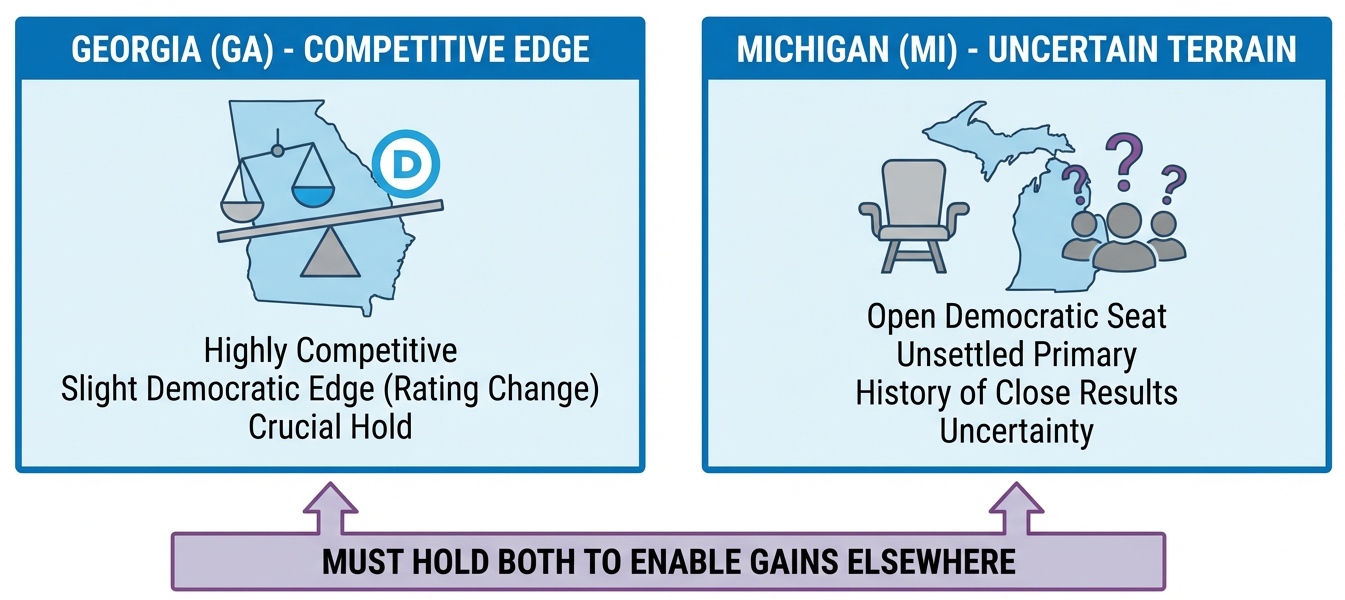
The math is unforgiving. Even if Democrats hold all of their current seats and flip both Maine and North Carolina, they would still fall short of the 51 seats required for control. That means they would need at least one additional breakthrough in a red leaning state. Achieving that in a polarized environment is difficult, particularly when many of the battleground states skew older and whiter than the national electorate, demographics that have recently favored Republicans.
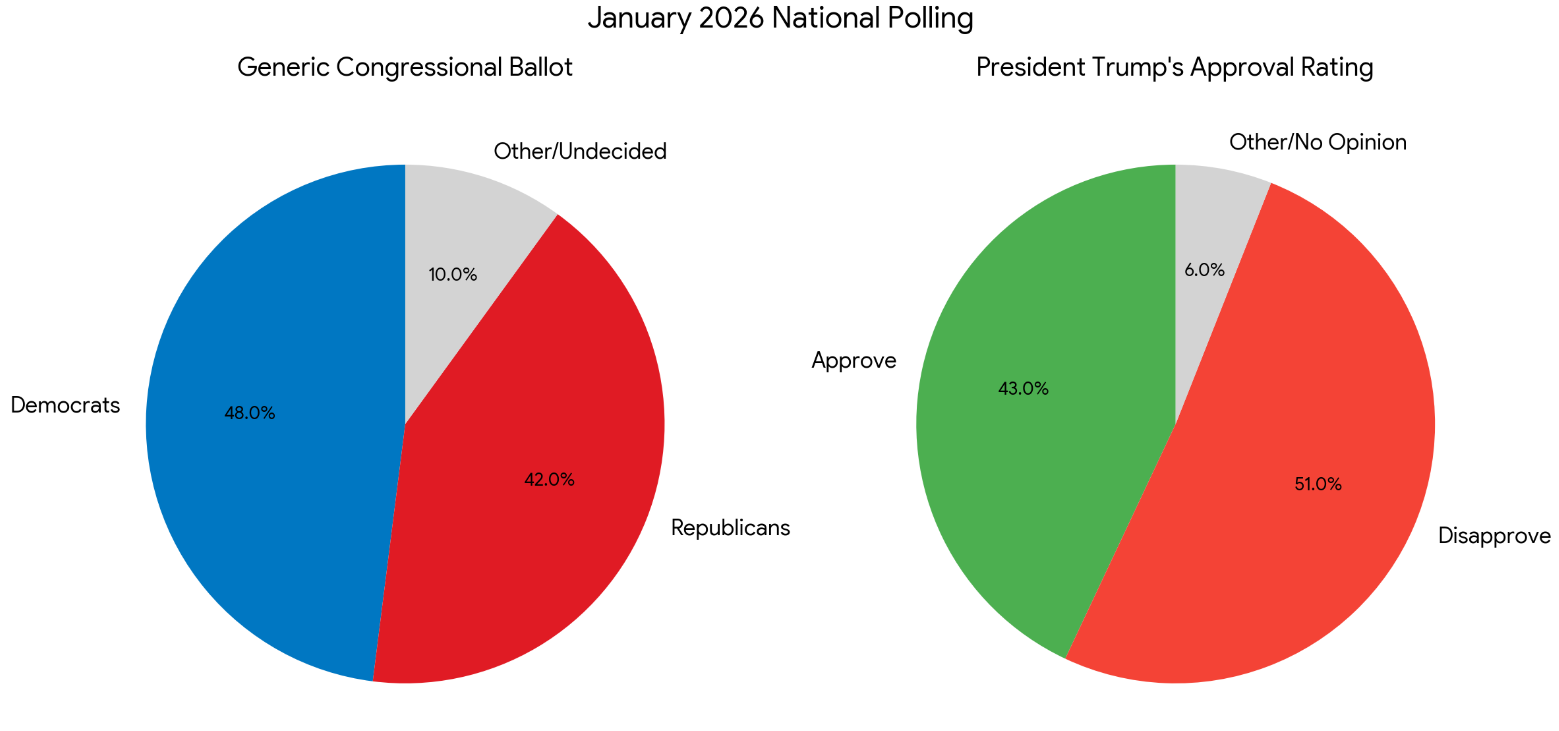
Recent January 2026 polling at Emerson College has shown erosion in Trump’s standing among younger and nonwhite voters. Democrats are entering the midterm year with a six point advantage on the generic congressional ballot, 48% to 42%, while President Trump’s approval stands at 43% with 51% disapproving. Independents break heavily toward Democrats, and women favor Democratic candidates by a double digit margin, signaling a softer national environment for Republicans.
The most competitive Senate races are concentrated in states where Republican coalitions, particularly among white and older voters, remain structurally durable. In states like Florida and Texas, Republicans have historically absorbed modest national swings without losing statewide ground, meaning a Democratic advantage on the generic ballot may narrow margins but not necessarily flip seats.
Key Battlegrounds
Control of the Senate will hinge on a small cluster of highly competitive states, even though Republicans remain favored overall. The University of Virginia’s Crystal Ball recently upgraded Sen. Jon Ossoff’s race in Georgia from Toss-up to Leans Democratic, citing a favorable midterm climate and uncertainty around the eventual Republican nominee, though the contest is still expected to be decided by only a few points.

Senator Jon Ossoff, image via Congress website
Michigan remains the lone Democratic-held Toss-up, with an open seat and a potentially messy Democratic primary creating uncertainty against Republican Mike Rogers, who narrowly lost a Senate race in 2024.

Representativ Mike Rogers; image via official website
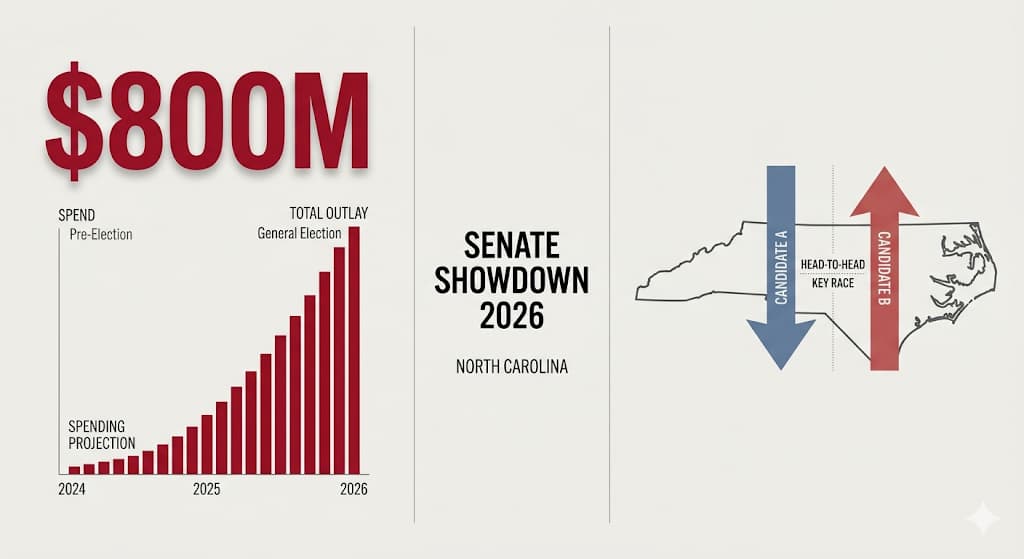
In North Carolina, an open Republican-held seat is also rated Toss-up, with former Gov. Roy Cooper positioned as a strong Democratic contender in a state that remains slightly red at the presidential level but competitive statewide.

Former Governor Roy Cooper; image via Wikicommons
Maine may be the purest Toss-up of the cycle, as Republican Sen. Susan Collins seeks reelection in a state that consistently votes Democratic for president but has repeatedly supported her personally.

Senator Susan Collins, image via Wikicommons
Despite a challenging national environment for Republicans, the map’s structure limits Democratic upside, as even flipping Maine and North Carolina while holding Georgia and Michigan would still leave Democrats short of a majority.
Wrap Up
The so-called “sixth year itch” or “midterm rule” points toward Democratic gains in 2026, and early national data gives them something to work with. Trump’s approval is sitting underwater, and Democrats hold a modest lead on the generic ballot. That sets the stage for a competitive environment.
But the Senate is not a national referendum. It is a state-by-state fight, and the map itself still leans Republican. Most GOP defenses sit in states that have hardened to the right, meaning Democrats must win in terrain that is structurally less forgiving.
The majority will come down to a narrow band of states like Georgia, Michigan, North Carolina, and Maine. In each of them, margins are likely to be tight and turnout coalitions will determine the outcome. The party that can nationalize the race without losing ground locally will control the chamber and the direction of the country’s governing agenda through the end of the decade.
-Aug-18-2026-07-55-14-0174-AM.jpg)