

Voters may be furious with Washington, but with most of the electorate politically locked in, control of Congress is increasingly being decided by a tiny pool of persuadable voters in a handful of battleground races.
What to Know
- 54% of likely voters told Rasmussen Reports they would vote to replace every member of Congress if they had the chance.
- Trump’s approval rating has remained in a narrow band in The New York Times’ approval tracker despite continued economic and political turbulence.
- Fewer than 40 House races are currently rated as true battlegrounds in The New York Times’ 2026 midterm race tracker.
- A deeply polarized electorate has left fewer voters open to changing their minds, even as frustration with Washington remains high.
- Control of Congress is increasingly being decided in a small number of competitive districts where persuadable voters still matter.
Voters are furious with Washington, but they are not changing sides. That is the contradiction shaping the 2026 midterms. Rasmussen Reports’ June 27 weekly survey roundup shows a public fed up with Congress and eager to punish political institutions, while The New York Times’ Donald Trump approval tracker shows the president’s numbers holding in a narrow range despite months of economic turbulence, tariff fights, and nonstop political conflict.
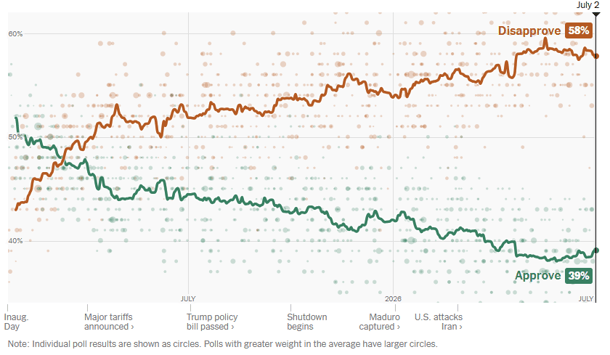
Screenshot from NYT Donald Trump Approval Tracker
That disconnect has changed the mechanics of American politics. In an electorate where most voters are already locked into one party or the other, broad dissatisfaction no longer guarantees broad electoral movement. And as The New York Times’ 2026 House and Senate battleground tracker makes clear, control of Congress is increasingly being decided in a limited number of competitive races by a much smaller universe of persuadable voters. National frustration is real, but the balance of power is likely to be determined by the few voters who still have room to change their minds.
The Calcified Electorate
As of July 2, Trump’s approval rating stood at 39%, with 58% disapproving. More importantly, the broader trendline has stayed remarkably tight despite months of economic turbulence, tariff fights, shutdown threats, foreign policy escalation, and domestic political conflict. The Times notes that after an initial decline early in his second term, Trump’s approval ratings have shown less variability than those of any presidency since Bill Clinton, with the exception of Trump’s own first term.
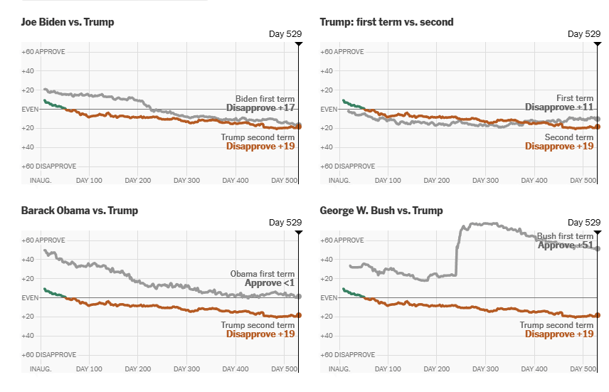
Screenshot of NYT President Trump Approval Rating Comparisons
That stability is what makes the current political moment so unusual. Trump’s approval is weak by historical standards, but it is also unusually durable. The New York Times’ polling average found that no president’s approval rating had remained below 38% for more than a few days over the last 17 years, putting Trump’s current standing in unusually difficult territory.
Yet even with that weakness, there has been no large-scale collapse in support and no broad movement away from the partisan camps that have defined his political coalition and opposition for years. This is not a sign that voters are satisfied. It is a sign that the electorate has hardened. Many Americans now interpret economic news, legislative fights, and political controversy through a deeply partisan lens before they interpret it as evidence for or against a candidate.
Supporters tend to absorb bad news without abandoning their side, while opponents are rarely moved by positive developments. The result is a political environment where dissatisfaction can be intense, but persuasion remains scarce.
An Illusion of "Cleaning House"
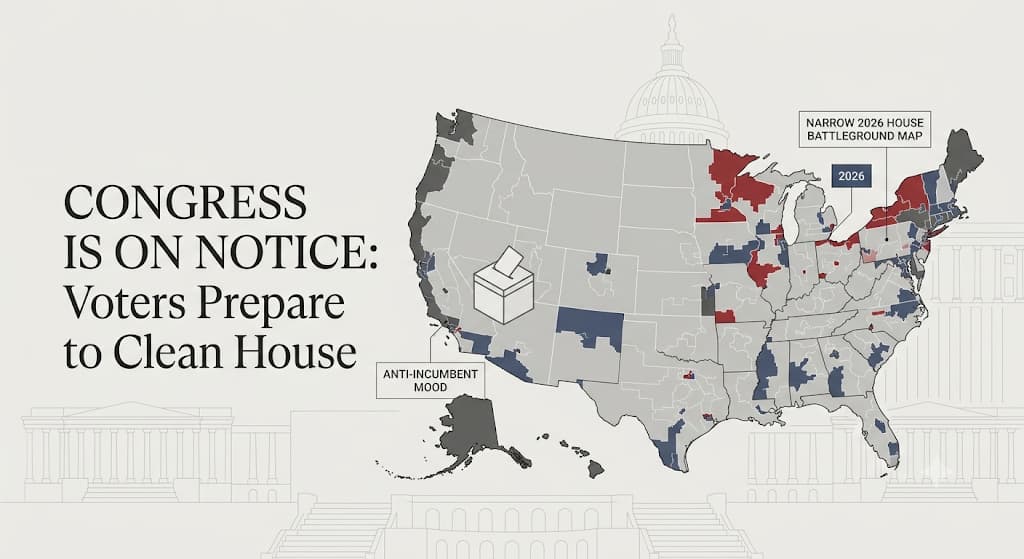
Simultaneously, voters are expressing profound frustration with the legislative branch. Data from Rasmussen Reports highlights a persistent, widespread desire among the public to "clean house" and vote against incumbents on Capitol Hill.
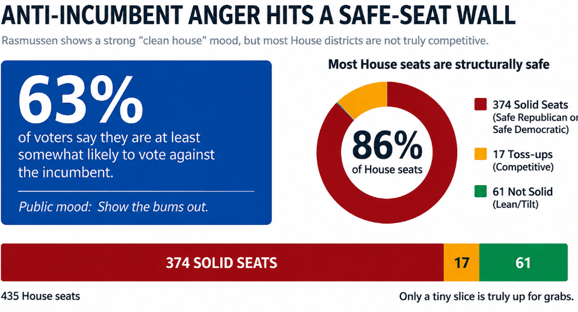
Image made by Gemini
However, the geographic reality of modern politics prevents that anger from becoming a sweeping national mandate. A combination of geographic sorting, with liberals concentrated in urban areas and conservatives clustered in rural regions, along with partisan gerrymandering, has left most of the 435 House seats structurally safe for one party or the other. As a result, even a strong anti-incumbent mood runs into a hard limit: more than 85% of House districts are not truly competitive, which means the desire to “fire Congress” can only play out in a small number of battleground races.
The Chosen Few
According to The New York Times’ 2026 House and Senate battleground tracker, the fight for congressional majorities has narrowed to fewer than 40 true battleground House races. In a country where most districts are structurally safe for one party or the other, those contests now carry an outsized share of the political weight. They are the places where the national fight for power is still genuinely unsettled and where small shifts in turnout, persuasion, or candidate quality can still decide who controls Congress.
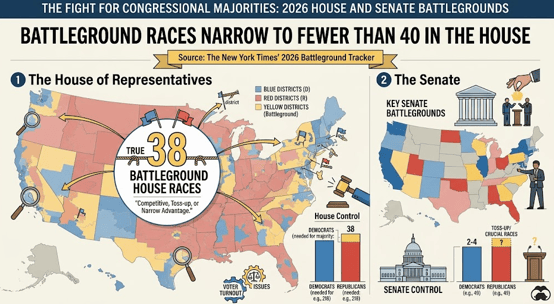
Inside those districts, the voters who matter most are the ones who have not fully locked into one side. They are not necessarily ideological moderates, but they are persuadable enough to keep both parties competing for them. Some are independents uneasy with both parties. Some are split-ticket voters who can still separate their feelings about Congress, the White House, and a local candidate. Others are lower-engagement voters who do not follow politics closely but can still break late in a close race.
|
Snapshot: The Fight for Congressional Majorities (July 2026) |
||
|
Category |
Key Metric / Name / Place |
Political Context & Significance |
|
The Big Picture |
Fewer than 40 |
The total number of true battleground House races out of 435 total seats. |
|
House Control |
218 seats |
The magic number required to win or maintain a majority. |
|
House Breakdown |
38 competitive races |
* 18 Tossups* 12 Lean Democratic* 8 Lean Republican |
|
House Dem Baseline |
194 seats |
Solidly or likely Democratic. Democrats need to win 13 of the 18 tossup seats to reach 218 (assuming they hold their leaning seats). |
|
House GOP Baseline |
204 seats |
Solidly or likely Republican. Republicans need to win 6 of the 18 tossup seats to maintain control (assuming they hold their leaning seats). |
|
Senate Breakdown |
10 competitive races |
* 4 Tossups (Alaska, Maine, Michigan, Ohio)* 3 Favor Democrats (Georgia, North Carolina, New Hampshire)* 3 Favor Republicans (Iowa, Texas, Nebraska—1 rated "Likely R") |
|
Current Senate Margins |
53 seats |
Held by Republicans. Democrats must net 4 flips while defending vulnerable terrain to reclaim the majority. |
|
The Senate Tie-Breaker |
Vice President JD Vance |
Casts the deciding vote in a 50-50 Senate, forcing Democrats to gun for a 51-seat outright majority. |
|
Key Senate Targets (GOP) |
Alaska, Iowa, Ohio, Texas |
Deep-red territory won by Donald Trump by double digits in 2024. Democrats must win at least two of these to reach 51. |
|
Vulnerable Dem Seats |
Michigan & Georgia |
The two most vital defensive holds for the Democratic Party. |
|
Prominent Names (Senate) |
Jon Ossoff (D-GA)Dan S. Sullivan (R-AK)Susan Collins (R-ME)Jon Husted (R-OH) |
Key incumbents or top-tier candidates locked in the cycle's most expensive and critical battleground races. |
|
The Independent Wildcard |
Dan Osborn (NE) |
An independent candidate backed by Democrats in Nebraska as a strategic play to unseat Republican incumbent Pete Ricketts. |
|
Primary Disruptors |
Melat Kiros (D-CO) |
A 29-year-old democratic socialist who unseated veteran incumbent Rep. Diana DeGette in Denver, signaling insider vulnerability to outsider fervor. |
|
High-Profile Backing |
Alexandria Ocasio-Cortez |
Endorsed Abdul El-Sayed in Michigan's highly contested, high-stakes Senate primary. |
That gives a relatively small number of voters enormous leverage over the national outcome. Political professionals understand the imbalance. National parties and super PACs are not spending heavily to convert voters in safe Republican or safe Democratic districts.
They are concentrating money, staff time, digital advertising, polling, and field operations in the small number of battleground seats where persuadable voters can still change the result. In practical terms, that means the fight for Congress is increasingly being decided by a narrow slice of suburban, independent, and late-deciding voters in places like Iowa, Pennsylvania, and Arizona.
The Consequences of the Lock-In
This hyper-concentration of political relevance has fundamentally changed how Washington governs. When a political party only needs to win over a tiny, specific subset of the population to capture or hold a majority, the incentive to build a broad, national consensus vanishes. Instead of crafting policies that appeal to the median American voter, party strategists focus heavily on a dual-track approach:
- Mobilize the Base: Turn out the fiercely loyal, "locked-in" core voters at all costs.
- Micro-Target the Margins: Tailor highly specific, localized promises to the handful of persuadable voters in swing districts.
The result is a political system that feels increasingly unresponsive to the public at large. Millions of Americans will cast their ballots this election cycle feeling a profound desire for systemic change, only to watch the balance of power be decided by a few thousand voters they have never met, living in districts they have never visited. The electorate is locked in, the margins are razor-thin, and the power belongs to the few who are still willing to change their minds.
Wrap Up
American politics is not short on anger. Voters are frustrated with Congress, underwhelmed by the status quo, and increasingly open to punishing the people in charge. But frustration alone is no longer enough to move the map. Rasmussen Reports shows the appetite for a clean sweep, The New York Times’ Trump approval tracker shows how little the electorate is actually shifting, and The New York Times’ battleground map shows where the real fight is taking place: not everywhere, but in a narrow set of districts and states where a small number of persuadable voters still have leverage.
That is the defining reality of the 2026 midterms. The country may sound restless, but the electorate is largely locked in place. Most voters already know which side they are on. Most districts already lean decisively one way or the other. That leaves control of Congress resting with a tiny slice of the electorate in the few places where persuasion still matters. Washington may be hearing a roar of national dissatisfaction, but the next majority will likely be decided by the voters still willing to move.