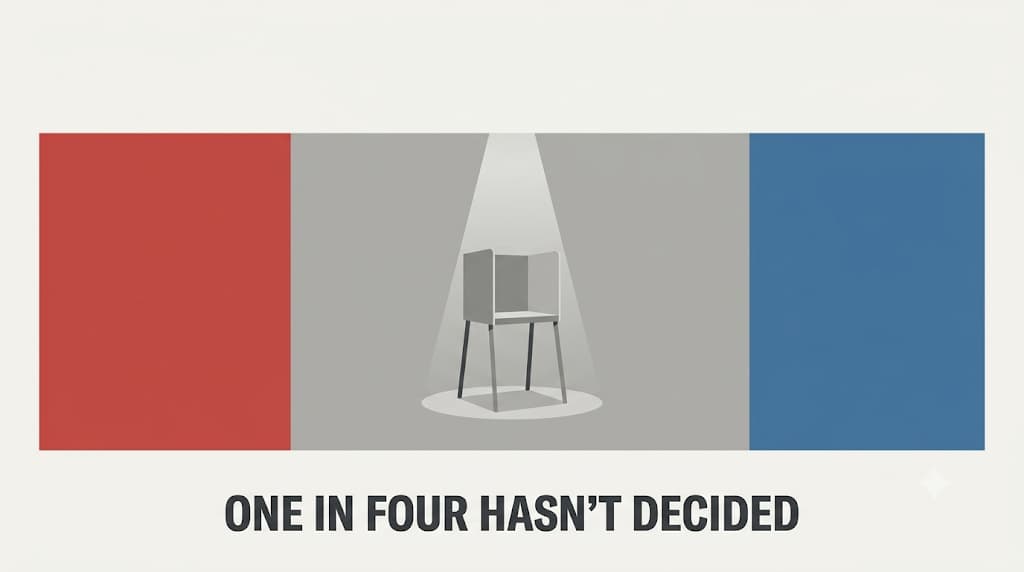

Nearly a quarter of the American electorate is politically homeless heading into November and Republicans have a narrow, closing window to win them back.
What to Know
- Republicans are losing voters to undecided, not to Democrats
- Roughly 25% of the electorate remains politically unsettled heading into 2026
- Cost of living triggers visceral voter anger above every other issue
- Immigration contrast flips the ballot from D+6 to R+18 on one question
- Two-thirds of GOP's November opportunity sits with low-propensity Trump voters
Republicans are not watching voters walk into the Democratic tent. According to Cygnal, a May survey of 1,500 likely midterm voters found that the movement is sideways, not left. Voters who gave President Trump his second term are drifting toward undecided, disillusioned by a system they feel has again stopped listening to them. Pollster Mitch Brown put it plainly on the Signal Pulse Pod: "This isn't a blue wave so much as a warning light."
That warning light is flashing brightest among a specific group: young, non-college-educated white men under 55 who are moderately conservative socially but fiscally hawkish, and who earn between $75,000 and $125,000 a year. These are the exact voters who don't consume traditional media, don't show up reliably in midterms without Trump on the ballot, and will not be reached by a standard ad buy. They are not going Democrat. But if Republicans don't give them a reason to vote, they won't show up at all, and that silence will cost seats.
Who These Voters Actually Are
Strong Republicans are down net 20-plus points on country direction in just three months. A third of "mostly Republican" voters say they don't plan to vote based on what President Trump is doing right now.
%20copy-jpg-1.jpeg?width=647&height=361&name=image%20(1)%20copy-jpg-1.jpeg)
Strong Republicans drifting toward undecided, not Democrats. Campaign Now (Gemini)
Strong Republicans are now net 20-plus points lower on direction of the country than they were just three months ago. A third of voters who call themselves "mostly Republican" say they don't plan to vote based on what President Trump is doing right now. These aren't ideological defectors. These are exhausted, economically squeezed Americans who voted for change and are still waiting to feel it.
-jpg-Jun-04-2026-10-31-42-3636-AM.jpeg?width=248&height=248&name=image%20(3)-jpg-Jun-04-2026-10-31-42-3636-AM.jpeg)
Nick Weinstein, Principal and Pollster at Cygnal
Nick Weinstein of Cygnal told the Tudor Dixon Podcast that there is a major populist anxiety underpinning both parties right now, driven by voters who are "solely focused on the economy and incredibly frustrated with incumbent politicians in both political establishments." Cygnal polling also confirmed that 45% of voters say the Democratic Party's top priority is simply opposing President Trump, not governing, not solving problems. That leaves the persuadable middle with nowhere to go but further into disengagement, which is exactly where they are heading.
Why Both Parties Are Failing Them
Both parties are bleeding the same voter. Democrats have peaked and Republicans are gaslighting, and the middle is watching both of them do it.
-jpg-Jun-04-2026-10-31-54-6485-AM.jpeg?width=495&height=270&name=image%20(1)-jpg-Jun-04-2026-10-31-54-6485-AM.jpeg)
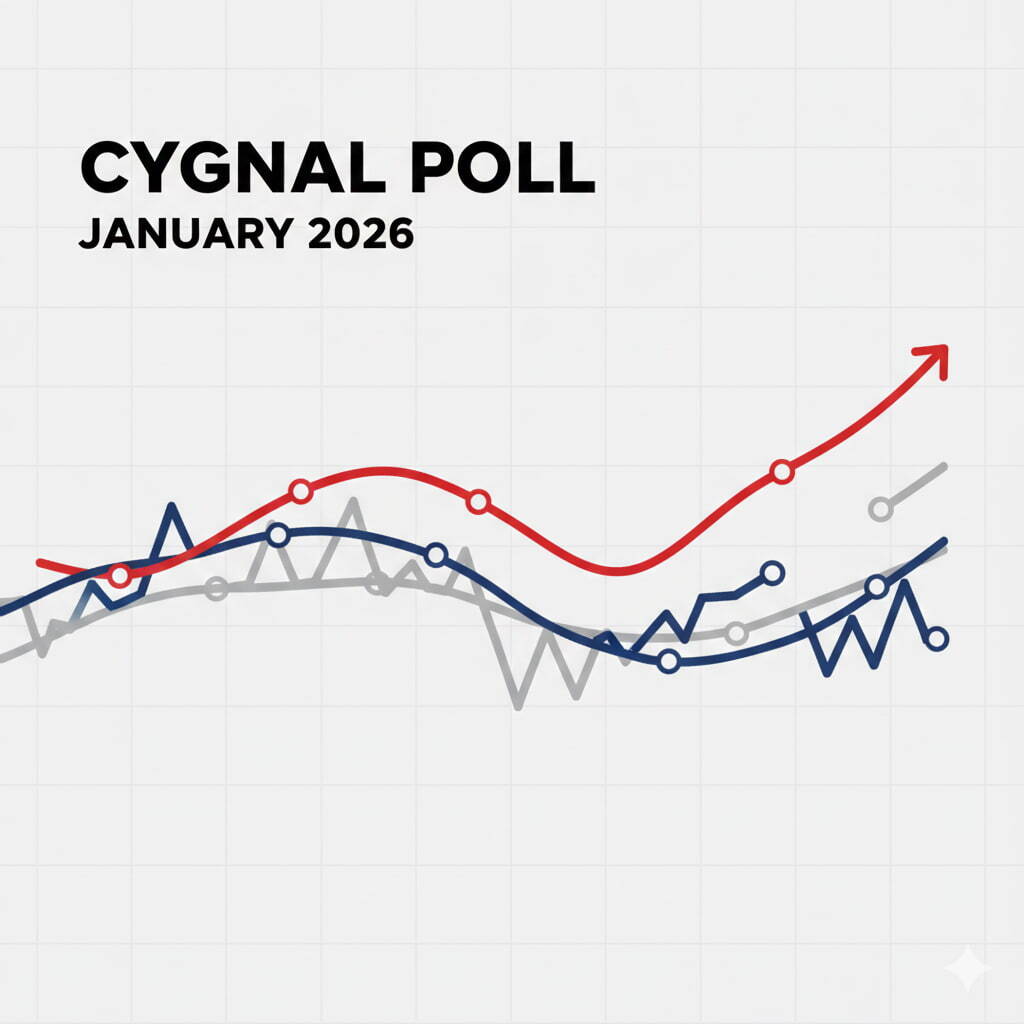
Both parties losing voters to the middle. Campaign Now (Gemini)
Democrats peaked in ballot share several months ago and have actually lost ground since, despite every headwind working in their favor. Republicans, meanwhile, are making the opposite error: glossing over real pain with optimistic economic messaging that lands as gaslighting.
-jpg-Jun-04-2026-10-32-02-4157-AM.jpeg?width=360&height=360&name=image%20(4)-jpg-Jun-04-2026-10-32-02-4157-AM.jpeg)
Brent Buchanan, Founder and CEO of Cygnal
Brent Buchanan, CEO of Cygnal, on Daily Wire's Wired In Live:
"Don't gaslight Americans. Empathize with them. But we also have to have a plan."
Cygnal's open-ended sentiment analysis found that "body sense", a visceral, physical emotion, was the single dominant feeling associated with cost of living. Voters said things like "I can't afford to eat," "I'm choosing between fuel and food," and "I'm barely surviving." Ribeye prices are up 90% since 2020 and gas is up 66% in the past year. Telling those voters the economy is strong is not just ineffective, it is an act of political self-destruction.
What Issues Actually Move Them
Two issues close the deal with unsettled voters: cost of living opens the door and immigration enforcement slams it shut for Democrats. Energy production ties both together.
-jpg-Jun-04-2026-10-32-12-4098-AM.jpeg?width=453&height=253&name=image%20(2)-jpg-Jun-04-2026-10-32-12-4098-AM.jpeg)
Cost of living leads every issue voters care about. Campaign Now (Gemini)
Cost of living is the emotional entry point and immigration is the contrast closer. Cygnal's informed ballot test framed the choice as a Democrat who opposes deporting convicted criminal illegal immigrants versus a Republican who supports it. That single framing moved the generic ballot from D+6.1 to R+18, a swing that cut across every demographic group, including Democrats and Hispanics. Independents moved by 40 points on that contrast alone.
Buchanan told Wired In Live that increasing domestic energy production is the single broadest economic coalition builder available to Republican candidates right now. Democrats have handed Republicans a clean contrast: they want to restrict energy in the name of climate policy, an issue that has dropped to the bottom of every issue ranking alongside abortion. Republicans who are still messaging on anything other than cost of living, immigration enforcement, and energy production are, as Buchanan put it, "focused on something else", and they are going to lose.
Are They Persuadable or Just Disengaged
Most of these voters are not persuadable in the traditional sense. They are reachable, but only through turnout, not ideology. Getting them off the sideline is the whole game. These are not swing voters. They already lean right. They already backed Trump. But they consume almost no traditional political media, they feel forgotten, and a midterm ballot without Trump on it does not naturally motivate them to drive to a polling location.
%20copy-jpg-1.jpeg?width=449&height=245&name=image%20(2)%20copy-jpg-1.jpeg)
Two-thirds of GOP opportunity is turnout only. Campaign Now (Gemini)
Buchanan's state-level analysis showed that in a typical competitive race, two-thirds of the GOP's opportunity sits with low-propensity Republican voters and only one-third lies in true persuasion. Weinstein reinforced this on the Tudor Dixon Podcast, noting that roughly 10% of young men who voted for Trump in 2024 also considered left-leaning candidates, not because they are ideologically flexible, but because they are economic populists who will back whoever most convincingly tells them the system is rigged against them.
Brent Buchanan, CEO of Cygnal, in America's Emotional Divide:
"An expectation is a premeditated resentment. Right now, a lot of expectations have been let down."
Republicans do not lose this group to Democrats. They lose them to the couch, and that is a problem no ad buy alone can fix.
What Republicans Must Do Now
Republicans have the voters. They just have not given them a reason to show up. A two-step formula separates winners from losers in November.
Campaigns targeting low-propensity Trump voters ages 25–59, leading with cost-of-living acknowledgment, and closing with the immigration contrast are positioned to close the enthusiasm gap that Democrats are counting on. Those that coast on Big Beautiful Bill messaging will find it has already faded from voter memory.
As Buchanan put it on Wired In Live, "You can't leave it to the voters. They are so busy with their life. You have to simply set the table stakes for them." Cygnal's data is equally clear on what does not work: pretending economic pain does not exist, messaging at altitude with policy jargon, or leaving the contrast to voters to figure out on their own. That two-step formula, acknowledge the pain and draw the contrast, is the only path to turning disengaged Trump voters back into midterm voters.
Wrap Up
Republicans do not need to find new voters in November. They need to find the ones they already have and give them a reason to show up. Voters leaning away from the GOP are not ideologically lost, they are emotionally unmet, economically frustrated, and waiting for a candidate who will say out loud what they are already feeling at the grocery store, the gas station, and the kitchen table.
Democrats have no national figure, no unifying message, and a base that has peaked in both intensity and ballot share. What they do have is an opponent still deciding whether to fight for the middle or assume it will come along. November will settle that question.