
New polling shows a quiet but significant suburban shift toward Republicans, and Democrats are focused everywhere except where the battle is actually being won.
What to Know
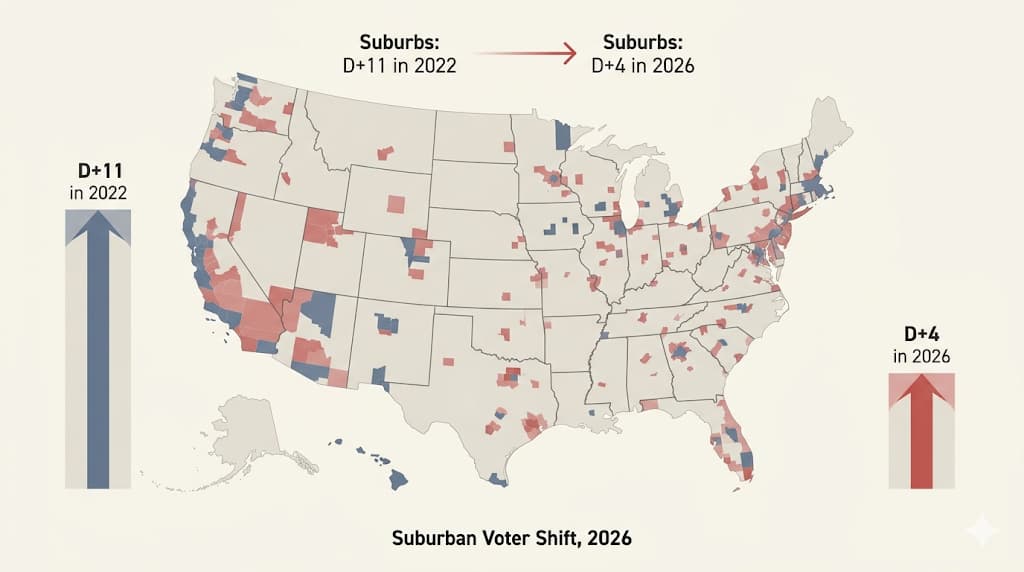
- GOP suburban deficit narrowed from -11 to -4 in roughly 60 days
- Suburban voters shifted 7 points toward Republicans since March 2026
- Suburbs represent 55% of all voters and decide virtually every swing race
- Immigration contrast testing produced a nearly 25-point ballot swing for Republicans
- Democrats have peaked on the generic ballot despite a worsening national environment
Suburban voters have spent nearly a decade drifting away from the Republican Party, and most of Washington's political class has treated that drift as permanent. New data from Cygnal's May 2026 national survey of 1,500 likely midterm voters, discussed in detail on Pulse Pod Episode 89, shows the drift is slowing but the path back is not clean. Suburban areas have narrowed the Democratic advantage from -11 to -4 since March, yet the same voters fuming about inflation still leave Democrats with a +4 generic ballot margin in these critical districts, which is exactly why the national generic ballot sits at D+6.1 and not in Republican territory
Most media coverage of the 2026 environment remains fixed on national mood metrics and wrong-track numbers, and those numbers are genuinely difficult for Republicans. The overall generic ballot still sits at Democrats +6.1, and strong Republicans' direction-of-country score has dropped a net 20-plus points over the last three months. Middle-class suburban voters in the $75,000 to $125,000 income bracket collapsed by a net 26 points on country direction, and Boomers and Hispanics shifted hard toward Democrats. But Cygnal's pollsters make clear this is not a straightforward blue wave. Republican-leaning voters are not fully committing to Democrats. They are drifting toward undecided, and that incomplete commitment is the narrow, volatile window Republicans must act on before it closes.
What Is Driving the Suburban Return
Suburbs overall sit at Democrats +3 in 2026 according to USPollingData's April 2026 analysis, with college-educated suburbs still leaning Democratic by 18 points and non-college suburbs running Republican by 12 points. Republicans have not won back the college-educated professional suburbs lost between 2016 and 2022, and the mixed-education middle suburb, the 30 to 55-year-old homeowner bracket with children at home, is where the bleeding is sharpest. These voters have not fully committed to Democrats yet, which is the only reason a window still exists.
-jpg-Jun-20-2026-09-40-39-4700-AM.jpeg?width=172&height=172&name=image%20(4)-jpg-Jun-20-2026-09-40-39-4700-AM.jpeg)
-jpg-Jun-20-2026-09-40-45-3868-AM.jpeg?width=288&height=288&name=image%20(5)-jpg-Jun-20-2026-09-40-45-3868-AM.jpeg)
Brent Buchanan, Partner and Pollster, Cygnal
Cost of living is the dominant driver of that movement in this bracket. US inflation hit 3.80% year-over-year in May 2026 according to FXMacroData, accelerating sharply from 3.30% the prior month. Buchanan's data points specifically to the $75,000 to $125,000 income bracket as the most acutely pressured group, describing families in this band as overburdened and squeezed between rising costs and stagnant purchasing power. The Hill reported in May 2026 that despite some progress, millions of Americans still do not feel sufficient relief on everyday essentials.
-jpg-Jun-20-2026-09-41-23-1317-AM.jpeg?width=555&height=310&name=image%20(1)-jpg-Jun-20-2026-09-41-23-1317-AM.jpeg) Campaign Now (Gemini), Suburban family, cost-of-living pressure, 2026 midterms.
Campaign Now (Gemini), Suburban family, cost-of-living pressure, 2026 midterms.
Buchanan warned that optimistic economic messaging skipping acknowledgment of ongoing pain will fall flat with exactly this group. Voters in this bracket are not expecting prices to return to 2020 levels. What they want, according to Cygnal's open-ended sentiment analysis, is to be seen first and given a credible plan second. Messaging that leads with achievements before acknowledging struggle registers as tone-deaf, the same error that cost Democrats badly in 2024.
Immigration Is the Sleeper Issue in the Suburbs
On a generic ballot, Democrats lead by 6.1 points. When Cygnal tested a contrast framing, a Democrat who opposes deporting convicted criminal illegal immigrants versus a Republican who supports it, that nearly 25-point swing erased the Democratic lead entirely and pulled the race into a dead heat with a slight Republican advantage.
-jpg-Jun-20-2026-09-41-38-3763-AM.jpeg?width=222&height=222&name=image%20(6)-jpg-Jun-20-2026-09-41-38-3763-AM.jpeg)
Mitch Brown, Pollster and Principal, Cygnal
Every single demographic tested, including Democrats, moved further toward the Republican position under this contrast than the generic ballot showed. Brown noted the contrast moved independents by 40 points and Hispanics by the mid-20s, with suburban voters in the older millennial and younger Gen X bracket showing particularly strong responses, especially those with children at home. ABC News reported in November 2025 that suburban women are prolific consumers of political information with high expected turnout in 2026, making this group both persuadable and highly likely to show up.
-jpg-Jun-20-2026-09-41-52-6986-AM.jpeg?width=579&height=323&name=image%20(2)-jpg-Jun-20-2026-09-41-52-6986-AM.jpeg) Campaign Now (Gemini), generic ballot D+6 vs. immigration contrast R+18.
Campaign Now (Gemini), generic ballot D+6 vs. immigration contrast R+18.
Brown was direct about what this means strategically: immigration is not the only issue, and running exclusively on it does not guarantee an 18-point win. But as a contrast tool that activates intensity and draws a clear line between the parties, it is among the most powerful single-issue levers Cygnal has tested heading into November.
What Democrats Are Missing and What Republicans Must Not Waste
Democrats have a structural ceiling problem that their generic ballot lead obscures. Support has plateaued and actually shaved roughly a point over the past two months even as Trump's image declined and inflation accelerated. Brown's assessment is direct: the Democratic base is as fired up as it can get, but that ceiling is not high enough.
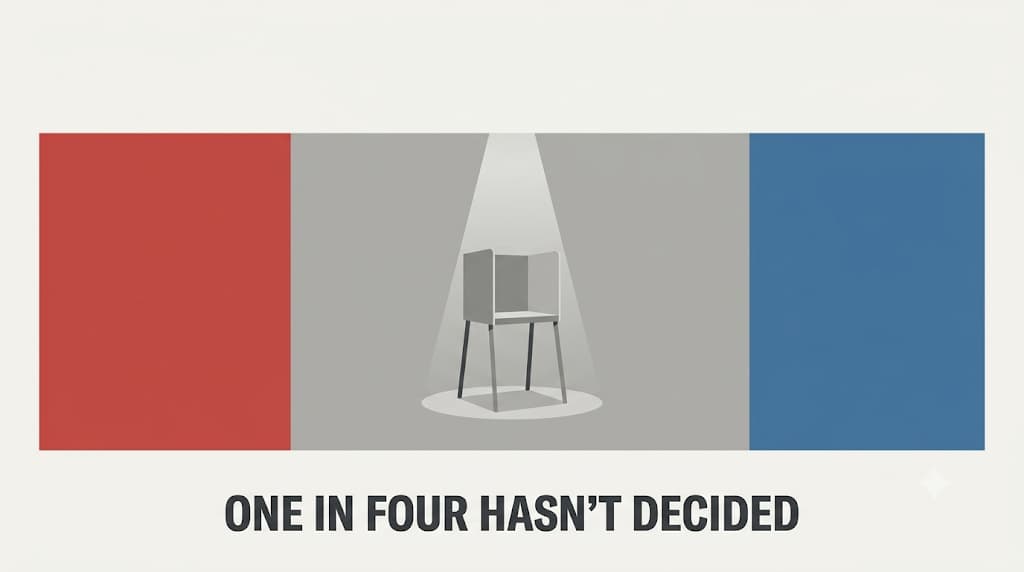
According to Cygnal's May survey, 45% of voters believe Democrats' primary focus is simply opposing Trump rather than offering solutions, a perception that lands particularly hard in suburbs where voters are living the cost-of-living reality every week. Because Democrats have plateaued, the suburban movement is not a Republican recovery but a pause, with disillusioned voters parked in the undecided column rather than committing to either side.
-jpg-Jun-20-2026-09-42-19-4526-AM.jpeg?width=496&height=277&name=image%20(3)-jpg-Jun-20-2026-09-42-19-4526-AM.jpeg)
Campaign Now (Gemini), Democratic plateau and the undecided suburban pause.
Republicans, meanwhile, are sitting on a genuine opportunity that carries an equally genuine warning. Cygnal's data identified that two-thirds of the Republican path to winning swing-state races runs through low-propensity GOP voters, not persuasion. That path requires a dual approach: turn out low-propensity base voters in the suburban zip codes while using empathetic economic messaging to close the deal with the undecided suburbanites still up for grabs.
Axios reported in September 2025 that GOP strategists have been warning for months that tone-deaf economic messaging could erase structural advantages heading into November. Winning the suburbs in 2026 requires a two-step: acknowledge the pain, then present the contrast.
Wrap Up
Suburban voters have not handed Republicans anything. What Cygnal's May data shows is a fluid window, not a done deal, where voters are sitting in undecided and have not committed to either party. That window opened fast and can close just as fast.
Democrats have the national environment, the anger, and the institutional momentum, but their ceiling is not high enough to close without these voters. Republicans have the contrast tools and the data. Whoever wins the final messaging war on cost of living and immigration wins the suburbs. Whoever wins the suburbs decides which party controls Congress in November.

-4.jpg)