
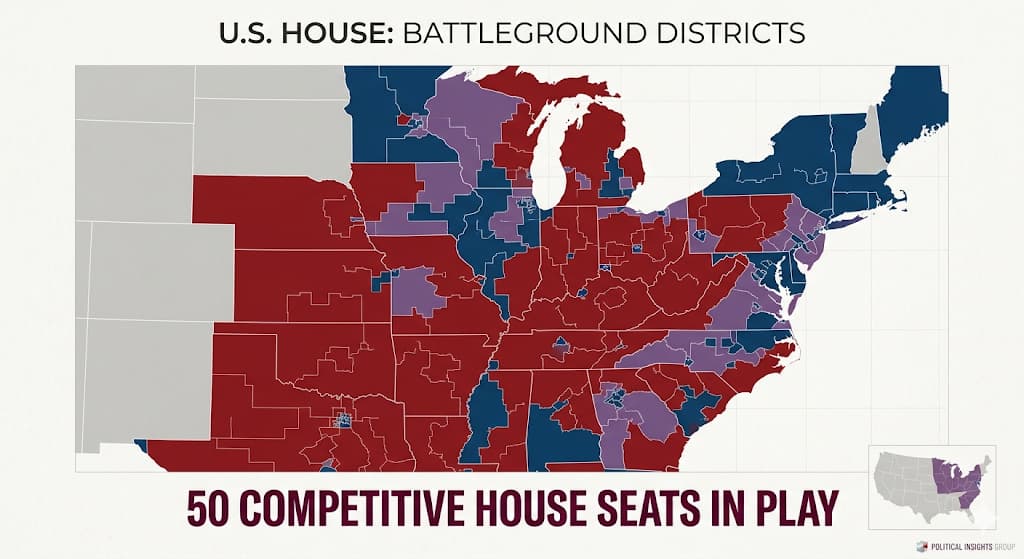

Republican map-makers built a structural fortress, but low-propensity voters and Sun Belt math will determine whether it holds.
What to Know
- Redistricting shifted the House bellwether seat from Trump +3.1 to Trump +5.1, narrowing the wave threshold Democrats need to flip the chamber.
- Roughly 50 House seats are rated competitive heading into November, but redistricting has structurally pre-loaded most toward Republicans.
- North Carolina's new map eliminated multiple competitive seats, converting Democratic-leaning districts into safe Republican terrain.
- Texas is projected to gain up to 4 congressional seats after the 2030 census, while Florida is on track to gain 2 to 3, cementing Sun Belt dominance.
- Low-propensity Trump voters are largely apathetic without Trump on the ballot, giving Democrats a high-propensity turnout advantage in 2026.
Structural forces shaped long before November are already determining which party controls the House. Redistricting, demographic migration into Sun Belt states, and the compressed behavior of low-propensity voters have narrowed the battlefield so dramatically that neither a modest Democratic wave nor a modest Republican hold can be read through traditional seat-count models. Patrick Ruffini, Republican pollster and author of Party of the People, laid out exactly how severe that compression has become in his May 2026 analysis for The Intersection.
Ruffini found that a Democratic wave cresting at Trump +9 would yield only a 222-213 majority under new district lines, versus 239-196 under old lines, a swing of 17 seats taken off the board by redistricting. Democrats need only a net +4 seats for the majority today, but the map they must win it on is the most hostile in the modern era.
Redistricting Rewrote the Terrain
Republican-controlled legislatures in Texas, Missouri, and North Carolina drew aggressive gerrymanders as part of a coordinated national push. North Carolina's redraw is the sharpest example of map-making as a structural weapon. Multiple seats that leaned Democratic under old lines were redrawn into safe Republican terrain, removed from the competitive pool before a single dollar was spent.
New York's court-ordered remapping produced a mirror-image dynamic, Democrats redrawing lines aggressively after the state Court of Appeals approved a new map. Inside Elections rates roughly 50 House seats competitive heading into November, but redistricting pre-loaded the outcome in dozens that would have been genuine battlegrounds under old lines.
-jpg-May-31-2026-08-58-52-6703-PM.jpeg?width=771&height=421&name=image%20(1)-jpg-May-31-2026-08-58-52-6703-PM.jpeg)
Campaign Now (Gemini), data from Ballotpedia, NC and NY redistricting terrain shift
-jpg-May-31-2026-08-57-25-1122-PM.jpeg?width=280&height=280&name=image%20(4)-jpg-May-31-2026-08-57-25-1122-PM.jpeg)
Patrick Ruffini, Political Analyst, The Intersection
Patrick Ruffini, writing in his May 22 newsletter, framed the bellwether shift plainly:
"The tipping point in the House moved from Trump +3.1 in AZ-1 to Trump +5.1 in PA-10. That matters enormously in any campaign to win back the House in 2028."
AZ-1 and PA-10 function as benchmarks for wave conditions rather than a fixed majority threshold, but the directional shift is unambiguous. For Republicans the tactical implication is clear: protect the Hindenburg Line at Trump +9 and starve Democrats of oxygen in the 13 seats redistricting removed. For Democrats the only path is nationalizing the environment enough to push past that threshold.
Demographic Migration and the Sun Belt Math
Redistricting is one structural layer. Demographic migration is the other. Brennan Center projections show Texas gaining up to 4 congressional seats after the 2030 census, Florida gaining 2 to 3, North Carolina adding 1 and Arizona 1. Republicans control the legislatures that will draw those maps, meaning every new Sun Belt seat under favorable lines carries forward as a structural asset into 2032 and beyond.
-jpg-May-31-2026-08-59-25-7173-PM.jpeg?width=627&height=342&name=image%20(2)-jpg-May-31-2026-08-59-25-7173-PM.jpeg) Campaign Now (Gemini), data from Brennan Center, projected Sun Belt seat gains after 2030 census
Campaign Now (Gemini), data from Brennan Center, projected Sun Belt seat gains after 2030 census
If Sun Belt population trends hold, the South would hold a record 164 House seats next decade. Democrats' only counter is winning enough Sun Belt seats now to influence future mapmaking before reapportionment locks in another decade of disadvantage.
The Low-Propensity Problem Republicans Cannot Ignore
Structural map advantages matter less if the voters who power them stay home. Ruffini's Echelon Insights tribal analysis shows the Hard Right makes up less than 1 in 5 low-propensity Trump voters. J.L. Partners research found large numbers of former Trump voters unenthusiastic about 2026. OnMessage pollster Sam Kay told the Daily Caller News Foundation that Republicans will have a hard time surviving the midterms without engaging the low-propensity Trump voter.
-jpg-May-31-2026-08-57-06-5217-PM.jpeg?width=590&height=322&name=image%20(3)-jpg-May-31-2026-08-57-06-5217-PM.jpeg)
Campaign Now (Gemini), data from Echelon Insights, Hard Right share of low vs. high propensity Trump voters
Republicans' tactical answer must be a mobilization operation built around protecting Trump's agenda. Democrats' answer is the inverse: nationalize the environment against Trump and force Republican incumbents onto defense in seats redistricting assumed were safe.
Wrap Up
Republicans enter 2026 holding terrain unimaginable under old district lines. Fewer genuinely competitive seats, higher Democratic wave thresholds, and a Sun Belt map growing more favorable every census cycle represent a structural advantage earned through disciplined redistricting strategy.
Holding it requires activating the tribal coalition Ruffini maps. Middle American Optimists at 14% of the electorate backed Trump by 28 points and represent the persuadable center of gravity. Low-propensity voters in Trump +9 territory are the firewall. Getting them to the polls without Trump on the ballot is the one variable redistricting cannot solve.

-3.jpg)
-4.jpg)