
National mood is inching upward, but financial stress remains widespread—and the early midterm landscape shows voters leaning toward checks and balances even as Trump’s image improves.
What to Know
- Financial fragility is widespread: The poll found 30% of voters are “not at all confident” they could handle a $1,000 unexpected emergency expense.
- The midterm map starts tight: The poll shows Democrats lead the generic congressional ballot 48%–45% (D+3).
- Trump’s image is improving: The poll finds Donald Trump’s image has improved by +6 net points since November 2025.
- Voters want checks and balances: A majority prefer a divided Congress (51%) over unified GOP control (42%).
- Capitalism isn’t a slam dunk: Just 54% view capitalism favorably, dropping to 40% among low-propensity voters.
This analysis draws on Cygnal’s January 2026 National Voter Trends (NVT) poll of 1,500 likely general election voters, conducted January 7–8, 2026 (±2.51% margin of error). The findings were released January 15, 2026, and discussed in detail by lead pollsters Brent Buchanan and Mitch Brown on Pulse Pod Episode 85.
.jpg?width=640&height=480&name=cover%20YT%20(1).jpg)
Cygnal Pulse Pod Episode 85 (January 2026 NVT Poll discussion).
Empathy, Not Victory Laps, Is The Hidden Driver Of Trump’s Rebound
The Cygnal poll suggests the political environment is loosening slightly without becoming “good.” National mood improved +9 net since November: “wrong track” sits at 55% while “right direction” rose to 42%. At the same time, Trump’s image improved +6 net since late 2025—an early indicator that persuasion is possible, especially if campaigns communicate in the right register.
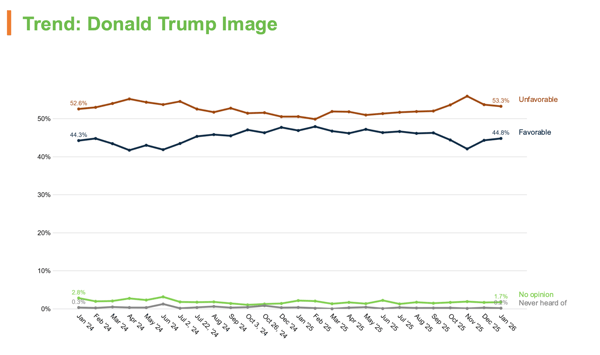
Screenshot from the Cygnal’s January 2026 National Voter Trends
Cygnal poll also tests whether telling voters about a package of claimed economic and national security wins changes how they see the president. After hearing those accomplishments, 45% say they become more favorable toward Trump, compared to 17% who become less favorable—suggesting the narrative can move opinion, but not automatically.
.jpg?width=394&height=394&name=brent%20(1).jpg)
Cygnal CEO and pollster Brent Buchanan
On the Pulse Pod podcast, Cygnal CEO and pollster Brent Buchanan warned that campaigns must lead with understanding rather than statistics, arguing that
"if you can't solve the problem in two months... you at least got to tell people like I get it. I get that it sucks." He cautioned that "just gaslighting Americans and saying, ‘Look at all these successes actually pushes them away further.’"

Mitchell Brown, Partner & Pollster
Cygnal partner and pollster Mitch Brown echoed this point with a sequencing argument:
"I think the only way to talk about success is to say, ‘Okay, that was step one.’ ... Next will be housing affordability or next will be food prices or healthare costs, whatever that is. Like, hey, this was step one. We know that's not enough."
The Midterm Landscape: Tight Races, Divided Government, And A Party-Brand Trap
The poll’s toplines show a competitive environment: Democrats hold a 48%–45% edge on the generic ballot, and voters broadly prefer divided government (51%) over unified GOP control (42%). That’s a warning light for any party tempted to campaign on dominance instead of competence.
At the same time, the party images are ugly—especially for Democrats in Congress. Cygnal finds Democrats in Congress at 57% unfavorable (net -20), compared with Republicans in Congress at net -12. That combination—tight generic ballot + weak party brand—usually signals volatility: swing voters are available, but also easily spooked.
Campaign implication: In competitive districts, the message that tends to travel furthest is “problem-solving competence” rather than “total control.”
What Type Of Republican Will Win?
Cygnal asked voters what kind of Republican they prefer. The plurality choice is a moderate who works across the aisle (32%), ahead of Trump-aligned (21%) and traditional conservative (20%). Among swing voters, the appetite for “moderate” branding is even stronger: 45% say they want a moderate Republican.
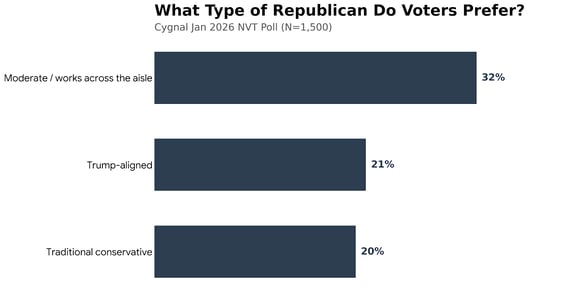
sRepublican voter preferences based on the Cygnal January 2026 poll— created by Campaign Now with Gemini.
But the pollsters' detailed analysis adds a critical reality check: labels are not destiny. Brown cautioned that “moderate Republican” as a brand has often underperformed in practice: “A moderate Republican has ran and lost. We’ve seen this over and over again.” He argued Trump’s advantage is coalition breadth—a populist edge that can pull from multiple factions.
Buchanan framed the winning formula more practically: “You can be a somewhat moderate Republican who is very aggressive on the key issues that that particular district matters for,” and stressed the need for sharp contrast: “You’ve got to let them know what the alternative is. I am this, they are that.
Strategic read: The “winning Republican” in 2026 is likely not a purity type. It’s a candidate who can project empathy + competence, keep Trump’s coalition, and localize issue intensity to what matters most in-district.
The Affordability Paradox: The Priority Drops, The Pressure Stays
Even when “inflation and the economy” shifts in salience, it still defines lived experience. Cygnal finds inflation/economy remains the #1 issue at 20%—and the stress indicators are blunt: 37% have zero confidence they could find a comparable job within three months, and 30% say they’re not at all confident they could handle a $1,000 emergency.
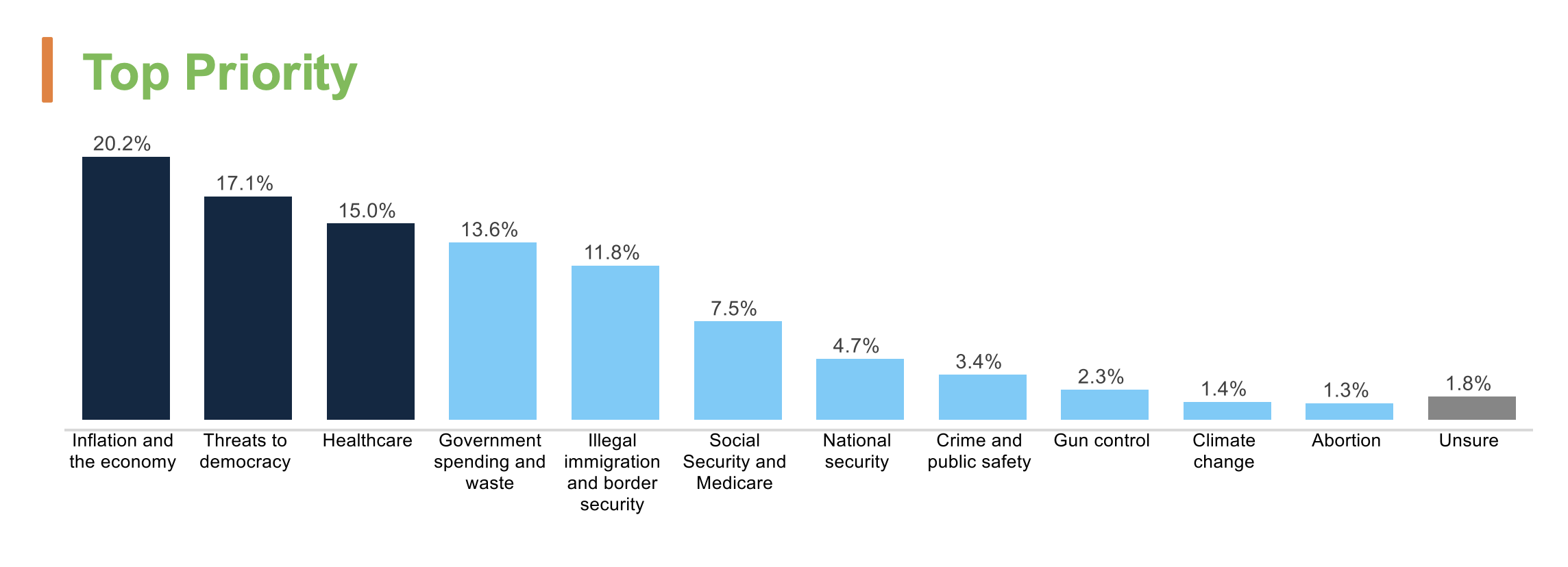
Screenshot from the Cygnal’s January 2026 National Voter Trends
Housing is the clearest example of “pressure without movement.” On mortgage rates, 44% say current rates make no difference to homebuying plans, 31% say it makes buying less likely, and only 13% say it makes them more likely to buy—suggesting a market that feels locked for many households.
Cygnal poll also flags health-cost brittleness: 20% say they would go without health insurance if faced with significantly higher premiums (with another meaningful share unsure how they’d handle it). That’s a strong indicator that affordability politics aren’t just gasoline and groceries—they’re also healthcare tradeoffs.
What the pollsters emphasize: Buchanan’s core warning is interpretive: you can’t rename the election away from affordability just because voters rotate to new headlines.
Venezuela: A Strike Voters Back, Without An Appetite For Nation-Building
Cygnal finds 50% support the U.S. military operation targeting Nicolás Maduro, with 46% opposed. But the same voters draw a hard boundary around long-term involvement: 54% oppose the U.S. “running” Venezuela, and even among Republicans support is only around half for establishing a stable government there.
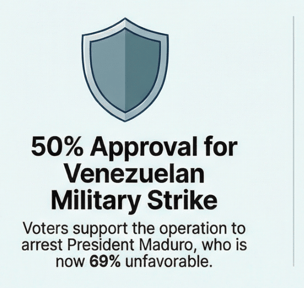
sssFigure based on the Cygnal January 2026 poll — created by Campaign Now with Gemini.
Cygnal’s data also suggests the operation increased salience: Maduro’s image moved sharply more negative (a large jump in unfavorable sentiment compared with prior measurement).
What the pollsters emphasize: Buchanan framed it as “decisive action” that voters will credit—so long as it doesn’t slide into nation-building.
Immigration Enforcement: Safety Vs. Overreach, And The Emotional Split
On deportation enforcement, voters are conflicted. Cygnal finds 50% say deportations have gone “too far,” while 25% say “about right” and 22% say “not far enough.” At the same time, 39% say enforcement is making their communities safer—showing that “too far” and “safer” can coexist in the same electorate.
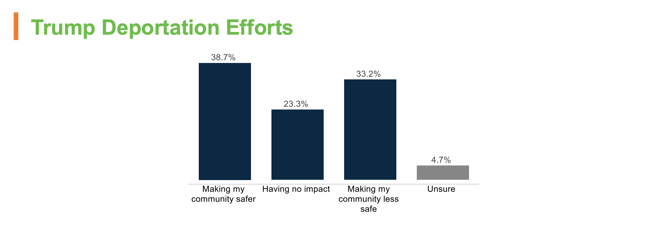
Screenshot from the Cygnal’s January 2026 National Voter Trends
Cygnal also highlights an intense emotional faction driving opposition—particularly college-educated liberal white women. In prior Cygnal tracking from October 2025, 61% of liberal white women ages 18–44 said violence against ICE agents is acceptable—an extreme signal that the conflict is not just policy-based but identity- and emotion-driven.
How Cygnal characterizes it: Buchanan describes an “emotional calamity” dynamic and adds: “The emotional divide over this issue is massive.” (Pollster commentary)
Capitalism, Socialism, And The “Does The System Work For Me?” Voter
Cygnal finds capitalism remains ahead—54% favorable versus socialism at 30% favorable—but the topline is softer than many Republicans assume it should be. Brown calls the 54% capitalism number “alarming” and argues younger voters “have been robbed of an education that tells the truth about capitalism…” in a broader critique of civic and economic instruction.
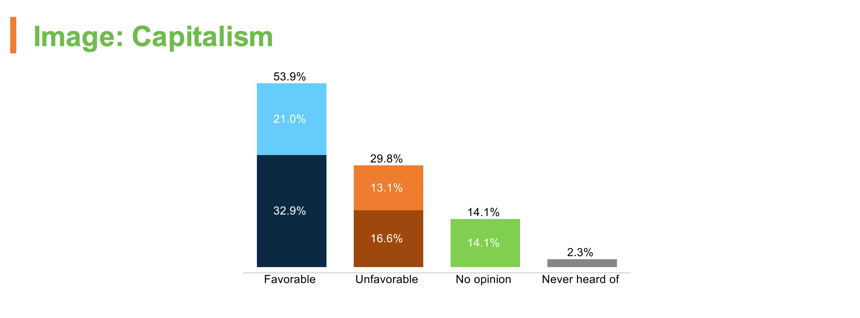
Screenshot from the Cygnal’s January 2026 National Voter Trends
Cygnal also frames the current debate through the lens of Zohran Mamdani’s rise in New York City, arguing that the real question for many persuadable voters isn’t ideology—it’s whether the system feels like it delivers. That’s the strategic vulnerability: when affordability is high and mobility feels blocked, “capitalism” becomes a referendum on lived outcomes.
Campaign implication: If Republicans want to defend capitalism, they have to prosecute the argument in practical terms—housing, debt, wages, and opportunity—rather than treating it as a default cultural inheritance.
Why Politics Feels Faster Now: The Social Media Cycle Effect
One of the more useful strategic observations from the Pulse Pod podcast is Brown’s theory of accelerated political cycles. He argues Americans increasingly expect rapid change—and punish delays—because they experience everything else at “instant” speed. As he put it: “People have gotten things at the tip of their fingers. They want change. They expect it like they expect change in a year.” He also points to how quickly expectations shifted in the smartphone era: “2012… was one year after the first iPhone came out… Now, it is just the custom norm.”
Campaign implication: On affordability, “this takes time” may be true—but it’s not persuasive unless paired with visible near-term steps and a credible timeline voters can feel.
Wrap Up
Cygnal’s January 2026 NVT read is not a victory story for either party—it’s a persuasion story. The electorate shows modest movement in mood, a measurable improvement in Trump’s image, and a tight generic ballot—but also deep personal financial stress, skepticism of one-party control, and a growing premium on candidate tone.
Practical takeaways:
- Lead with empathy, then “step one / step two.” The pollsters’ through-line is that voters want acknowledgment before metrics—and a sequenced plan, not a brag sheet.
- Win on candidate fit, not a label. “Moderate” tests well, but the winning Republican profile looks like coalition breadth plus district-specific issue aggression, delivered competently.
- Affordability remains the proving ground. Emergency-expense stress, job-market pessimism, housing paralysis, and healthcare tradeoffs create the conditions for rapid opinion swings.
Methodology: Cygnal’s January 2026 NVT poll surveyed 1,500 likely general election voters Jan. 7–8, 2026, with a ±2.51% margin of error.