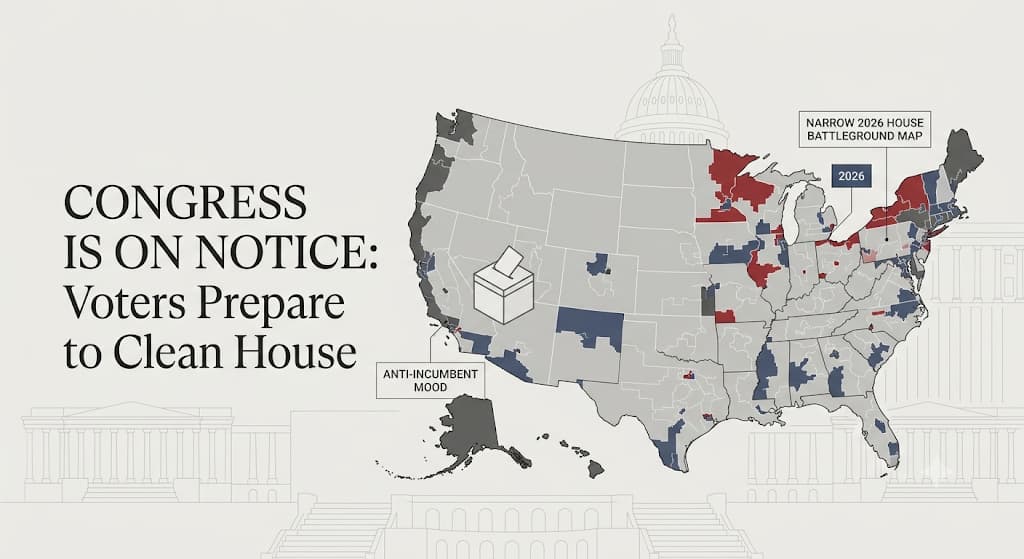

Aggressive map-drawing is creating brittle majorities, turning “safe” seats into liabilities ahead of a potential Democratic wave.
What to Know
- Redistricting is not a zero-sum game; creating hyper-partisan districts often lowers margins in surrounding areas, increasing vulnerability in a wave election.
- Despite a permissive Supreme Court, the 2026 redistricting wars have so far resulted in a strategic draw, not the structural GOP advantage many predicted.
- Incumbent risk aversion and public opinion act as powerful constraints on maximalist map-drawing, as seen in Indiana Republicans’ resistance and California Democrats’ relative restraint.
- Democrats’ willingness to retaliate with their own aggressive gerrymanders, like California’s Prop 50, has altered the strategic dynamic from a one-sided affair to a "prisoner's dilemma."
- Even a potential weakening of the Voting Rights Act may not create a permanent GOP majority due to backlash dynamics and ongoing demographic shifts.
The long-held belief was that redistricting offered a simple means for a political party to secure a lasting advantage. However, as parties now draw increasingly extreme maps, they may inadvertently be setting the stage for their own electoral undoing.
A recent analysis from Nate Silver’s Silver Bulletin suggests the answer is yes, framing the redistricting wars as a classic prisoner’s dilemma where mutually assured escalation is backfiring, particularly for Republicans. The strategy of "cracking and packing" voters to create safe seats simultaneously makes surrounding districts less secure, a critical vulnerability heading into the volatile 2026 midterms.
The Gerrymandering Prisoner's Dilemma
Redistricting has evolved into a classic prisoner’s dilemma, where restraint is punished and retaliation becomes rational. As Nate Silver has noted, once one party treats map-drawing as a weapon, the other side only loses by refusing to respond. Democrats appear to have crossed that threshold. California’s Proposition 50, the Election Rigging Response Act, signed by Governor Gavin Newsom marked a quiet but consequential break from the party’s long-standing preference for procedural restraint.

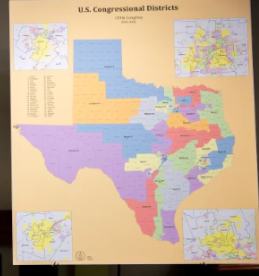
That logic is now shaping the 2026 battlefield. Republicans, pushed by President Donald Trump, are moving aggressively in Texas to convert multiple Democratic seats, while Democratic leaders are signaling they will counter in states where they retain leverage, including California and New York.
According to Axios, what began as rhetorical threats has hardened into real planning, driven by the belief that standing down would lock in structural losses. The result is not a durable advantage for either side, but a tense equilibrium, where escalation on one front is quickly offset elsewhere, leaving the national map effectively fought to a draw.
The Anatomy of a Backfire: Cracking, Packing, and Vulnerability
The strategic risk of gerrymandering lies in its two primary techniques: "cracking" and "packing." Packing concentrates the opposing party's voters into a few unassailable districts, conceding those seats to win more elsewhere. Cracking splits the opposition's base across many districts so they cannot form a majority in any of them.
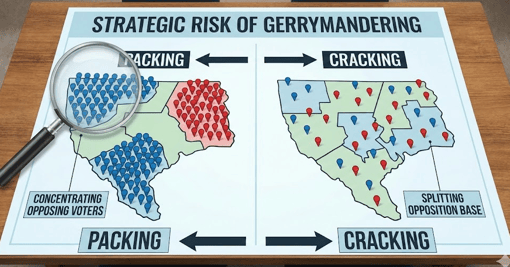
While effective on paper, this delicate math creates hidden vulnerabilities. To make a district safely Republican, for instance, GOP map-drawers must pull Republican voters from adjacent areas. The result is that those neighboring districts become less Republican and therefore more competitive.
This matters for campaigns because it lowers the threshold for a district to flip. A district that was once R+15 might become R+8 after redistricting. While still considered safe in a neutral political environment, it becomes a prime target in a Democratic wave year.
|
Metric |
Neutral Year (Baseline) |
Democratic Wave Year (+8 Swing) |
Status Change |
|
District Lean |
R+8 |
EVEN (R+0) |
Safe → Toss-up |
|
Republican Vote % |
54% |
46% |
Loss |
|
Democratic Vote % |
46% |
54% |
Win |
|
Margin of Safety |
Comfortable |
Non-existent |
Extreme Risk |
This is the central threat facing Republicans in 2026. A D+8 national environment, as some recent elections suggest is possible, could suddenly transform dozens of these methodically gerrymandered "safe" seats into genuine toss-ups.
The Incumbency Factor: Personal Brands vs. Partisan Tides
Maximalist redistricting does not just reshape partisan math; it destabilizes individual political careers. Incumbents build durable advantages through geographic familiarity, constituent service, and local identity, assets that evaporate when courts or legislatures redraw districts with little regard for continuity.
As the Brennan Center for Justice documents in its Redistricting Litigation Roundup, post-2020 maps have triggered litigation in 30 states and produced court-ordered redraws in 13, often forcing incumbents into unfamiliar territory or against fellow officeholders. The result is a measurable erosion of incumbency advantage, not because voters shift ideologically, but because map changes sever the relationships incumbents rely on to survive.
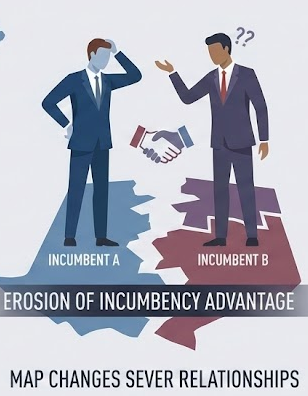
This dynamic helps explain why resistance to extreme gerrymanders often emerges from within the dominant party itself. Aggressive maps invite lawsuits, judicial intervention, and unpredictable outcomes, especially in state courts that are increasingly willing to police partisan excess.
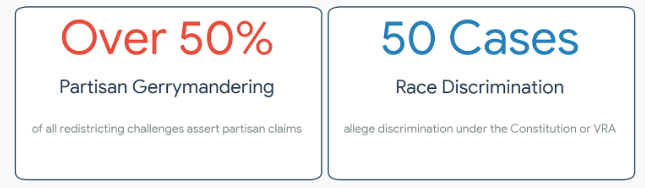
According to Brennan Center analysis, more than half of all redistricting challenges this decade assert partisan gerrymandering claims, and fully 50 cases allege race discrimination under constitutional or Voting Rights Act theories. For incumbents, the risk is not abstract.
Court-ordered redraws in states like Ohio, North Carolina, Wisconsin, and New York have already scrambled districts mid-cycle, demonstrating that pushing too far can cost sitting lawmakers their electoral footing. Even in an era of hardened polarization, self-preservation remains a limiting force on how extreme gerrymanders can become.
The Real-World Limits of Map Power
Parties do not draw maps in a vacuum. In California, Democrats faced clear political and institutional constraints that limited how far partisan advantage could be pushed. According to a Politico poll conducted with the Citrin Center for Public Opinion Research, a strong majority of California voters support keeping the state’s independent redistricting commission rather than returning full mapmaking authority to the legislature.
That public sentiment places a practical ceiling on maximalist strategies. Maps that cross the line from aggressive to absurd, such as a hypothetical New York district stretching from the Adirondacks to the Bronx, risk immediate legal challenges and public rejection. This constraint still matters because voters continue to punish perceived overreach.
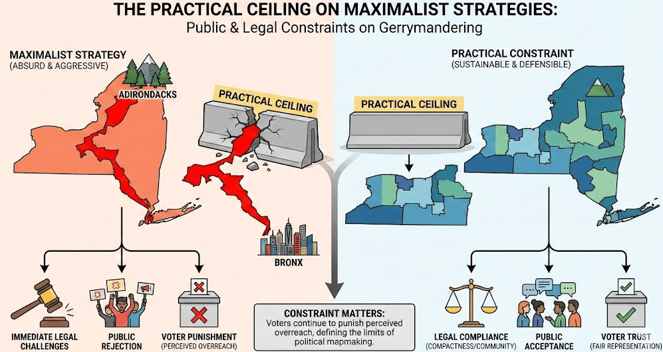
The Politico polling shows bipartisan discomfort with overtly partisan redistricting, reinforcing why party leaders remain cautious even when theoretical power exists. In a polarized era, the optics of procedural fairness and geographic coherence retain real political value. Courts, commissions, and voters together impose limits on mapmaking, ensuring that structural power is exercised within boundaries that cannot be ignored without consequence.
Wrap Up
The key lesson for 2026 is that the power of the map has its limits. Aggressive gerrymandering gives a party more seats with slight but brittle majorities. This strategy can reduce losses at the margins, but it cannot reliably prevent control of the House from flipping in a national wave. In fact, by spreading their voters thinner across more districts, parties may inadvertently raise their downside risk in a volatile midterm environment like the one shaping up for 2026. A D+8 national environment could suddenly put dozens of these “safe” Republican seats into play.
Looking beyond 2026, campaign professionals must internalize that redistricting is not a substitute for political persuasion. While a favorable map provides a buffer, that buffer can evaporate quickly when the national mood turns hostile. The fight for House control will still be won not by the party with the most creative mapmakers, but by the one that captures the support of the electorate. The lines on the map matter, but the voters within them matter more.