
When the ratings move and the cushion disappears, freshman Republicans are left with nowhere to hide.
What to Know
- Cook Political Report has moved 5 House races toward Democrats and only 1 toward Republicans in its latest ratings update, leaving Republicans defending 14 Toss-Up seats against Democrats' 3.
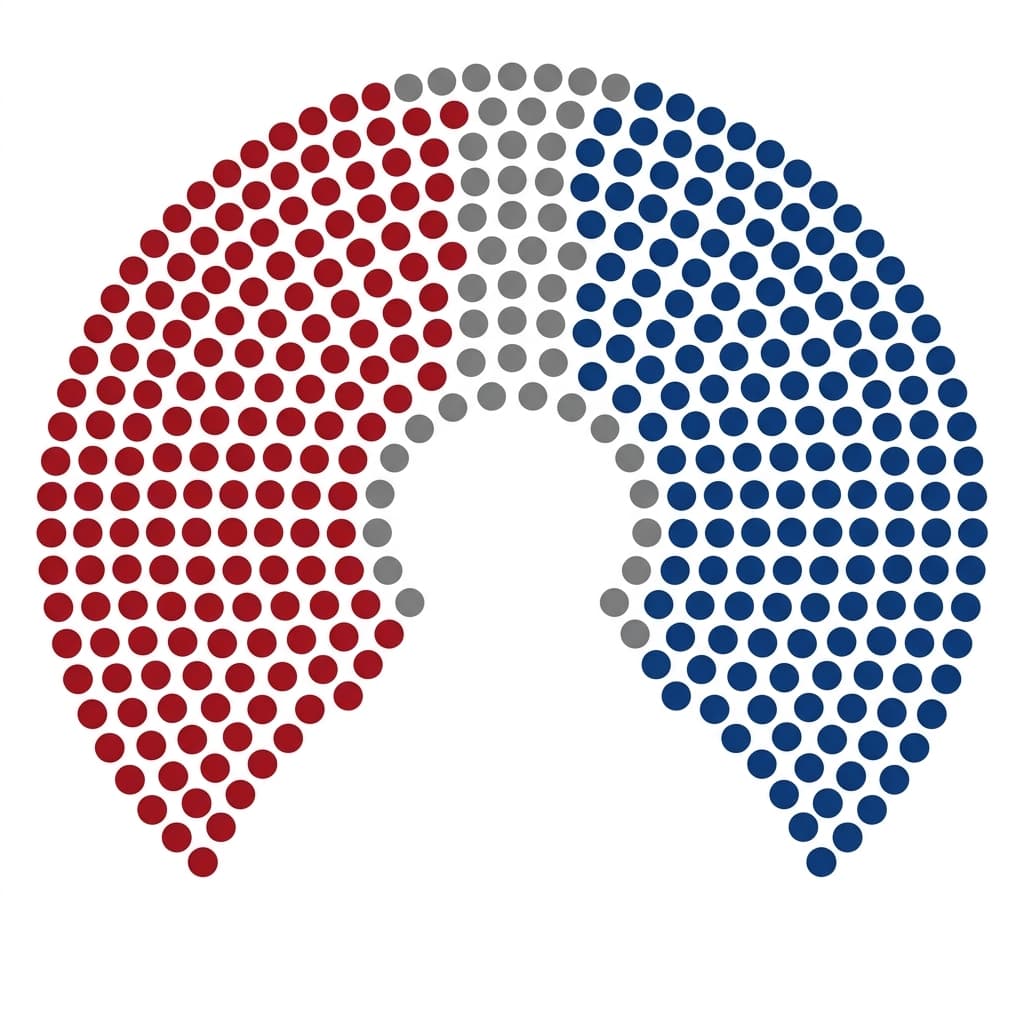
- Republicans currently hold a 220-215 House majority, meaning a net loss of just 3 seats hands the chamber to Democrats.
- Freshman Rep. Rob Bresnahan's PA-08 has been moved from Lean Republican to Toss-Up after his prolific stock trading gave Democrats a potent and self-reinforcing line of attack.
- The 2026 generic ballot polling average now sits at Democratic +5.4 points, with every major pollster tracked showing a consistent Democratic advantage ranging from +2 to +7.
- David Wasserman of Cook Political Report warns that Republicans must win 76% of all Toss-Up seats to hold the House majority, a threshold that grows harder to clear with every ratings shift.
Republicans came into the 2026 cycle with what looked like a structural advantage. President Trump won dozens of House districts by comfortable margins in 2024, and many of those same districts sent freshman Republican members to Congress just 18 months ago. On paper, those high Trump margins were supposed to function as a protective shield, a built-in buffer that would give Republican incumbents room to absorb a difficult midterm environment without losing their seats. That shield is cracking. The Cook Political Report's latest ratings update, authored by Erin Covey on April 7, 2026, moved 5 races toward Democrats and only 1 toward Republicans, a signal that the structural cushion freshmen were counting on is eroding faster than most campaigns anticipated.
The numbers behind this shift are not ambiguous. Race to the WH tracking shows the generic ballot sitting at Democratic +5.4 points as of April 21, 2026, consistent across every major pollster in the field. NPR reporting confirms that David Wasserman of the Cook Political Report now rates only 18 out of 435 House races as genuine toss-ups, meaning less than 5% of Americans will decide who controls Congress. That compression cuts both ways. For Republicans, it means the races that are competitive are intensely competitive, and freshman incumbents without deep roots in their districts are the most exposed.
The Ratings Map Has Shifted Against Republicans
The full picture of the Cook ratings update is worth reading carefully because each move tells a different story about how the Republican majority is being squeezed from multiple directions at once. Cook Political Report confirmed 6 total ratings changes on April 7, 2026: OH-01 moving from Toss-Up to Lean Democrat, OH-13 moving from Lean Democrat to Likely Democrat, NJ-09 moving from Lean Democrat to Likely Democrat, FL-27 moving from Solid Republican to Likely Republican, PA-08 moving from Lean Republican to Toss-Up, and the only rightward move, CO-03 moving from Likely Republican to Solid Republican.

Rep. Jeff Hurd, U.S. Representative, Colorado's 3rd Congressional District
The only Republican seat moving in a favorable direction is CO-03, where Rep. Jeff Hurd has strengthened his position. Every other move in this update either costs Republicans a seat they were counting on or tightens a race that should have been comfortable. The FL-27 shift is particularly notable because it is driven not by an incumbent's personal vulnerabilities but by Democrats recruiting a strong challenger into a district with a large Hispanic population, a warning sign that demographic targeting is producing results in seats Republicans once considered structurally safe.
-jpg-Apr-26-2026-04-57-45-8649-PM.jpeg?width=193&height=261&name=image%20(1)-jpg-Apr-26-2026-04-57-45-8649-PM.jpeg)
Erin Covey, U.S. House Editor, Cook Political Report
As Erin Covey at the Cook Political Report wrote on April 7, 2026:
"The political environment for House Republicans continues to look bleak. Even before President Donald Trump's approval rating reached a nadir amid spiking gas prices and an unpopular war with Iran, special and off-year elections showed Democrats with a significant enthusiasm advantage and Republicans were trailing the national generic ballot by five to six points."
That sentence frames the entire strategic problem. The ratings are not just a snapshot of individual races. They are a reflection of a national environment that was already deteriorating before the most damaging news cycles of 2026 hit Republican incumbents.
Rob Bresnahan Illustrates Exactly How the Shield Breaks
Pennsylvania's 8th is not a district Democrats were supposed to be able to target. It is a district that is proving they can.
-jpg-Apr-26-2026-04-57-57-2203-PM.jpeg?width=176&height=220&name=image%20(2)-jpg-Apr-26-2026-04-57-57-2203-PM.jpeg)
Rep. Rob Bresnahan, U.S. Representative, Pennsylvania's 8th Congressional District
PA-08 is the clearest case study in how a Trump-district cushion collapses in real time. Rep. Rob Bresnahan won his northeastern Pennsylvania seat in 2024 by only 2% in a district President Trump carried by roughly 8 points. That gap between the top of the ticket and the down-ballot result was always a vulnerability. It meant Bresnahan had less of a personal brand buffer than his district's partisan lean suggested, and it meant Democrats had a ready-made argument that the seat was never as safe as Republicans wanted to believe.
334-jpg.jpeg?width=220&height=220&name=image%20(1)334-jpg.jpeg)
Campaign Now (Gemini). PA-08 district shifting from Lean Republican to Toss-Up.
What turned a latent vulnerability into a Toss-Up is Bresnahan's stock trading record. Cook Political Report noted that his prolific stock trades have dogged him all cycle, giving Democrats a potent line of attack, and that his attempts to defend himself have only given Democrats more material for attack ads. This is the compounding dynamic that makes stock trading scandals so operationally damaging. Every response creates a new news cycle, every new news cycle feeds a new ad, and the candidate spends campaign resources playing defense in a district where they needed to be building offense. The DCCC has already made PA-08 a named priority target, citing the Cook move directly in their press communications.
-jpg-Apr-26-2026-04-58-18-3989-PM.jpeg?width=159&height=199&name=image%20(3)-jpg-Apr-26-2026-04-58-18-3989-PM.jpeg)
Rep. Tom Barrett, U.S. Representative, Michigan's 7th Congressional District
-jpg-Apr-26-2026-04-58-28-0008-PM.jpeg?width=165&height=206&name=image%20(4)-jpg-Apr-26-2026-04-58-28-0008-PM.jpeg)
Rep. Ryan Mackenzie, U.S. Representative, Pennsylvania's 7th Congressional District
The Bresnahan situation is not unique to Pennsylvania. TIME reporting from March 11, 2026 on freshman Republican survival strategies found that members like Gabe Evans in CO-08, Tom Barrett in MI-07, and Ryan Mackenzie in PA-07 are all navigating the same fundamental tension: they represent districts that Trump won, but they personally won by margins narrow enough that a 5 point national headwind could erase their cushion entirely. Freshman incumbents, TIME noted, lack the name recognition, constituent service history, and personal brand depth of long-serving members, which means they have fewer tools to decouple their own performance from the national environment.
The Generic Ballot Is Not Noise
Some campaigns in difficult cycles make the mistake of treating national polling as background noise that does not apply to their specific district. The 2026 generic ballot data does not support that comfort. Race to the WH tracking as of April 21, 2026 shows Democrats leading by 5.4 points in the polling average, with individual polls ranging from Democratic +2 (Yale Youth Poll) to Democratic +7 (Strength in Numbers). A tracker that correctly called 97.2% of House races in the last 2 election cycles is showing no Republican lead in any poll currently in the field.
343-jpg.jpeg?width=291&height=291&name=image%20(2)343-jpg.jpeg)
Campaign Now (Gemini), data from Race to the WH. Democratic generic ballot lead April 2026.
NPR reporting adds critical historical context. At this same point in Trump's first term, Cook rated 48 races as competitive between the two parties. Today that number is 18. That collapse in competitive seats means the races that are in play are under extraordinary pressure, and the generic ballot moves through those seats with greater force because there are fewer moderating factors in play. Wasserman's finding that 32 states now have zero competitive congressional races is not reassuring for Republicans holding the remaining competitive seats. It means all of the national environment's energy is concentrated into a smaller battlefield.
-jpg-Apr-26-2026-04-59-02-7191-PM.jpeg?width=193&height=261&name=image%20(5)-jpg-Apr-26-2026-04-59-02-7191-PM.jpeg)
David Wasserman, Senior Elections Analyst, Cook Political Report
As David Wasserman told NPR in February 2026:
"Right now, we only rate 18 out of 435 races as toss-ups, which means that less than 5% of Americans will truly be deciding who's in control of the House. By comparison, at this point in Trump's first term, we had 48 races that were competitive between the two parties."
That shrinkage in the competitive landscape is not a reason for Republican campaigns to feel protected. It is a reason to treat every toss-up race as a must-win with no margin for error.
The Majority Math Leaves No Room for Drift
The arithmetic of the Republican majority is unforgiving and campaigns need to internalize it now rather than in October. 13WHAM reporting citing University of Virginia Center for Politics analysis confirms Republicans hold 220 seats and Democrats need a net gain of just 3 to reclaim the chamber. With 14 Republican-held seats currently rated Toss-Up against only 3 Democratic Toss-Ups, the structural exposure is not a talking point. It is a mathematical reality.
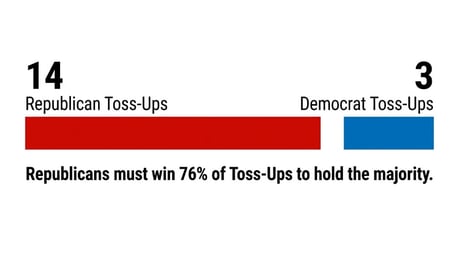
Campaign Now (Gemini). Republican versus Democrat Toss-Up seat count compared.
The Hill reporting on the Cook ratings update puts the threshold plainly: Republicans must win 76% of all Toss-Up seats just to hold their current majority. That is before accounting for any seats currently rated Lean Republican that could move to Toss-Up in a worsening environment, and before accounting for open-seat risks created by members like Rep. Mike Lawler in NY-17, who is rumored to be considering a gubernatorial run that would leave a competitive seat without an incumbent advantage. TIME noted that in 2018, 30 Republican House incumbents lost their seats in a similarly difficult national environment. The current map has roughly 3 dozen races Cook considers competitive, a number that is still growing.
As Republican pollster Whit Ayres told TIME in March 2026:
"The environment is very difficult for Republicans. The question is whether individual members can separate themselves from the national brand enough to survive a wave that is clearly building."
That question is the entire strategic challenge for Republican campaigns between now and November. The answer will be decided district by district, and the districts with freshman incumbents sitting on narrow personal margins are the ones where that question is most urgent.
Wrap Up
The Cook Political Report's April 7 ratings update is not a routine housekeeping exercise. It is a signal that the protective shield Republican campaigns were counting on, built from Trump's 2024 margins and a favorable post-redistricting map, is eroding at a pace that demands immediate strategic response. Fourteen Republican Toss-Up seats against three Democratic ones, a generic ballot deficit of 5.4 points, and a 76% win-rate requirement to hold the majority is not a situation that resolves itself. It requires campaigns to act now on candidate differentiation, voter contact depth, and earned media strategy before the environment hardens further.
The Bresnahan case in PA-08 is a template for how quickly a Lean seat becomes a Toss-Up when a candidate hands the opposition a compounding attack line and fails to neutralize it early. Every Republican freshman sitting in a district Trump won by single digits needs to be asking what their version of the stock trading story is and what their opposition research team has already found. The campaigns that ask that question in April have time to build a counter-narrative. The ones that ask it in September do not.