

The 2025 White House salary disclosures are not a personnel report. They are a governing blueprint.
What to Know
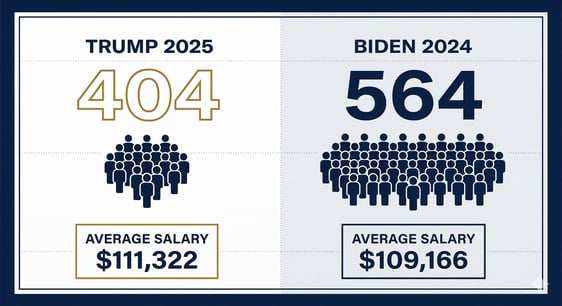
- The 2025 Trump White House employed 404 staff members as of July 1, 2025, compared to 564 under Biden in 2024
- The average salary for paid White House staff was $111,322, with 81 staff members earning $150,000 or more
- 40 staff members earned the maximum salary of $180,000 or more, concentrated in legal, policy, communications, and trade roles
- Schedule PolicyCareer, reinstated by executive order on January 20, 2025, targets approximately 50,000 federal positions for reclassification as at-will employment
- Stephen Miller took a pay cut to $195,200 after earning over $567,000 in total compensation from America First Legal in 2024, signaling ideological commitment over financial incentive
- The 1:4 replacement ratio mandated by the DOGE workforce executive order means federal agency capacity is being deliberately and systematically reduced from the outside in
The 2025 White House salary report offers more than compensation data. It reveals a deliberate governing architecture built around loyalty, legal firepower, and long-term executive consolidation that most political observers failed to read correctly.
This analysis draws from Ballotpedia, Congressional Research Service, Axios, NOTUS, Britannica, Government Executive, AFSCME, Partnership for Public Service, and the White House.
The Payroll Is the Policy
Reporting from Axios, drawing on the White House's annual personnel disclosure filed to Congress in July 2025, reveals a staffing structure that reads less like a personnel roster and more like an org chart for a government being rebuilt from first principles. Ballotpedia's comprehensive tracking of Trump White House staff confirms what the raw numbers signal: every role, every salary tier, and every title in this administration was chosen with intention. The Trump White House did not simply fill seats. It built a command structure where compensation reflects institutional priority, and institutional priority reflects a coherent theory of executive power.
-2.jpg?width=181&height=236&name=image%20(2)-2.jpg)
Susie Wiles, Assistant to the President and Chief of Staff
At the top of the pay scale, Susie Wiles anchors a senior tier where nearly every role earning $195,200 carries either a legal, policy, trade, or communications mandate. This is not coincidence. It is architecture.
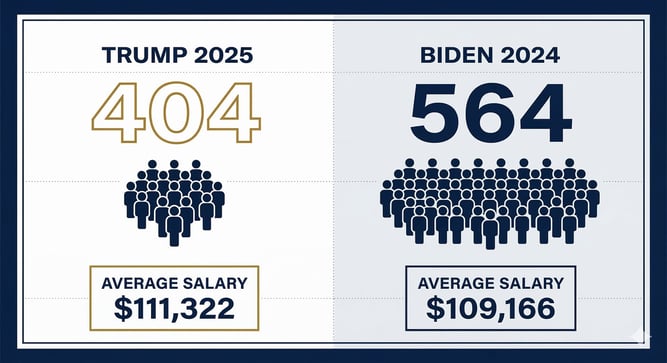
Trump versus Biden White House staff count compared. Image generated by Campaign Now with Gemini using Data from Ballotpedia
The lean staff count of 404 versus Biden's 564 is the first signal. Fewer people at the top means fewer decision nodes, faster execution, and tighter message discipline. Washington interpreted this as understaffing. It was the opposite.
Loyalty Vetting as Operational Infrastructure
The people inside that payroll did not arrive by accident. According to reporting by the Associated Press, White House screeners asked applicants to identify when their "MAGA revelation" occurred and cross-checked social media histories for any deviation from the president's stated agenda. Even detailees, temporarily assigned from other agencies, were vetted for political contributions before receiving White House access.
-2.jpg?width=238&height=307&name=image%20(1)-2.jpg)
Stephen Miller, Assistant to the President and Deputy Chief of Staff for Policy
As reported by NOTUS, Stephen Miller received a $175,000 bonus plus a $100,000 compensation adjustment from America First Legal before joining the White House at $195,200 per year:
"These facts raise questions about whether these payments were a so-called golden parachute, meaning bonuses paid on the basis of a person entering government service."
The quote reflects the opposition's framing. The operational reality is different. Miller, Gene Hamilton, and others who moved from the conservative nonprofit ecosystem into top White House pay grades represent a deliberate pipeline, not a patronage arrangement. The salary data confirms what the vetting process began: these are committed institutional actors, not rotating political appointees.
Trade, Energy, and the New Power Councils
The salary roster reveals 2 entirely new power centers that did not exist in the first term. The National Energy Dominance Council and the Presidential Council for Digital Assets each carry dedicated senior staff earning between $151,987 and $195,200. These are not advisory bodies. They are operational units embedded at the highest compensation tier of the executive office.
New executive councils embedded at top salary tier. Image generated by Campaign Now with Gemini using Data from Ballotpedia
-1.jpg?width=246&height=308&name=image%20(4)-1.jpg)
Peter Navarro, Assistant to the President and Senior Counselor for Trade and Manufacturing
Peter Navarro, earning $195,200 as Senior Counselor for Trade and Manufacturing, represents the clearest example of salary as ideological signal. After serving a four-month prison sentence for contempt of Congress, Navarro returned to the White House with expanded influence over economic policy.
As noted by Britannica, economic analysts attribute his second-term dominance to total alignment with the president's worldview, with one analyst observing:
"The reason Navarro has such influence is it dovetails with what the president thinks about the world."
The first term saw Navarro constrained by internal moderates. The 2025 staffing model removed that friction entirely.
The Deeper Restructuring Washington Ignored
The White House payroll is only the visible layer. Beneath it, the administration has been executing a structural transformation of the entire federal workforce. The reinstatement of Schedule PolicyCareer via Executive Order 14171 reclassifies approximately 50,000 policy-influencing federal positions into at-will employment, stripping MSPB appeal rights and routing whistleblower complaints to internal agency counsel.
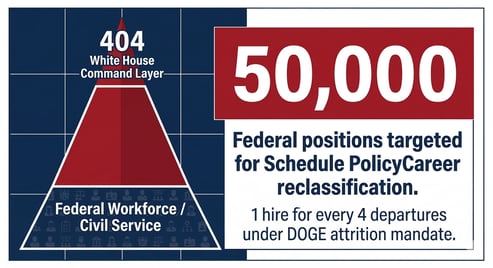
50,000 federal positions targeted for reclassification. Image generated by Campaign Now with Gemini using Data from Government Executive
-2.jpg?width=204&height=340&name=image%20(3)-2.jpg)
Scott Kupor, Director, Office of Personnel Management
As Government Executive reported in February 2026, OPM Director Scott Kupor defended the rule directly:
"This is not about political appointments or terminations. There is no involvement of the political process in the hiring or firing of these individuals."
The DOGE workforce executive order compounds this by mandating that agencies hire only 1 new employee for every 4 departures in non-exempted roles. The result is a federal bureaucracy being structurally thinned at the agency level while decision authority concentrates upward into a smaller, loyalty-verified White House staff. The 404-person payroll at the top is not lean by accident. It is lean by design, calibrated to hold the center of a much larger restructuring effort happening across every federal department simultaneously.
Legal Infrastructure as Strategic Investment
The legal cluster within the White House salary data is one of the most telling and least discussed features of the 2025 disclosures. Multiple Deputy Counsels earning $150,000, senior Associate Counsels earning $195,200, and a Counsel to the President also at $195,200 represent a legal command structure unlike anything in recent administrations. This is not defensive spending. It is offensive capacity.
-1.jpg?width=212&height=279&name=image%20(5)-1.jpg)
David A. Warrington, Assistant to the President and Counsel to the President

Gene Hamilton, Special Assistant to the President and Deputy Counsel
David A. Warrington and Gene Hamilton anchor the legal architecture at the highest compensation tiers available under federal pay law. Hamilton, who earned $673,000 from America First Legal in 2024 before joining the White House at $150,000, represents the sharpest salary sacrifice in the entire roster. The America First Legal pipeline reinforces the broader reading of this payroll: these are attorneys who built the legal architecture of the conservative movement outside government and are now executing it from inside the executive office.
Wrap Up
Washington's default interpretation of the 2025 salary disclosures was transactional: who got rewarded, who got cut, and what the numbers say about the budget. That framing missed the actual story. The payroll is a map of institutional intent, showing exactly where the administration placed its highest-value operators and what missions it considered non-negotiable from day one.
The combination of a lean senior staff, a loyalty-vetted detailee system, new policy councils for energy and digital assets, an expanded legal infrastructure, and a Schedule PolicyCareer reclassification reaching 50,000 federal positions below the White House level tells a single coherent story. This administration is not managing the executive branch. It is rebuilding it.
Washington missed it. The salary data was always in plain sight.

-May-16-2026-10-24-03-9739-PM.jpg)