
Americans who reject current leadership now trust election honesty more, complicating both parties’ legitimacy arguments before the midterms.
What to Know
- Americans who disapprove of national leadership express 11 percentage points more confidence in election honesty than those who approve.
- Overall confidence remains divided, with 49% trusting the honesty of American elections and 51% lacking confidence.
- Leadership supporters worldwide hold a 40-point election-confidence advantage, while the American relationship runs in the opposite direction.
- Election confidence reaches 63% among Democrats, compared with 37% among Republicans and 35% among independents.
- Only 14 of 26 campaigns in competitive Senate races gave unconditional assurances that their candidates would accept the election results.
American election distrust has developed an unusual political shape. Gallup’s global analysis found that Americans who disapprove of national leadership are more confident in election honesty than those who approve, reversing the relationship observed elsewhere. That inversion places the United States outside a pattern measured across more than 100 countries.
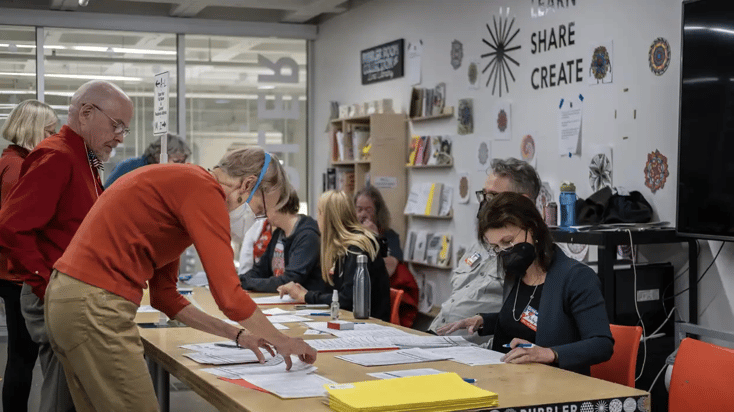
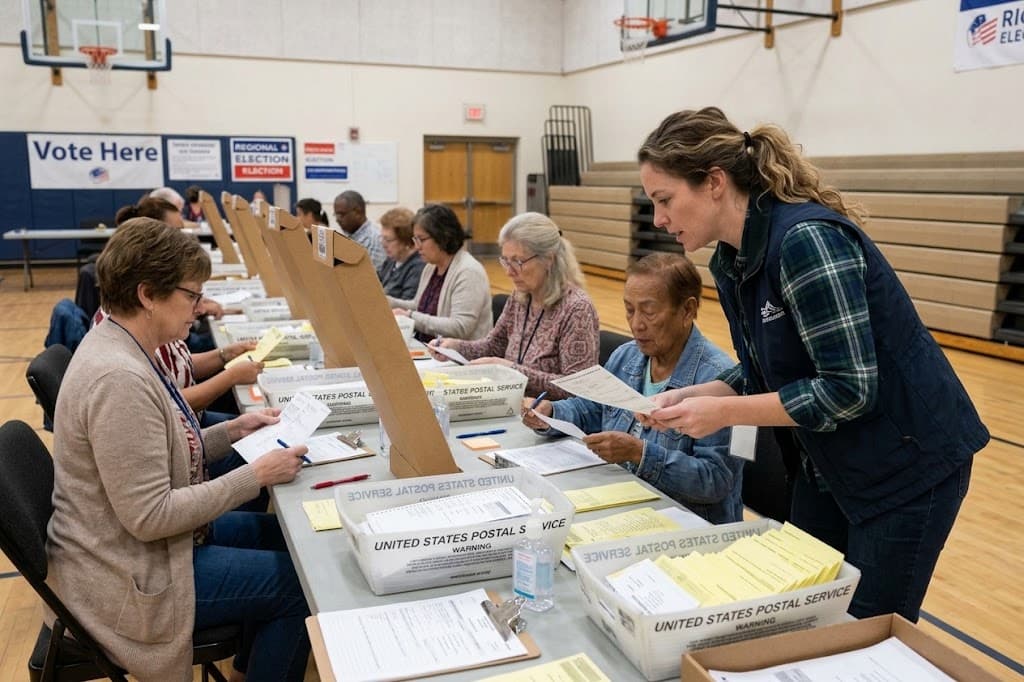
Local election workers perform the procedures behind public democratic confidence, via The Fulcrum.
Such distrust creates a volatile environment for the 2026 midterms. Candidates must persuade voters to participate while addressing supporters who question the system administering the contest. Campaigns that treat election confidence as a partisan talking point risk weakening acceptance of results their own candidates may need voters to trust.
American Confidence Now Runs Against the Global Pattern
Public confidence in election honesty is almost evenly divided. Gallup found 49% of Americans confident in the honesty of elections, while 51% lacked confidence. The overall figure is weak, but the alignment beneath it carries the larger political consequence.
Americans who disapprove of national leadership report 52% confidence in election honesty, compared with 41% among those who approve. That produces an 11-point confidence advantage among leadership disapprovers. Gallup reports that no other country measured during the previous 15 years produced a statistically significant relationship in that direction.
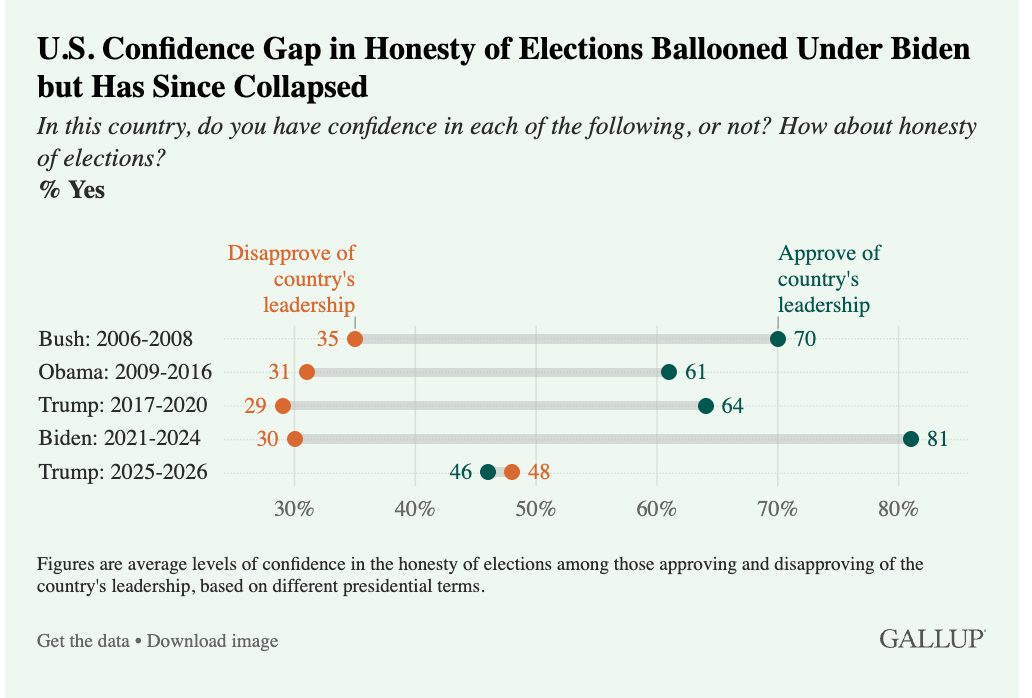
American election confidence now runs opposite the prevailing global relationship, via Gallup.
International results establish how unusual the American numbers are. Across more than 100 countries measured in 2025, a median of 70% of leadership approvers trusted election honesty, compared with 30% of disapprovers. Leadership supporters therefore held the expected 40-point advantage worldwide.
American opinion followed that conventional relationship for years. From 2006 through 2020, leadership approvers held average confidence advantages of 35 points during George W. Bush’s administration, 30 points during Barack Obama’s administration and 35 points during Donald Trump’s first term. The relationship widened to 51 points after the disputed 2020 presidential election before collapsing after the latest change in party control.
Results from 2025 had not yet produced the current inversion. Leadership approvers registered 51% confidence that year, while disapprovers registered 45%. By 2026, confidence among approvers had fallen 10 points, while confidence among disapprovers had risen 7 points.
That movement means electoral victory did not restore confidence among the coalition aligned with the governing party. Instead, distrust persisted after power changed hands. The winning-party boost seen in other countries and earlier American administrations no longer describes the current electorate.
Partisan Control No Longer Guarantees Institutional Trust
Party identification helps explain the reversal. Gallup measured confidence in election honesty at 63% among Democrats, 37% among Republicans and 35% among independents. Republicans therefore remain skeptical even while their party controls the White House and Congress.
Those figures also show that distrust is broader than one partisan constituency. Nearly 4 in 10 Republicans express confidence, while more than 1 in 3 independents do. Democrats register the highest confidence, but more than one-third of the party remains outside the confident group.
Separate research from the University of California San Diego Center for Transparent and Trusted Elections asked whether votes in the 2026 midterms would be counted as voters intended. Its survey of 5,016 adults, conducted from September 1 through September 9, found confidence at 63% among Democrats, 58% among Republicans and 49% among independents. The survey carried a 1.4-point margin of error.
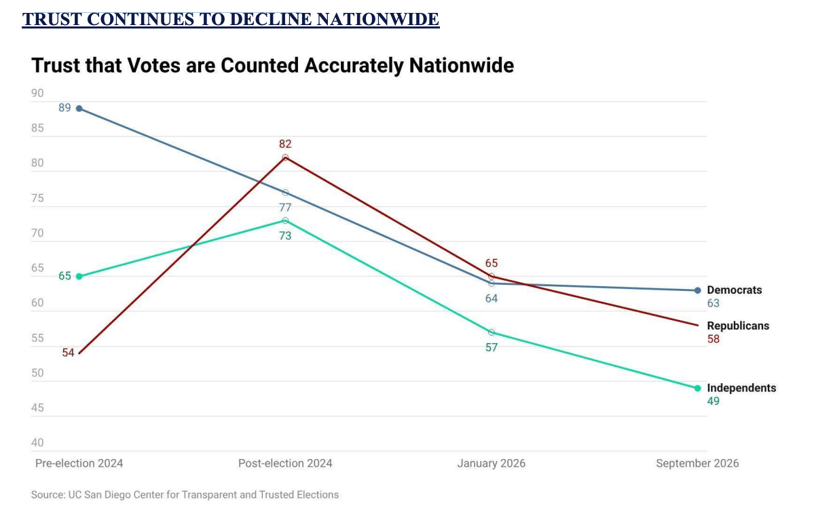
Election confidence declined across Democratic, Republican and independent voter groups, via UC San Diego.
Those results should remain separate from Gallup’s findings. Gallup asked about confidence in the honesty of elections, while the university survey asked whether midterm votes would be counted as intended. Different questions, samples and field periods produce different percentages, although both studies identify substantial distrust.
The university’s trend data add another dimension. Overall confidence that votes would be counted as intended reached 77% immediately after the 2024 election, fell to 60% in January 2026 and dropped another 5 points by September. Confidence declined across Democrats, Republicans and independents during that period.
Partisan groups also distrust different elements of election administration. The university survey found 53% of Republicans distrusting whether ballots would be counted accurately, compared with 19% of Democrats. Democrats expressed greater concern about obstacles facing eligible voters and intimidation during voting.
Campaigns therefore face several distrust narratives rather than one shared objection. Republican skepticism concentrates more heavily on ballot handling and voter eligibility, while Democratic skepticism concentrates more heavily on access and political interference. Independent voters sit between those coalitions but remain the least confident group in Gallup’s election-honesty measure.
Accepting Results Has Become a Campaign Test
Election confidence affects campaign strategy before any disputed result appears. Candidates must decide whether to promise unconditional acceptance, reserve the right to challenge a result or avoid the subject. Each choice signals how the campaign expects its supporters to interpret defeat.
A Reuters survey of 26 campaigns across 13 competitive Senate races found that only 14 campaigns gave unconditional assurances that their candidates would accept the results. That group included 9 Democratic campaigns, 4 Republican campaigns and 1 independent campaign. Other campaigns offered qualified responses, redirected the question or did not respond.
That campaign survey is not a measure of public opinion. It records responses from campaigns in selected competitive races, while the Gallup and university findings measure attitudes among adults. Together, they show how public distrust and candidate conduct can reinforce one another.
A separate Reuters and Ipsos poll cited in the same report found 76% of registered voters confident that their ballots would be accurately counted, up from 69% in 2022. That finding appears more optimistic than Gallup’s 49% election-honesty measure because the surveys ask different questions. Confidence in personal ballot counting can coexist with broader doubts about national election honesty.
Campaigns must address that distinction carefully. A voter may trust a local polling location while distrusting institutions, national outcomes or political actors. Messages that defend voting equipment without addressing political pressure may therefore miss the actual source of concern.
Information threats add another layer. A Bipartisan Policy Center and Morning Consult survey found 77% of registered voters concerned that artificial intelligence could spread disinformation or manipulate public opinion during the midterms. Concern crossed party lines, reaching 76% among Democrats and 62% among Republicans.
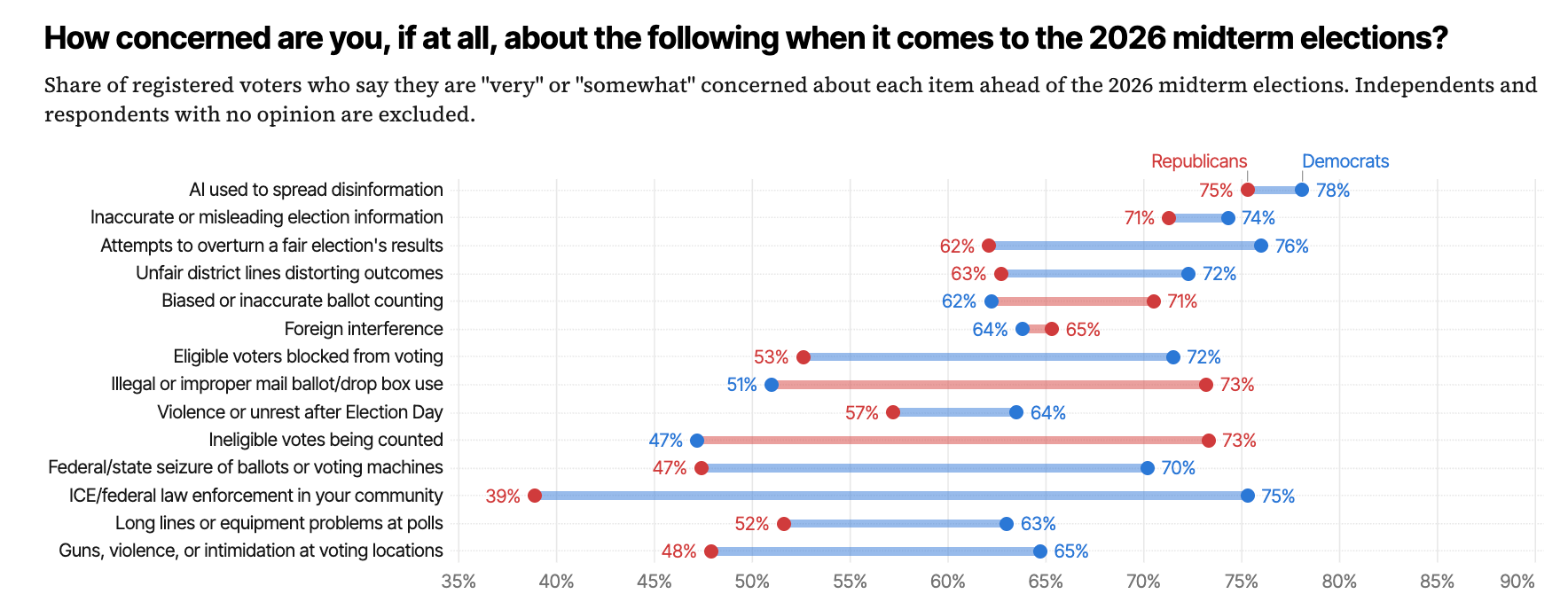
Voters across parties fear artificial intelligence will distort election information, via Bipartisan Policy Center.
Brennan Center research found that artificial intelligence has increased the speed, scale and apparent authenticity of influence operations. Existing safeguards still make undetected changes to vote counts at scale extremely difficult, but synthetic content can deepen doubt about authentic campaign messages and legitimate results.
Campaigns, parties and election officials occupy different roles in rebuilding confidence. Election administrators can explain procedures and document results, while candidates determine whether those explanations reach supporters or become submerged beneath fraud allegations. Public trust will depend partly on whether political incentives reward evidence or suspicion.
Wrap Up
America’s election-confidence problem now breaks the usual relationship between political power and institutional trust. Americans who disapprove of national leadership express more confidence in election honesty than those who approve, producing an inversion unmatched in Gallup’s international comparisons over the past 15 years.That pattern leaves the governing coalition responsible for administering elections that many of its own supporters distrust.
Neither party can treat the division as someone else’s vulnerability. Republicans must address skepticism within their coalition, while Democrats must recognize that their higher confidence does not extend to a large share of independents. Both sides also face voters whose concerns arise from different parts of the election process.
The 2026 midterms will test whether campaigns can compete without further weakening confidence in the system producing the result. Clear procedures and secure election administration remain essential, but candidate conduct will shape how voters interpret that evidence. Acceptance of the outcome may depend as much on political communication as on the mechanics of counting ballots.