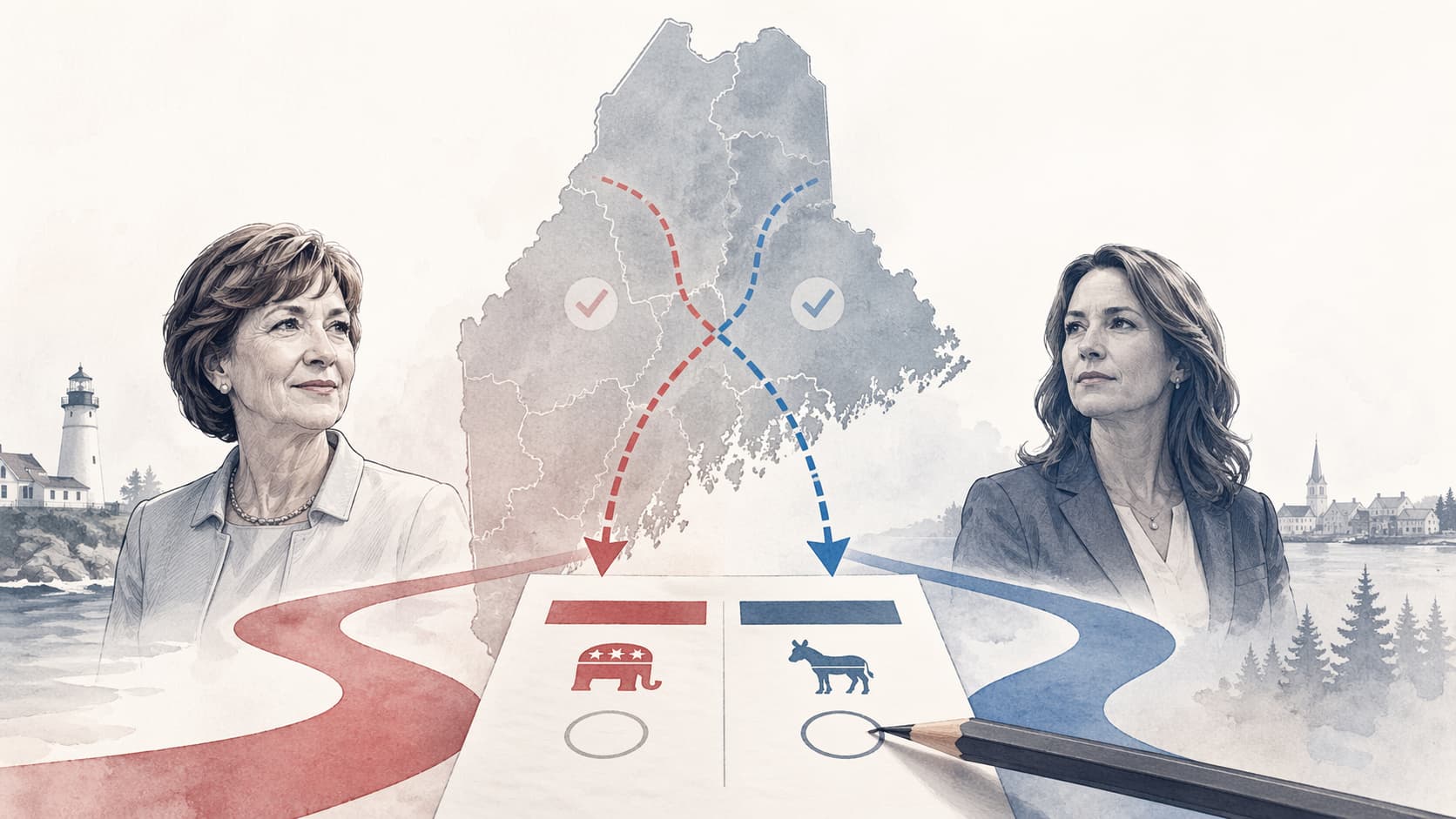

With the Senate majority hanging in the balance, Maine and Iowa are shaping up to be critical firewall states for both parties.
What to Know
- Incumbent Republican Senator Susan Collins of Maine is expected to face a competitive reelection environment, though no major challengers have officially entered the race yet.
- The Democratic field in Maine remains undeclared, with early speculation pointing to a potential divide between establishment and progressive candidates if the race develops.
- In Iowa, Rep. Ashley Hinson is viewed as a leading potential Republican contender for a Senate seat, though the field has not formally consolidated.
- Democrats are exploring candidates in Iowa who can expand their coalition, with figures like state Rep. Josh Turek represents the type of profile under consideration, though no candidacy has been confirmed.
- The 2026 midterm elections are expected to present historical headwinds for the party in power, but potential retirements and open seats could create unexpected opportunities for both parties.
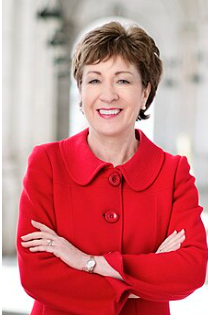
Maine’s Senate race is shaping up as a test of whether long-serving incumbents can maintain political durability in an increasingly polarized environment. Susan Collins, who has represented Maine since 1996, built her career on moderation and bipartisan cooperation, an approach that has historically allowed her to attract support from independents and some crossover Democratic voters.

United States Senator from Maine, Susan Collins
The political environment surrounding Collins has shifted in recent years as national polarization has reduced the space for candidates who position themselves between parties. Her votes on high-profile judicial confirmations and moments of alignment with parts of Donald Trump’s agenda have drawn criticism from progressive voters and reshaped her standing with segments of the electorate.
At the same time, Maine’s electoral trends have moved toward Democratic candidates in recent presidential cycles, particularly in urban and coastal areas such as Portland. Collins continues to retain support among moderate and older voters, but demographic changes and increased partisanship have tightened margins and elevated national attention on the race.
Democratic Primary Reflects Party Divisions
Democrats view Maine as one of their more plausible opportunities to compete for a Republican-held Senate seat, but the party has not yet coalesced around a defined field of candidates. Before mounting a challenge to Senator Susan Collins, Democratic leaders are navigating early-stage discussions that reflect broader internal debates about strategy, messaging, and candidate profile. At this stage, no major Democratic figures have formally entered the race, leaving the direction of the primary unsettled.

Governor Janet Mills
Governor Janet Mills remains a prominent figure within Maine’s Democratic Party and is frequently mentioned in speculation about potential candidates, given her statewide recognition and established fundraising network. However, she has not announced a Senate run. More broadly, Democrats are weighing whether to prioritize an establishment-backed candidate focused on coalition-building and electability, or a more populist, grassroots-driven contender who can energize progressive voters.
Ranked Choice Voting Adds Uncertainty
Maine’s ranked choice voting system complicates primary calculations for both campaigns. Instead of selecting a single candidate, voters rank preferences across multiple contenders. If no candidate secures an outright majority in initial results, lowest-performing candidates are eliminated and ballots are redistributed according to second choices.
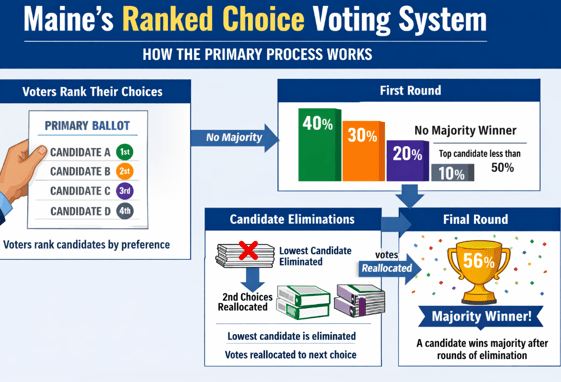
Such systems reward coalition-building and broader voter appeal rather than narrow ideological bases. Candidates must attract supporters while also positioning themselves as acceptable second or third choices for voters backing other contenders. Strategy therefore requires balancing passionate supporters with broader electability arguments.
Ranked choice voting could also extend campaign drama beyond election night. Redistribution of ballots often changes final outcomes in close races, meaning early vote leaders do not always win. Political observers nationwide will watch Maine’s primary closely as a case study in how ranked choice voting shapes high-stakes contests.
Iowa’s Open Seat Creates New Battleground
Iowa offers a different political story. Retirement of Senator Joni Ernst opened a seat that Republicans have held for nearly a decade, instantly creating a competitive statewide contest. Open seats tend to produce unpredictable outcomes because no candidate enters the race with advantages associated with incumbency.

Former Senator Joni Ernst
Republican leaders quickly rallied behind Congresswoman Ashley Hinson. Representing Iowa’s First Congressional District, Hinson has developed strong ties with conservative voters and national Republican figures. Early endorsement from Donald Trump and aggressive fundraising efforts helped consolidate her position as an early GOP favorite.

Campaign strategy from Hinson emphasizes retail politics across rural communities and small towns. Iowa’s tradition of personal voter engagement remains influential in statewide campaigns. Visits to all ninety-nine counties aim to reinforce her statewide presence while strengthening connections with local party organizations.
Democratic Strategy Centers on Economic Populism
Democratic hopes in Iowa are still in an early formation stage, with no confirmed Senate nominee, but much of the party’s attention is focused on identifying candidates who can reconnect with working-class and rural voters.
State Representative Josh Turek is often cited as an example of the type of candidate Democrats are looking for. A Paralympian who competed internationally in wheelchair basketball, Turek brings a compelling personal story that aligns with the party’s effort to broaden its appeal.

Rep. Josh Turek; image via Wikicommons
Messaging among potential Democratic contenders is expected to center on economic concerns affecting working families, including healthcare costs, agricultural policy, and wage stagnation.
Strategists believe Iowa still contains persuadable voters despite its recent shift toward Republicans, particularly in communities that respond to economic-focused, locally grounded campaigns. The path to competitiveness depends on whether Democrats can emphasize kitchen-table issues over national ideological divisions and rebuild credibility with rural voters.
National Stakes Extend Beyond Two States
Outcomes in Maine and Iowa could play an outsized role in determining Senate control during a period of narrow margins. Even a single seat can shift committee leadership, legislative priorities, and the confirmation process for federal judges and cabinet officials. Both parties therefore view these races as critical components of their broader national strategy.
“Graham Platner is going to flip Maine and then actually deliver change for working people in the Senate.” — Sen. Elizabeth Warren (D-MA)
Competitive Senate races can also influence turnout across entire states. High-profile contests at the top of the ballot tend to energize voters and can shape down-ballot outcomes in House and state legislative races. The political effects of these campaigns are likely to extend beyond Washington and into state-level power dynamics.
“It’s going to require a campaign like ours that’s laser focused on these issues of affordability… because there’s a link between the broken economy… and the corruption of our political system.” — Zach Wahls (D-IA)
Midterm conditions will further shape the landscape. Historically, the party controlling the White House loses congressional seats in midterm elections, as voters often use these contests to register dissatisfaction with national leadership. That dynamic could create a more favorable environment for the opposition party, while forcing the governing party to defend its position under more challenging conditions.
Economic Conditions May Shape Voter Decisions
Economic conditions will not just influence the 2026 races. They may define them. Across battleground states like Maine and Iowa, voters are not engaging with abstract policy debates. They are responding to everyday pressure points, rising costs, stagnant wages, and a persistent sense that the economy is not working for them. In that environment, candidates who can translate national economic policy into tangible, local impact gain a decisive edge.

In Iowa, the fight is grounded in the realities of agricultural markets, rural investment, and economic survival for farming communities navigating volatility and consolidation.

In Maine, the focus shifts to coastal economies, small business resilience, and the mounting cost-of-living pressures facing working families. These are not peripheral issues. They are the ballot. Both parties understand that whoever owns the economic narrative at the local level will likely control the outcome.
National messaging will attempt to frame the economy in broad terms, but elections are rarely won at that altitude. Voters make decisions based on what they feel, not what they are told. If one side successfully convinces voters that economic conditions are improving, it gains momentum. If the other persuades them that they are falling behind, it creates backlash. In a midterm cycle historically driven by frustration, the side that best channels economic anxiety into a clear political argument will have the advantage.
Wrap Up
Maine and Iowa represent two distinct paths to Senate majority control. One race tests survival of a long-serving incumbent navigating an increasingly polarized political landscape. Other race examines whether economic populism can help Democrats compete in a state that has trended Republican in recent years.
Both contests highlight the evolving nature of American electoral politics. Voter coalitions, demographic change, and candidate identity continue to reshape battleground maps in unpredictable ways. Political analysts expect spending and campaign activity in these states to intensify as election year approaches.
Control of the Senate may ultimately depend on margins produced in races like these. Small shifts in voter turnout or persuasion can change the balance of power in Washington. Maine and Iowa therefore stand poised to play outsized roles in determining the political direction of the country during the next decade.