
Voter attitudes in November point to entrenched views on the economy, leadership, and national direction with limited room for persuasion.
What to Know
- The November McLaughlin poll shows voter opinions stabilizing rather than softening after the 2024 election.
- Economic anxiety remains the dominant driver of political decision making.
- Voters continue to express dissatisfaction with national leadership and institutional performance.
- Partisan identification shows little movement, signaling early polarization ahead of 2026.
- Issue salience favors Republicans on border security and inflation, while Democrats struggle to reset the conversation.
The November McLaughlin national poll suggests that voters are not moving on from the political divisions of the last election cycle. Instead, opinions appear to be settling into place earlier than many strategists expected. With 2026 midterms still more than a year away, this matters because persuasion becomes harder once attitudes harden.
Rather than a reset moment, November looks like a consolidation phase. Voters are prioritizing economic conditions, expressing skepticism toward political leadership, and signaling limited patience for broad messaging that does not directly address cost of living concerns.
Economic Anxiety Continues to Dominate
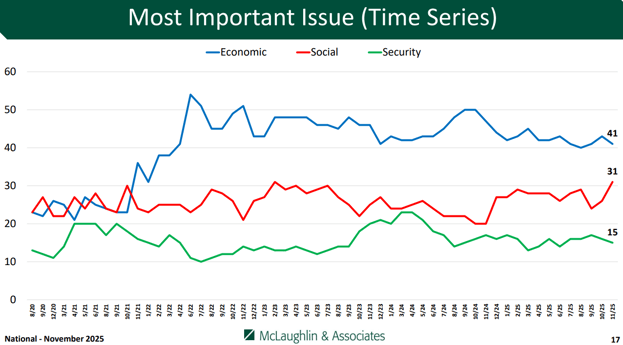
Economic pressure remains the defining force shaping voter attitudes one year after the 2024 election. In the November 2025 survey, inflation and cost-of-living concerns overwhelm every other issue, with 41% of voters naming the economy as their top priority. A clear majority say conditions are deteriorating, as 58% believe the economy is getting worse, and 49% say the United States is already in a recession.

Screenshot from McLaughlin Poll for November
This anxiety is not theoretical. 77% of voters report being personally impacted by inflation and higher prices. Among them, 41% say they are actively struggling to afford basic necessities, while another 36% say inflation has had a significant impact even if they are not yet falling behind. Only 23% of voters say they can afford normal spending without cutting back, underscoring how widespread financial constraint has become.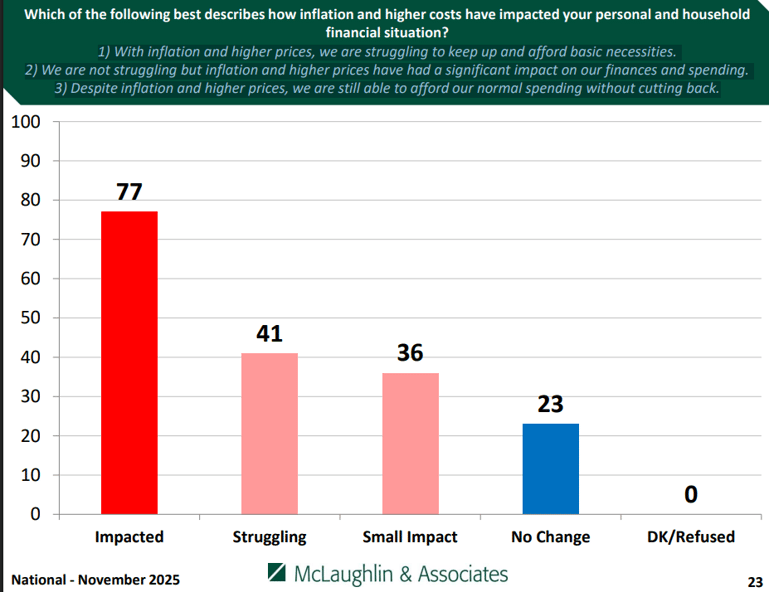
Screenshot from McLaughlin Poll for November
That reality reshapes the campaign environment. Voters are no longer evaluating leadership primarily through ideological alignment or institutional debates. Instead, they are judging parties on perceived economic outcomes and whether proposed solutions feel credible and immediate. Messaging that does not directly address prices, household stability, and purchasing power consistently fails to gain traction across partisan lines.
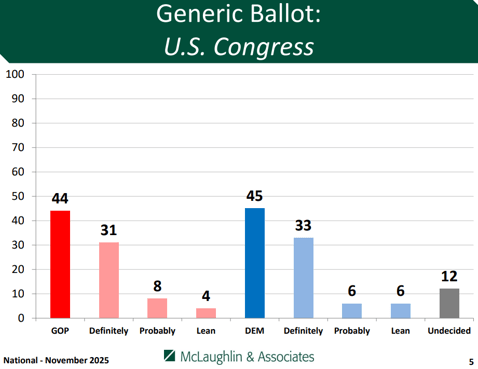
For Republicans, this environment reinforces an existing structural opportunity. With 44% of voters currently backing Republicans on the generic congressional ballot, economic dissatisfaction strengthens arguments centered on inflation, government spending, and fiscal competence.
Screenshot from McLaughlin Poll for November
For Democrats, the challenge is more acute. While individual policy achievements may poll favorably, they have not translated into improved confidence on economic management. Until voters experience tangible relief, economic frustration is likely to remain the dominant lens through which leadership and campaign messaging are judged.
Leadership Trust Remains Low
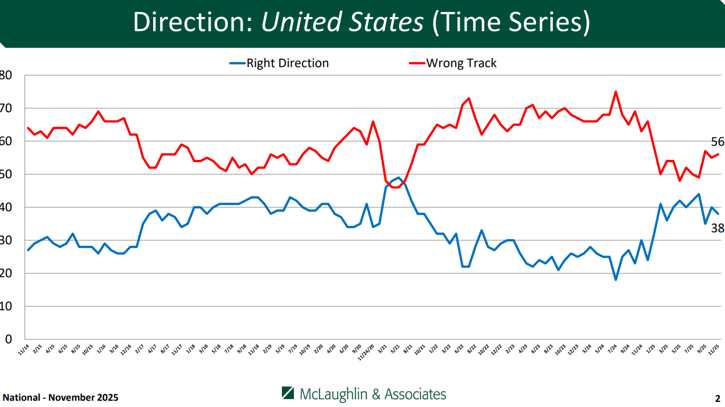
The November 2025 McLaughlin data points to a sustained erosion of confidence in national leadership and political institutions. With 56% of voters saying the country is on the wrong track and only 38% believing it is headed in the right direction, dissatisfaction appears structural rather than situational. These attitudes have persisted beyond the immediate aftermath of the 2024 election, suggesting voter frustration is becoming a durable feature of the political environment.
Screenshot from McLaughlin Poll for November
Low-trust conditions fundamentally alter how campaigns are received. Voters are less responsive to appeals rooted in institutional credibility and more receptive to candidates who frame themselves as challengers to entrenched systems. Anti-establishment messaging aligns naturally with an electorate that believes existing leadership is disconnected from their lived experience, particularly on economic and cost-of-living issues.
For incumbents and governing parties, this creates a strategic liability. Messaging that defends the status quo or emphasizes procedural accomplishments struggles to break through when a majority of voters believe the system itself is failing. In this environment, credibility is earned not through continuity, but through clear signals of disruption, accountability, and change.
Issue Advantage Still Favors Republicans
On issue handling, the November 2025 polling shows Republicans continue to hold a practical advantage on the issues voters care about most. Economic pressure and security concerns dominate the agenda, with 41% of voters naming the economy and inflation as their top issue and 15% prioritizing border security and immigration. These are areas where voters consistently associate Republicans with stronger positions and clearer solutions.
Screenshot from McLaughlin Poll for November
Democrats maintain advantages on select social issues, but those issues are not driving vote choice at the same intensity. While social policy remains relevant, it competes poorly against immediate concerns like prices, safety, and economic stability. The data highlights a recurring strategic error: confusing issue agreement with issue priority. Voters may support a position in theory, but still base their vote on a different set of concerns entirely.
The November data reinforces a core campaign reality. Winning the argument does not matter if the issue itself is not decisive. In a cycle defined by financial strain and institutional distrust, relevance outweighs persuasion, and issue advantage flows to the party aligned with voters’ most urgent fears.
The Broader Picture: A Volatile but Leaning Environment
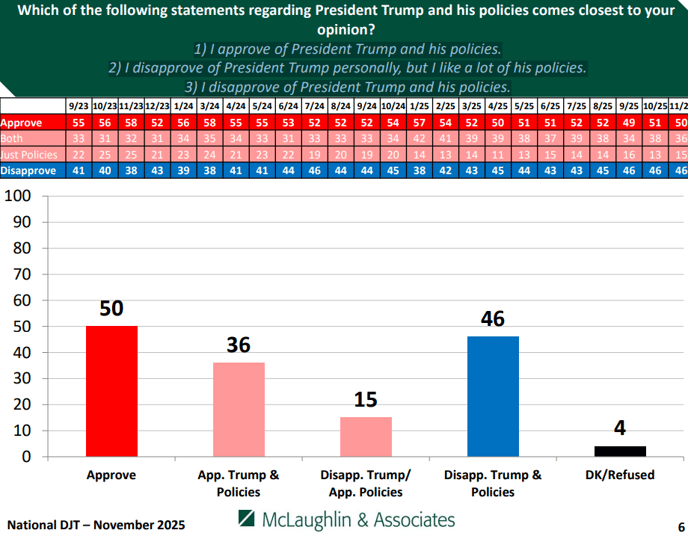
Taken together, the November 2025 survey paints a picture of an electorate that is dissatisfied, economically strained, and increasingly pragmatic in how it assigns political trust. President Trump’s standing reflects this tension. His job approval sits at 50%, with 46% disapproving, underscoring a polarized but stable base of support.
 Screenshot from McLaughlin Poll for November
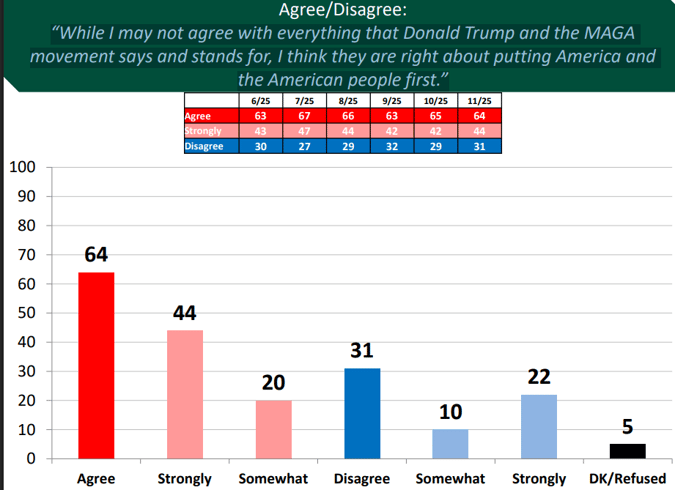
Importantly, sentiment toward the broader MAGA movement extends beyond traditional alignment. 64% of voters agree with the statement that the movement is right about putting America and Americans first, even if they disagree with some of its rhetoric or positions. That finding helps explain why populist and nationalist framing continues to resonate in a low-trust, high-cost environment.
 Screenshot from McLaughlin Poll for November
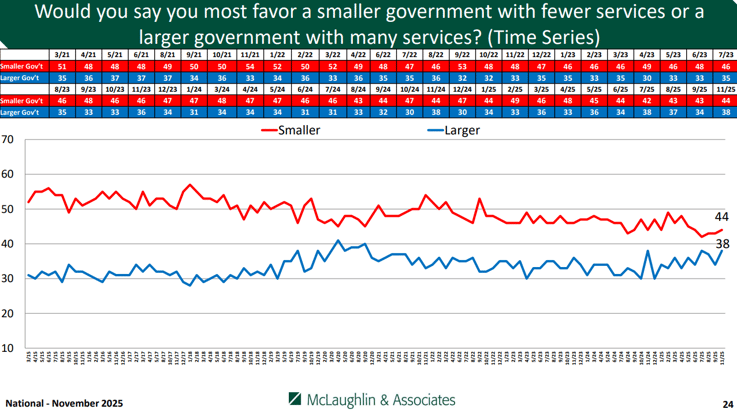
Ideologically, voters tilt more conservative than recent cycles might suggest. A plurality favors smaller government, with 44% preferring fewer services compared to 38% who want a larger government role.
Screenshot from McLaughlin Poll for November
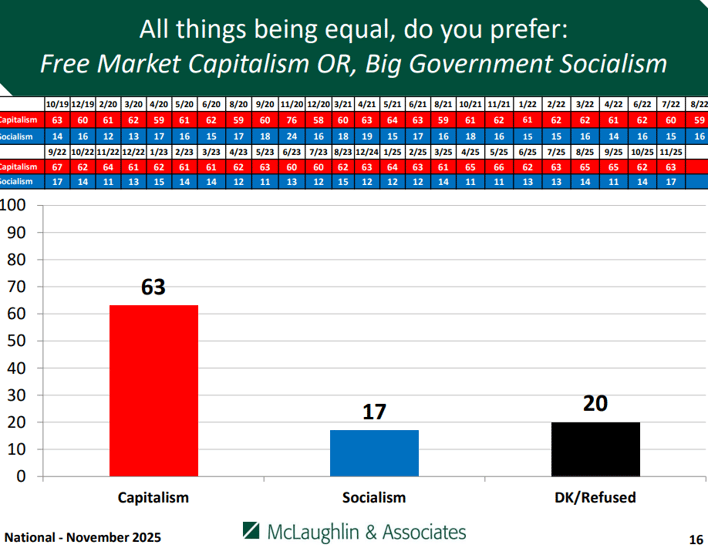
On economic systems, 63% of voters express a preference for free-market capitalism, while only 17% favor big-government socialism. These preferences reinforce why economic messaging focused on restraint, efficiency, and cost control has more room to grow than expansive policy arguments.
Screenshot from McLaughlin Poll for November
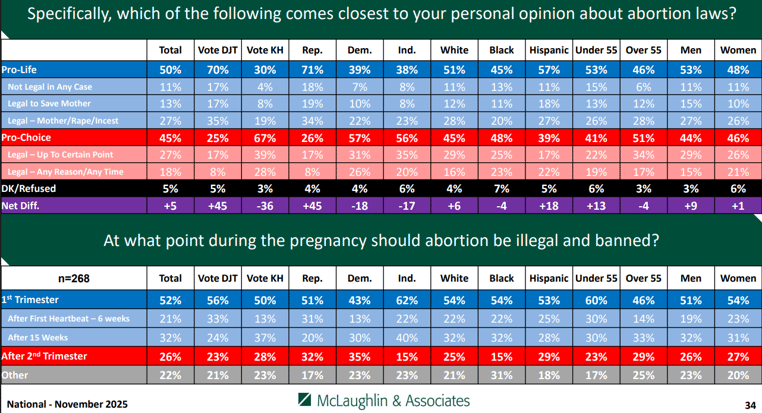
On social issues, particularly abortion, voter views are more nuanced than binary narratives allow. While 50% identify as totally pro-life and 45% as totally pro-choice, a majority of voters support restrictions, with 52% favoring limits after the first trimester. This complexity suggests that absolutist messaging on either side risks misreading the median voter, especially when economic concerns dominate attention.
Screenshot from McLaughlin Poll for November
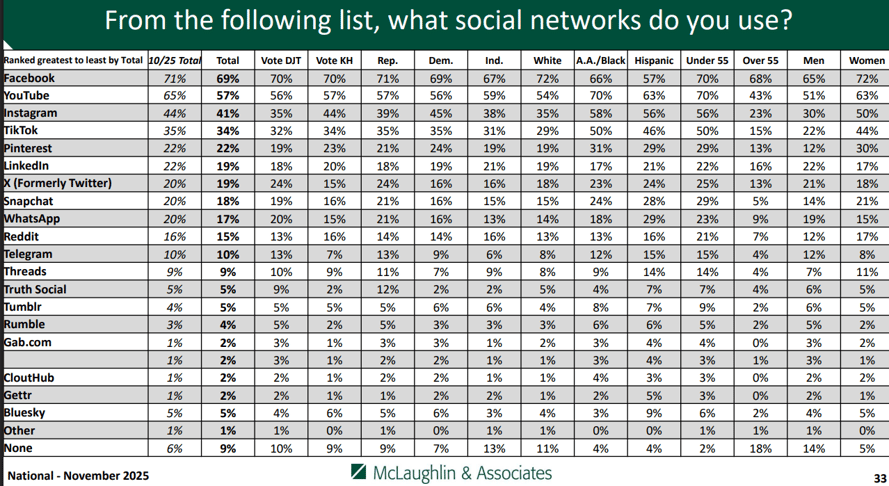
Media consumption patterns further complicate the landscape. While 67% of voters still watch cable news weekly, audiences are fragmented across platforms, with 69% using Facebook, 57% YouTube, and 34% TikTok. This reinforces that persuasion is no longer centralized; campaigns must meet voters where they already are, rather than relying on a single media strategy.
 Screenshot from McLaughlin Poll for November
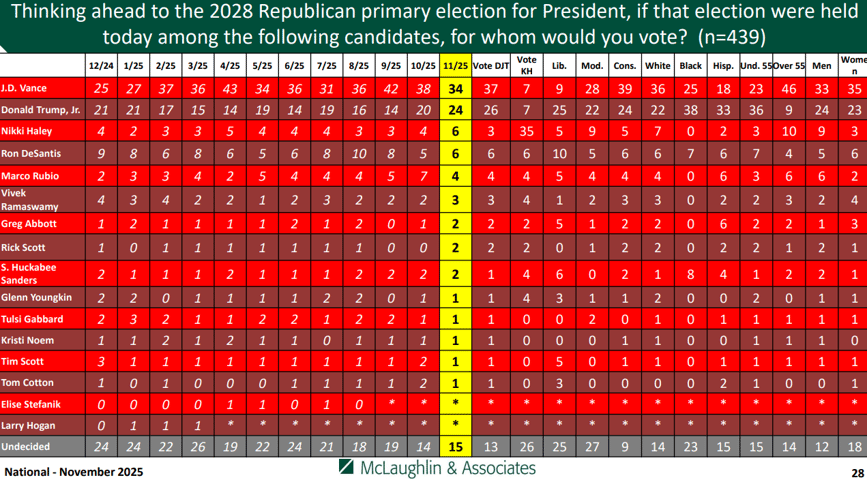
Finally, early 2028 primary preferences show unsettled leadership pipelines in both parties. On the Democratic side, Kamala Harris leads with 29%, but 16% remain undecided. Among Republicans, J.D. Vance leads with 34%, followed by Donald Trump Jr. at 24%, with 15% undecided.
Screenshot from McLaughlin Poll for November
These numbers signal opportunity for consolidation, but also vulnerability if economic and trust conditions worsen.
Wrap Up
The November McLaughlin poll paints a picture of an electorate that is not in flux but in formation. Voters are entering the pre midterm period with defined priorities, hardened skepticism, and limited tolerance for political abstraction. Economic performance remains the lens through which nearly all political messaging is filtered.
For 2026, this means campaigns have less room for experimentation and more pressure to meet voters where they are. Candidates who ignore economic anxiety or overestimate the appeal of national messaging risk speaking past an electorate that has already made up its mind. The window for persuasion may not be closed, but it is narrowing faster than many expected.