

Democratic leads against Ryan Mackenzie and Rob Bresnahan put Pennsylvania’s recent Republican House gains back under electoral pressure.
What to Know
- Bob Brooks led Ryan Mackenzie by 49% to 44% in an October likely-voter survey.
- A September registered-voter survey also gave Brooks a 5-point advantage.
- Paige Cognetti led Rob Bresnahan by 51% to 46% in the October Siena release.
- An earlier October survey reported Cognetti ahead by 52% to 48%.
- Similar results from separate surveys strengthen the evidence of competition without proving a trend.
Pennsylvania Republicans are defending two seats they flipped in 2024, and district polling suggests neither is secure. In the 7th Congressional District, Democrat Bob Brooks leads incumbent Ryan Mackenzie in separate September and October surveys. In the 8th District, Democrat Paige Cognetti also leads incumbent Rob Bresnahan in more than one published poll.
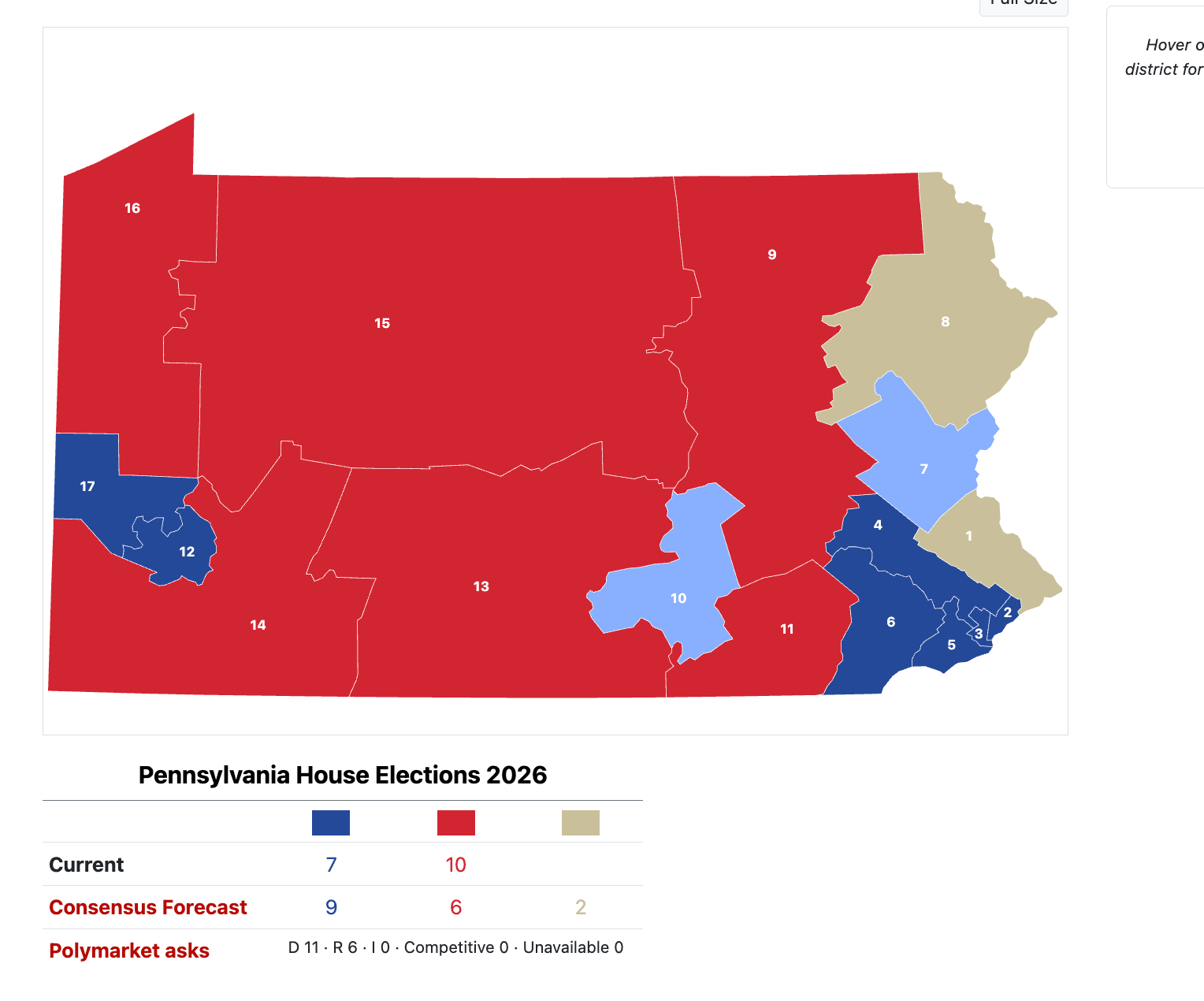
Pennsylvania’s eastern districts place recent Republican gains under renewed scrutiny, via 270toWin.
The New York Times, Philadelphia Inquirer and Siena University release gives both challengers a 5-point advantage. Those findings warrant attention because they reinforce earlier district evidence rather than standing alone. They do not establish that either Republican will lose, that support has remained unchanged or that Pennsylvania’s results will mirror national voting preferences.
Matching Margins Do Not Establish Stability in PA-07
Brooks led Mackenzie by 49% to 44% in Siena’s survey conducted from October 16 through October 22. The poll included 401 likely voters, with a reported margin of sampling error of ±5.7 percentage points. That uncertainty makes the result evidence of a competitive contest, not a secure Democratic advantage.
An earlier Franklin & Marshall College survey found Brooks ahead by 45% to 40%. Interviews ran from September 9 through September 20, and the district sample comprised 357 registered voters. Its reported sampling error was ±5.8 percentage points.
Both surveys produced the same candidate margin, but they measured different populations using different methods. Franklin & Marshall sampled registered voters from a voter file, notified them by mail and completed interviews by phone or online. Its release explicitly withheld likely-voter results because that subgroup was too small.
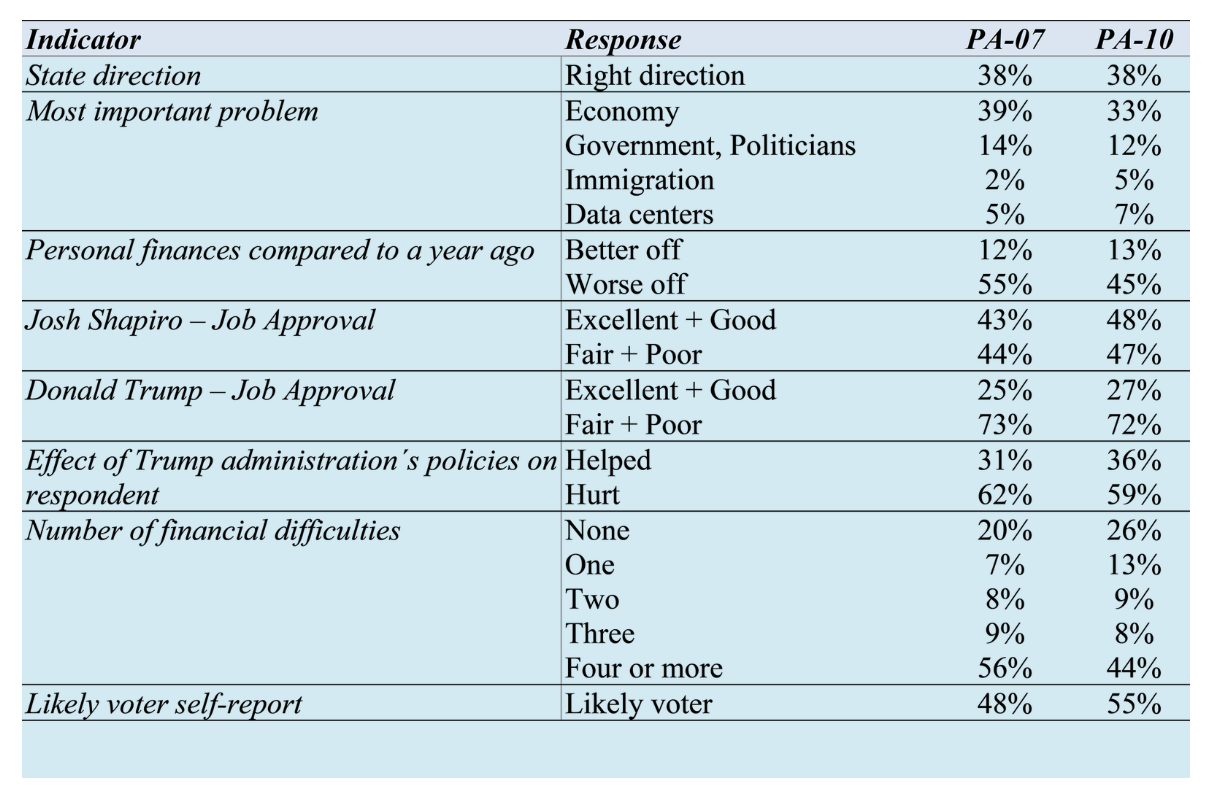
Economic concerns provide context for the congressional contest in PA-07, via Franklin & Marshall College Poll.
The defensible conclusion is narrower than a claim that Brooks maintained a stable lead. Separate research organizations found him ahead at different points in the campaign. Without a consistent survey series, the increase in each candidate’s reported support cannot be cleanly separated from changes in sampling, turnout screening or question design.
For Mackenzie, the repeated deficit raises the importance of demonstrating support beyond his existing Republican constituency. For Brooks, the findings establish an opening rather than a completed coalition. Neither survey shows precisely how many voters each campaign can persuade or mobilize before ballots are counted.
PA-08 Also Shows More Than One Democratic Lead
Cognetti led Bresnahan by 51% to 46% in Siena’s October release. Its district sample included 402 likely voters, with a reported margin of sampling error of ±5.8 percentage points. As in PA-07, the candidate margin does not establish a statistically secure outcome.
An Emerson College survey sponsored by Poll Vault, conducted from October 12 through October 14, reported Cognetti at 52% and Bresnahan at 48% among 396 likely voters. Poll Vault confirmed its partnership with Emerson, while the published poll record identifies the sample, dates and reported result. Those figures provide another indication of Democratic competitiveness, not an interchangeable measurement of the same electorate.
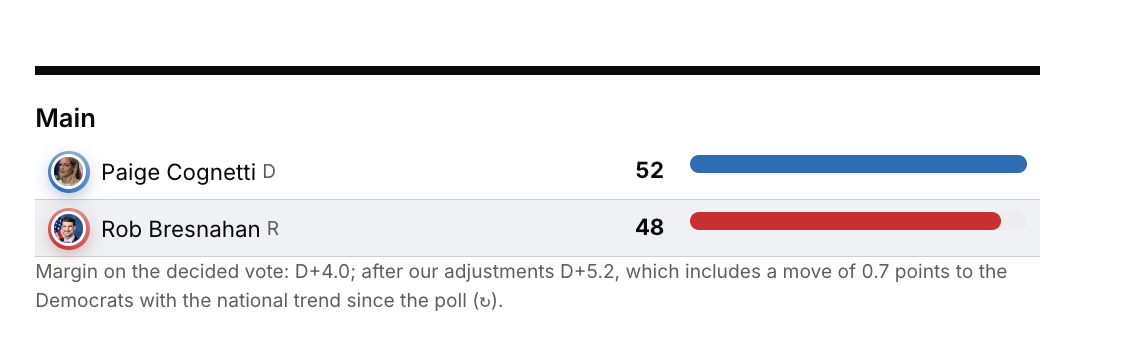
An earlier October survey also reported a Cognetti advantage in PA-08, via Polling Forecast.
The comparison requires particular care around uncertainty. A reported result totaling 100% does not, by itself, establish that no respondents were undecided during interviewing. Without the original questionnaire and complete tabulation, it would be inappropriate to infer whether leaners were allocated, respondents were required to choose or another reporting convention applied.
Likewise, a difference between Bresnahan’s support in the two releases does not demonstrate that he gained voters. The polls have different field periods and may handle undecided respondents differently. Their common message is that Cognetti is competitive against the incumbent, not that her precise advantage has been independently replicated.
Pennsylvania’s Recent Flips Remain Strategically Important
Republicans hold a 10–7 advantage in Pennsylvania’s House delegation after winning PA-07 and PA-08 in 2024, according to 270toWin’s state overview. Mackenzie’s victory margin was approximately 1 point, while Bresnahan’s was approximately 1.6 points. Those narrow outcomes help explain why both seats remain consequential defenses.
If Democrats won both while other Pennsylvania seats stayed unchanged, the delegation would move to 9 Democrats and 8 Republicans. That is a conditional calculation, not a forecast. It illustrates how a small number of district outcomes can reverse a state delegation’s partisan balance.
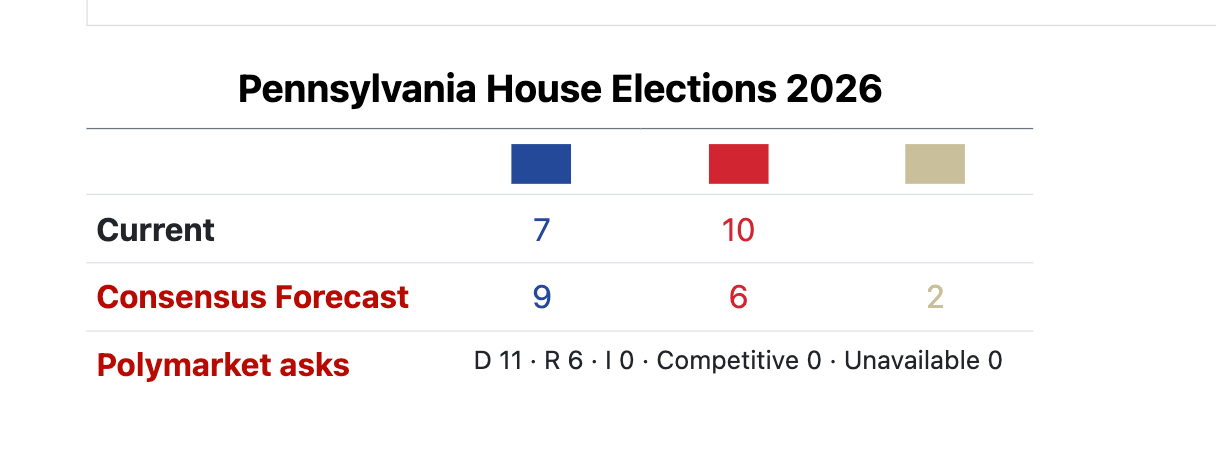
Narrow prior victories explain the importance of both Republican defenses, via 270toWin.
District evidence is more directly relevant to these contests than assuming a national polling advantage translates uniformly into seats. Even so, repeated polls can share weaknesses, including turnout assumptions or difficulty reaching particular voters. Agreement reduces reliance on one isolated release without eliminating the possibility of common error.
The political pressure is therefore real but bounded. Both incumbents face evidence that their challengers have assembled competitive support. Both challengers still need that support to survive the final campaign period and translate into votes.
Wrap Up
PA-07 and PA-08 belong in the same analysis because Republicans narrowly captured both in the previous election. Multiple surveys now place Democratic challengers ahead. That combination makes the districts meaningful tests of whether those Republican gains can endure.
Matching margins are not proof of stability, and different percentages are not automatically evidence of movement. Registered-voter and likely-voter samples must remain distinct. So must results whose treatment of undecided respondents cannot be fully compared.
Pennsylvania’s contribution to the House majority fight will ultimately come from district outcomes, not national expectations. These polls identify two Republican defenses under pressure. They leave the result unresolved.