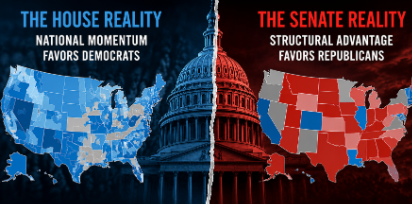


The structural battlefield quietly tilts toward Democrats, even before a single ad is aired.
What to Know
- Republicans are defending 33 competitive seats, compared to 29 for Democrats.
- That four-seat exposure gap defines the operational burden each party faces.
- The House majority will likely be decided by who manages risk more efficiently across a constrained map.
- Democrats do not need to overperform everywhere. They need to win just enough of the right seats.
- Republicans must execute with far less room for error across a broader defensive map.
At a glance, the House battlefield looks evenly matched, with both parties competing across a similar universe of Toss-Up and Lean districts. But the underlying structure is not neutral. According to Inside Elections, Republicans are carrying a heavier defensive load, currently responsible for protecting 33 competitive seats compared to 29 for Democrats.
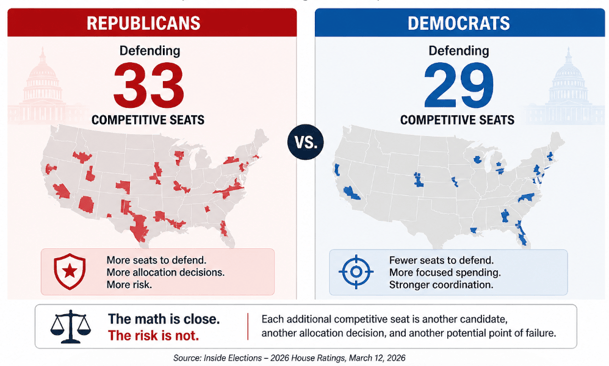
This four-seat gap is an immediate exposure problem. For Republicans, every extra seat demands more money, forces them to stabilize more candidates, and multiplies the risk of late-cycle shocks. Democrats, with a narrower, more focused battlefield, can concentrate resources and coordinate campaigns with greater discipline, quietly shifting the entire map's risk profile in their favor.
The Siege of the Slim Majority
The numbers behind the House map clarify how narrow the margin for error really is. Inside Elections currently projects a near-even chamber, with 213 Republicans and 212 Democrats in the Likely/Lean/Tilt categories, and just 10 Toss-Up seats standing between both parties and the 218-seat majority threshold. That is not a cushion. It is a pressure point.
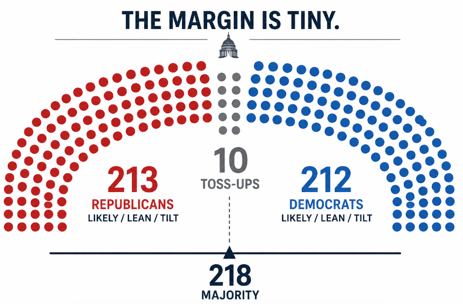
Republicans are not just holding the majority within that margin. They are defending a broader and more exposed battleground, with 33 competitive seats compared to 29 for Democrats. That imbalance compounds risk in real terms. A shift of only a handful of races inside the 10 Toss-Ups, or movement along the Lean and Tilt lines, is enough to flip control. The battlefield is not defined by sweeping waves. It is defined by incremental erosion across multiple districts at once.
This is where the “siege” dynamic becomes real. The majority party is forced to defend across a wide map that includes Toss-Up races like AZ-1, MI-7, and PA-7, while also protecting vulnerable Lean and Tilt districts that can quickly move under pressure. Meanwhile, Democrats are positioned to concentrate resources within a tighter set of targets, leveraging the density of competitive races rather than matching the full defensive spread.
|
District |
2026 Rating |
Current Incumbent |
2024 Election Result |
Strategic Outlook |
|
Toss-Up |
Open Seat |
David Schweikert (R) +3.8% |
Highest Risk. With Schweikert retiring to run for Governor, this affluent Phoenix-area seat loses its incumbency advantage in a district that has been trendling blue. |
|
|
Toss-Up |
Tom Barrett (R) |
Tom Barrett (R) +2.1% |
Lean Defense. Barrett flipped this open seat in 2024. He now faces a "siege" from Democrats looking to reclaim a district that was held by Elissa Slotkin for years. |
|
|
Toss-Up |
Ryan Mackenzie (R) |
Ryan Mackenzie (R) +1.0% |
Margin of Error. Mackenzie unseated Susan Wild by a razor-thin margin. This Lehigh Valley seat is a primary target for Democratic resource concentration. |
The result is a battlefield where control of the House is not decided by a single breakthrough moment. It is decided by whether small, consistent shifts in turnout, candidate quality, or persuasion stack up across enough of those 40+ competitive seats to tip the balance.
Suburban Realignment Is Still the Core Engine
The competitive map is heavily concentrated in suburban districts, and the distribution favors Democrats more than it appears at first glance. In the Toss-Up category, a majority of the truly competitive Republican-held seats are suburban or suburban-adjacent, including AZ-1, AZ-6, MI-7, PA-7, and VA-2. These are districts where margins are already tight and where recent election results show instability rather than durability.
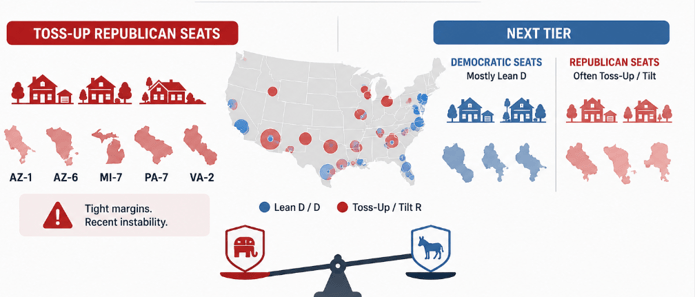
Image generated by DALL-E
Pattern carries into the next tier. Democratic seats are mostly Lean Democratic; Republican districts are often pushed into Toss-Up or Tilt. This subtle shift creates a structural pressure imbalance. Seats most likely to determine control show past voter movement and are disproportionately suburban.
Lean Seats Are Not Created Equal
A wider defensive map changes how Lean seats behave. Republicans are stretched across 33 competitive districts, while Democrats are exposed in 29, creating more points where movement can occur. That added surface area means more races sitting closer to the edge rather than safely outside it.
Control of the chamber is being decided inside a narrow band of districts, not outside of it. The current breakdown sits at 213 Republicans to 212 Democrats beyond the 10 Toss-Ups, leaving virtually no separation between the parties. In that environment, Lean and Tilt seats function less like insurance and more like extensions of the core battleground.
The distinction becomes structural. Democratic-leaning districts more often operate as a buffer layer, while Republican-leaning districts are more frequently pulled into active competition. When the margin is this tight, movement across even a small slice of those 10 Toss-Ups or adjacent Lean seats is enough to flip control.
Wrap Up
The path to 218 comes down to exposure. Democrats are working from a tighter battlefield with fewer vulnerable seats and more favorable positioning in the districts that actually decide control. They do not need a wave election to win the House. They need to hold their ground and convert a small number of already competitive races.
Republicans are in a different position. Holding 213 seats while defending 33 competitive districts leaves almost no room for error. The majority is stretched across too many races that can break late, which means a handful of losses in Toss-Up or Lean seats is enough to flip control.
That is the reality of this map. Control of the House is not about who wins the most races overall. It is about who loses the fewest in the small cluster of districts that matter, and right now the structure of the battlefield gives Democrats the cleaner path to get there.
-4.jpg)