
Democrats lead nationally, but affordability, turnout and a narrow independent center will decide control of Congress.
What to Know
- Democrats hold a stable D+5 generic ballot advantage, leading Republicans 49% to 44% among likely general election voters.
- Only 7% remain unsure, leaving turnout and Center Independents to shape many close congressional contests.
- Democrats now lead economic trust by one point and cost-of-living trust by four points, reversing earlier Republican advantages.
- Support for ending the Iran conflict reaches 74%, including majorities of Republicans, Independents, swing voters and Democrats.
- A prolonged war with elevated gasoline prices moves the tested ballot from D+5 to D+7.5.
Cygnal’s June National Voter Trends poll shows decisive movement below the party topline. Democrats lead the generic ballot 49% to 44%, yet six clusters reveal different levels of loyalty, frustration and openness. A stable margin coexists with unstable coalitions.
Cygnal surveyed 1,500 likely 2026 general election voters on June 2 and 3, 2026, with a ±2.53% margin of error. Its framework separates committed partisans, softer opposition, swing voters and distinct Independent groups. That segmentation shows where persuasion remains possible within an electorate marked by near-total partisan loyalty.
Six Clusters Reveal a Small Persuadable Middle
Cygnal divides voters into Committed Democrats, Anti-Trump Independents, Soft Opposition, Swing Voters, Engaged Republicans and the MAGA Base. These labels capture differences in motivation, candidate preference and issue trust. They also show that persuadable targets are smaller than the total Independent population.
About 76% of voters have made a definite choice, while 7% remain unsure. Republicans support their candidate 94% to 4%, while Democrats support theirs 97% to 1%. Turnout among committed voters therefore matters alongside persuasion among the remaining movable groups.
Independent voters separate into three distinct blocs. Republican-leaning Independents represent 30% of Independents and vote Republican by 66 points, while Democratic-leaning Independents also represent 30% and vote Democratic by 86 points. Center Independents make up 36%, lean Democratic by 19 points and include 29% who remain unsure.
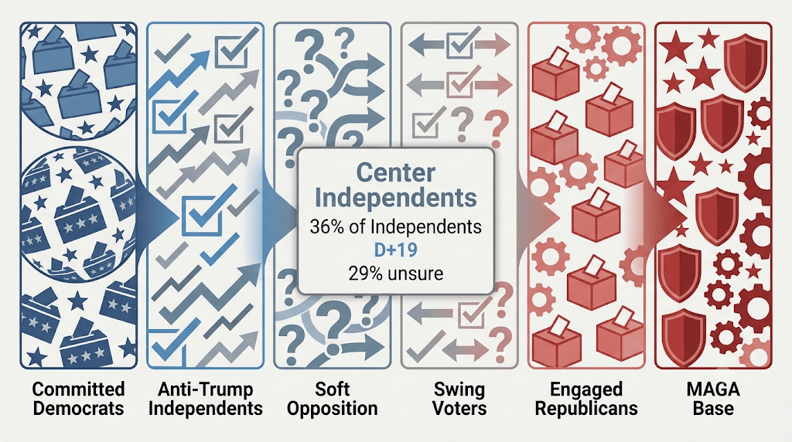
Campaign Now (Gemini), six clusters reveal the persuadable center
Center Independents provide the clearest path to movement because neither party owns them. Trump stands at net −49, they expect a Democratic victory by 49% to 31% and 42% cite frustration with both parties. Their dissatisfaction rewards candidates who build identities beyond national conflict.
Candidate style matters among swing voters who considered Republican options. About 51% prefer a moderate Republican, 26% prefer a traditional fiscal conservative and 7% prefer a Trump-aligned candidate. Among Trump 2024 voters in that subgroup, moderates lead at 40%, followed by traditional conservatives at 36% and Trump-aligned candidates at 14%.
Republicans retain trust advantages on immigration, crime and government spending. Candidate-profile results nevertheless show that many swing voters prefer moderation over a loyalty-first identity. That combination describes an electorate that can support conservative enforcement policies without embracing every feature of the national Republican brand.
A Stable Democratic Lead Hides Coalition Strain
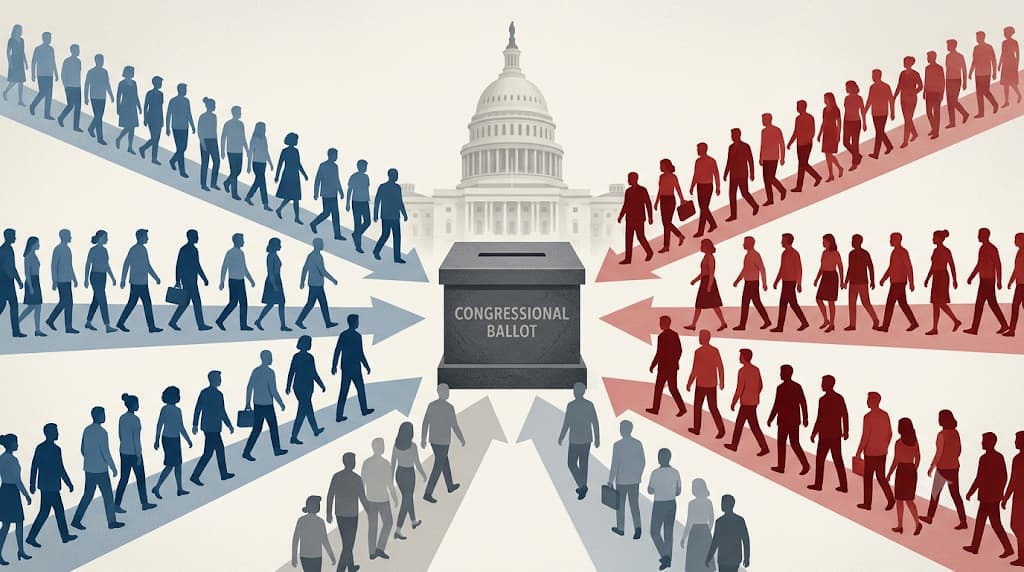
Democrats lead the generic ballot 49% to 44%, a D+5 margin largely unchanged across four months. Independents favor Democrats 47% to 33%, while swing voters divide at 36% to 36%. The topline shows a durable edge without revealing coalition vulnerabilities.
Other polling places the national environment in the same direction. Silver Bulletin’s July average stands near D+6.1, while Morning Consult’s tracker shows Democrats ahead 45% to 42% among registered voters. Cygnal’s D+5 result sits between those measures rather than outside the wider polling range.
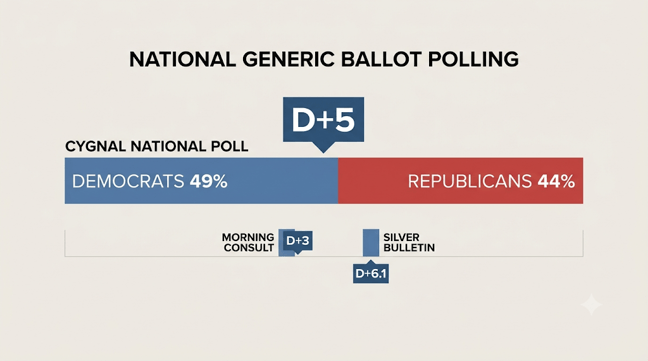
Campaign Now (Gemini), Democrats hold a stable five-point lead
Expectations also favor Democrats, although Republican perceptions improved in June. Independents expect a Democratic victory by 47% to 32%, while swing voters expect one by 40% to 32%. Republicans narrowed the overall expected-winner gap from D+9 to D+5 without gaining generic-ballot support.
Large demographic divides sit beneath the stable margin. Men lean Republican by nine points, while women lean Democratic by 17 points, producing a 26-point gender gap. Voters younger than 30 favor Democrats by 45 points, while voters age 45 and older lean Republican.
Education, race and marital status create more fault lines. Non-college voters favor Republicans by five points, college voters favor Democrats by 15 points, White voters lean Republican by seven points and Hispanics lean Democratic by 18 points. Married voters support Republicans by 12 points, while single voters support Democrats by 39 points.
Such gaps make turnout composition as important as persuasion. Republicans gain from older, married and non-college voters, while Democrats gain from younger, college-educated and single voters. Economic trust now shapes the argument for voters outside those blocs.
Cost of Living Trust Has Flipped
Affordability represents the poll’s clearest shift from the 2024 political environment. Democrats now lead trust on the economy 45% to 44% and cost of living 45% to 41%. Republicans held a two-point economic advantage in May 2025 and a two-point cost-of-living advantage one year earlier.
That reversal becomes larger among Independents. Democrats lead this group on the economy 44% to 33%, cost of living 42% to 29% and foreign affairs 41% to 33%. Republicans still lead Independents on immigration 46% to 28% and crime 39% to 30%.
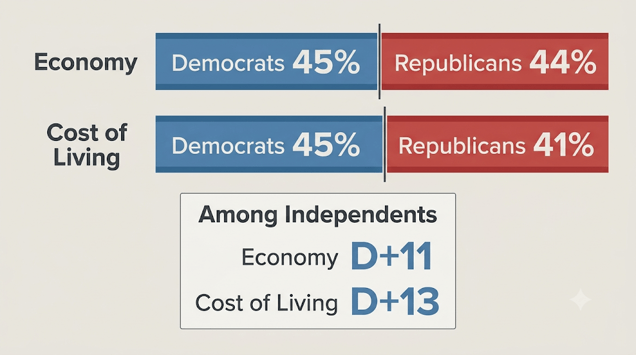
Campaign Now (Gemini), affordability trust now favors Democrats
Women strengthen the Democratic affordability advantage. They trust Democrats on the economy and cost of living by 50% to 37%, while men trust Republicans on the economy by 51% to 40%. Swing voters favor Republicans on the economy 38% to 33% but Democrats on cost of living 36% to 32%.
Cygnal’s Economic Sentiment Index explains the split between broad economic strain and limited ballot movement. About 55% of voters fall into the bottom two tiers, including 38% who are Falling Behind and 17% who are Decimated. Those tiers include 61% of Independents and 60% of swing voters.
Economic experience closely tracks vote choice. Voters Doing Well support Republicans by 79 points, while those Falling Behind support Democrats by 54 points and those Decimated support them by 66 points. Inflation and the economy rank first among congressional priorities at 23.8%, followed by threats to democracy at 17.7%, government spending and waste at 13.8% and illegal immigration and border security at 11.6%.
Republicans still lead on immigration, crime and wasteful spending. Voters experience those concerns alongside daily financial pressure, not instead of it. The party that wins affordability credibility gains the strongest route to Center Independents and control of the House.
Ending the Iran Conflict Commands Broad Support
Conflict with Iran produces a rare cross-partisan consensus. About 74% support finalizing an agreement to pause and end the war, while 16% oppose that course. Support reaches 85% among Republicans, 74% among Independents, 71% among swing voters and 62% among Democrats.
Economic costs strengthen the demand for de-escalation. Only 33% describe higher gasoline prices as a necessary cost of a justified operation, while 48% say the burden is too high. That judgment reaches 53% of Independents, 45% of swing voters and 83% of Harris voters.
Gasoline prices turn foreign policy into a household-budget issue. Cygnal reports that 58% experience a major or moderate burden from fuel prices, including 71% of households earning below $75,000 and 62% of Independents. Energy Information Administration data placed regular gasoline near $4.00 per gallon nationally in July after Middle East disruptions raised oil-market volatility.
Cygnal tested the electoral cost of a prolonged conflict with elevated fuel prices. Under that scenario, Democrats rise to 50.3% while Republicans fall to 42.8%, producing a D+7.5 margin compared with the original D+5 ballot. Independents move from D+14 to D+19, while voters earning below $75,000 move to a 54% to 37% Democratic advantage.
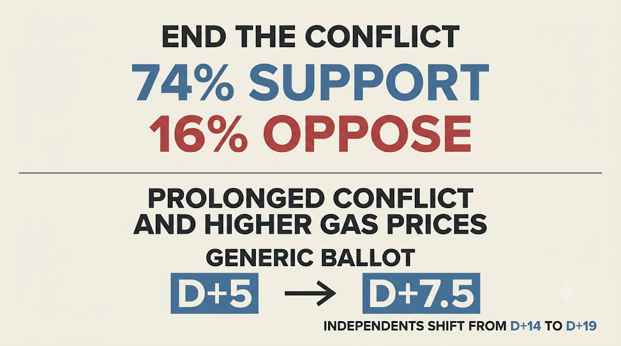
Campaign Now (Gemini), voters favor ending the Iran conflict
This scenario links the poll’s foreign-policy consensus to its affordability reversal. Voters support strength on security, but they reject an open-ended conflict that raises household costs without a clear endpoint. Ending the war therefore aligns the Republican base with the persuadable middle while reducing pressure on the party’s weakest domestic issue.
Wrap Up
Cygnal’s six clusters show an electorate that is highly committed but not fully settled. Democrats hold a stable D+5 lead, yet turnout gaps, Center Independents and candidate profiles still create movement inside that margin. Republicans retain advantages on immigration and crime, while Democrats now control the economic trust measures carrying the greatest daily relevance.
Affordability connects every major finding. It separates thriving voters from those falling behind, moves women and Independents toward Democrats and turns gasoline prices into an electoral cost of the Iran conflict. Broad support for de-escalation reflects economic pressure as much as foreign-policy preference.
Campaigns entering the final months face a narrow set of decisive tests. Republicans need to rebuild trust on household costs without weakening their security advantage, while Democrats need to convert economic trust into turnout across fragmented coalition groups. Center Independents, younger voters, Independent women and fuel prices will reveal whether D+5 remains stable or becomes a larger Democratic wave.