
National pride remains broadly popular, but its strongest political energy still sits on the right.
What to Know
- 89% of Republicans say they are extremely or very proud to be American.
- Only 29% of Democrats say they are extremely or very proud.
- 70% of Republicans call America fundamentally exceptional.
- Freedom and opportunity are the strongest crossover patriotic themes.
- America’s 250th showed why national pride remains politically visible.
Republicans still hold one of the clearest advantages in American politics: they speak the language of patriotism more naturally, and their voters respond to it with much greater intensity. That advantage comes from both familiar symbols and a Republican electorate that expresses national pride with greater intensity. Its strength becomes more important when other issue advantages are less settled.
Cygnal’s June national survey shows why that matters before the 2026 midterms. Economic trust has become more complicated for Republicans, but patriotic identity remains a durable emotional lane where conservatives and many moderates still feel more aligned with the right than with the progressive left. Patriotism therefore provides a clearer point of emotional alignment than many of the cycle’s more contested policy debates.
Republicans Own National Pride’s Familiar Language
Patriotic messaging has long given Republicans a simple emotional frame: country, flag, military, founding principles, freedom, and opportunity. That frame works because it does not need to sound new to feel powerful. Familiarity reinforces the message by connecting political identity with symbols voters already recognize.
Gallup’s July 2026 pride survey found that 70% of Republicans, 28% of independents, and 14% of Democrats said they were extremely proud to be American. That gap shows how much of the highest-intensity version of national pride still sits on the right. Republican intensity therefore remains substantially higher than the levels reported among either independents or Democrats.
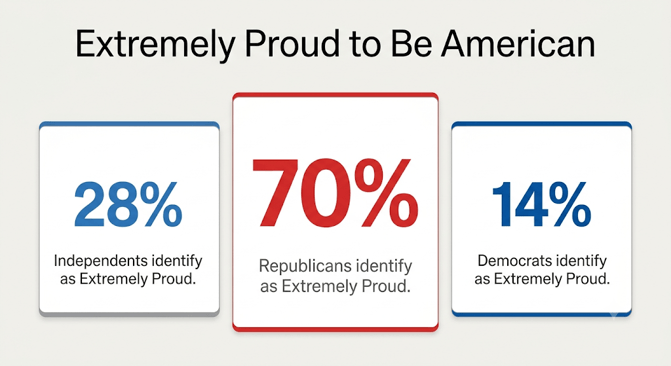
Campaign Now (Gemini), comparing Republican and Democratic pride intensity
Pew’s national pride research points in the same direction. Republicans and Democrats often describe national pride through different values, with Republicans more closely tied to traditional patriotic language and Democrats more likely to emphasize different sources of pride. Value selection shapes not only how pride is expressed, but also which patriotic appeals feel credible to each coalition.
That does not mean patriotism belongs only to one party. It means Republicans have a stronger vocabulary for pride, while progressive messaging often sounds more conditional, critical, or reform-focused. That contrast leaves the parties working from different emotional starting points even when both invoke national identity.
This first advantage is cultural before it is tactical. Once a party owns the emotional language of national pride, polling only has to show how wide that ownership still is. Polling becomes the measure of whether that cultural advantage still translates across age and party lines.
Cygnal Shows Patriotism Splitting By Party And Age
Cygnal’s June deck shows 58% of voters are extremely or very proud to be American. That topline looks healthy until the partisan breakdown appears: 89% of Republicans say they are extremely or very proud, compared with 52% of independents and 29% of Democrats. Partisan intensity, rather than the overall majority alone, carries the clearest political significance.

John Rogers, senior partner and pollster at Cygnal
John Rogers, senior partner and pollster at Cygnal, described the split this way:
“Overall, a majority say they’re very or extremely proud to be American, which is fantastic, right? But the intensity is heavily partisan and generational.”
Cygnal’s uploaded chart sharpens the point. 72% of Republicans say they are extremely proud to be American, while only 16% of Democrats say the same and 30% of Democrats say they are not proud at all. Such a wide gap shows that the strongest form of pride is concentrated heavily within the Republican coalition.
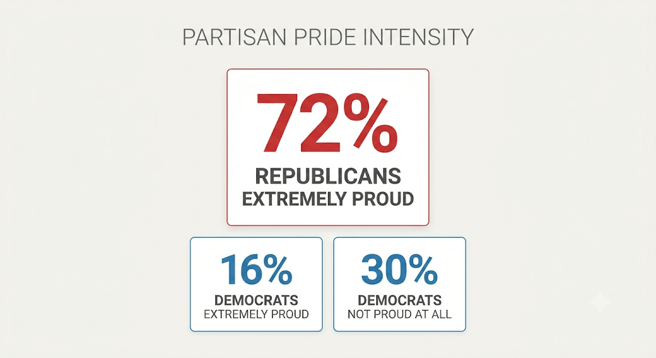
Campaign Now (Gemini), showing partisan splits in American pride
Generational data adds another warning. Only 28% of voters under 30 are extremely or very proud, compared with 68% of voters 65+ and 69% of voters ages 55 to 64. Age therefore separates patriotic intensity almost as clearly as party identification does.
Exceptionalism follows the same pattern. Cygnal shows 38% overall call America fundamentally exceptional, but that includes 70% of Republicans and only 11% of Democrats. Exceptionalism is consequently another measure where overall sentiment masks a much sharper partisan divide.
Those numbers explain why patriotic appeals can still energize conservatives and reach some moderates. They also show why the same message may fail with younger and more progressive audiences. Persuasion depends on whether patriotic language can reach those groups without relying on the cues they reject.
Polling does not show a country where pride has vanished. It shows a country where pride has become much more partisan, which makes message selection more important heading into campaign season. National pride remains present, but its political meaning now depends heavily on who is expressing it and how.
Freedom Messaging Gives Patriotism Its Midterm Opening
Campaign implications begin with a distinction between base pride and crossover pride. Military-centered patriotism is powerful on the right, while diversity-centered pride is stronger on the left, but neither is the broadest persuasion lane. That difference matters because symbols that deepen identification within one coalition may carry less persuasive value outside it.
Cygnal’s pride-factor data shows 66% select freedoms and individual rights as a source of American pride, while 53% select the opportunity to build a better life. Freedoms cut across parties, with 78% of Republicans, 61% of independents, and 57% of Democrats choosing that theme. Shared emphasis on freedom gives patriotic language a broader base than either military or diversity-focused appeals alone.
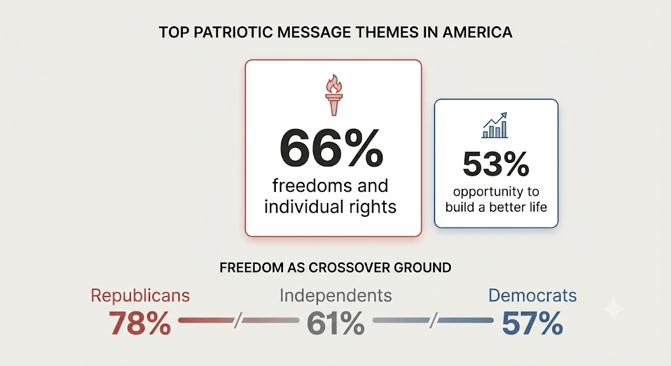
Campaign Now (Gemini), highlighting freedom as patriotic crossover ground today
More polarizing themes tell a different story. Military pride is much stronger among Republicans at 63% than Democrats at 26%, while diversity is stronger among Democrats at 65% than Republicans at 32%. Each party therefore finds stronger reinforcement in a different set of patriotic symbols.
America’s 250th anniversary moment gave this split more political meaning. Cygnal’s pre-July 4 data showed 35% planned nothing different from a typical year, rising to 53% among Democrats and 41% among independents, compared with just 13% among Republicans. Participation plans reflected the same partisan imbalance visible in broader measures of pride.
Republicans were also far more likely to report visible patriotic action. Cygnal showed 52% of Republicans planned to fly the flag or display patriotic decorations, compared with 13% of Democrats, while 47% of Republicans planned to watch anniversary programming, compared with 12% of Democrats. Visible celebration therefore became another marker of how differently partisan groups expressed national attachment.
Midterm messaging therefore has a clear opportunity. Patriotism can motivate the Republican base, but freedom and opportunity offer the safer bridge to moderates who still want pride without hard partisan cues. Crossover potential rests less on partisan imagery and more on civic ideas that retain meaning across coalitions.
Looking toward 2026, national pride may matter because it gives candidates an emotional story beyond prices, crime, or turnout mechanics. Strong patriotic language can make a campaign feel rooted in purpose rather than only grievance. That broader frame links patriotic identity to future-oriented purpose rather than a single issue or grievance.
Wrap Up
Republicans still hold the advantage on patriotism because national pride remains more intense, more visible, and more politically natural on the right. Cygnal’s pre-July 4 data showed Republican voters were far more likely than Democrats or independents to connect pride with public patriotic behavior, including flying the flag, displaying decorations, and watching anniversary programming. Even after the 250th anniversary moment has passed, that participation gap still matters because it shows which voters are most comfortable turning national pride into visible political identity.
Patriotism also gives Republicans a way to connect base energy with broader civic language. Military pride and traditional symbols can still motivate conservative voters, but the strongest crossover themes are freedom, individual rights, and opportunity. Those ideas allow patriotic messaging to reach beyond the base without sounding like a narrow partisan slogan.
Still, the advantage is not automatic. If patriotic messaging becomes too aggressive, too nostalgic, or too focused on base-only cues, it can lose moderates and independents who are open to pride but skeptical of partisan performance. The strongest 2026 opening is not simply saying America is great, but explaining why its freedoms, opportunities, and future are still worth defending.