
Polling buyers can no longer judge research quality by speed, price, or dashboards alone.
What to Know
- 5 bot accounts could generate $30,000 monthly when cheap open panels reward repeated survey-taking.
- Verified panelists average fewer than 2 surveys monthly and receive about $11 for each completed survey.
- AI-generated responses passed 99.8% of attention checks across 6,000 controlled trials.
- Just 10 to 52 fake responses could have changed the predicted winner in 7 close national polls.
- Recruitment method should be the first question asked before paying for political polling.
Pew Research Center’s May 2026 analysis reduces the technology threat to a practical purchasing question. Can anyone sign up for the panel, or were respondents selected through probability-based recruitment that blocks self-enrollment? That distinction cannot guarantee a perfect poll, but it shows how automated accounts can enter the sample.
AAPOR’s responsible AI framework adds a second quality test. Buyers need to know where AI entered the process, how humans reviewed its output, and whether generated responses were mixed with real participants. Recruitment protects the panel’s entry point, while disclosure explains what happened after data collection began.
Recruitment Determines the Attack Surface
Open opt-in panels are built for access and speed. People respond to advertisements or rewards, create accounts, and qualify for studies. Self-enrollment creates an opening for participants who are not who they claim to be.
Probability-based panels reverse that flow. Pew Research Center’s address-recruited panel begins with residential addresses, randomly selects households, and contacts prospective participants offline. People cannot nominate themselves, repeatedly enroll, or create extra panel identities.
Recent Pew methodology illustrates that infrastructure. Since 2018, its American Trends Panel has used address-based recruitment from a U.S. Postal Service delivery file estimated to cover 90% to 98% of the population. That breadth does not remove nonresponse or weighting problems, but it creates a traceable path to a verified account.
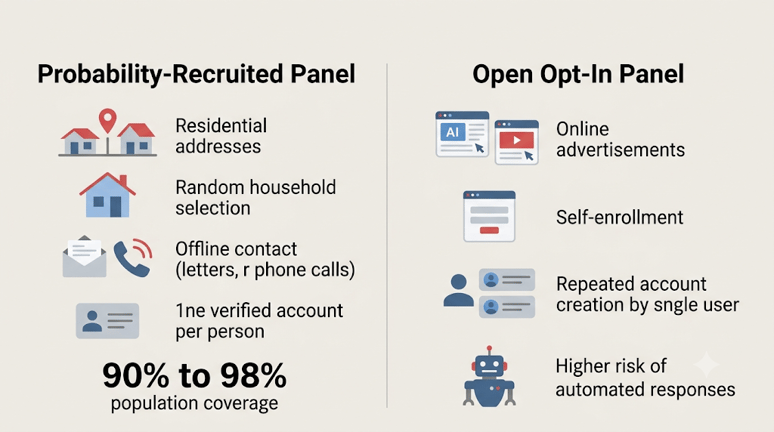
Recruitment determines polling fraud exposure. Created via Gemini.
Structural protection matters as AI agents become better at imitating careful respondents. A fraudster faces fewer barriers when the recruitment system lets anyone arrive at the door. Low barriers turn identity verification from a routine safeguard into the central vulnerability.
Probability recruitment remains a starting test rather than a complete quality certificate. Pew warns that weighting, questionnaire design, coverage, fieldwork, and analysis can still produce inaccurate results. A carefully recruited sample lowers one major risk, then directs attention to participation controls.
Recruitment therefore answers the first purchasing question, not the last one. Once the sample’s entry point is clear, the next issue is whether the panel’s economics reward honest participation or industrial-scale fraud.
Fraud Math Rewards Weak Panel Controls
Pew Research Center’s bot-fraud example makes the incentive gap concrete. It imagines 5 AI bot accounts completing 200 surveys a day for $1 per survey. Pew’s published $30,000 monthly total assumes those 200 daily completions apply to each account.
Pew Research Center’s probability-based panel creates a radically different payoff. Each verified respondent has 1 account, completes an average of fewer than 2 surveys monthly, and receives about $11 per survey. Using 2 surveys for comparison produces approximately $22 a month, removing the scale that makes automated cheating attractive.
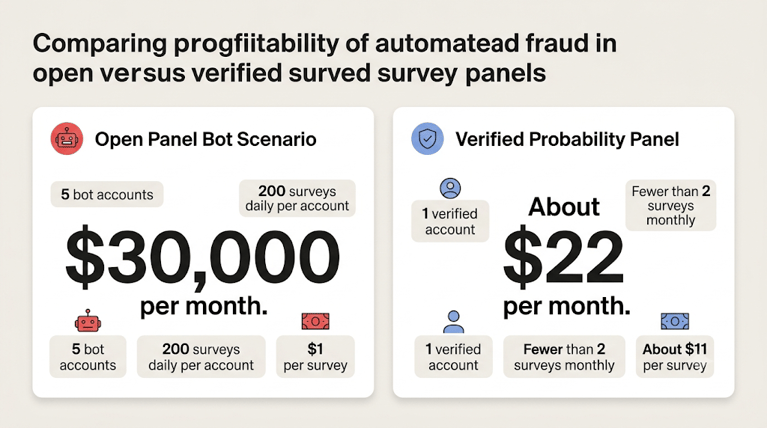
Weak controls make fraud profitable. Created via Gemini.
Higher respondent payments do not automatically create greater fraud exposure. Frequency limits and identity controls can make a better-paid panel less profitable to attack than an open marketplace. Panel design determines whether one operator can multiply identities and repeat the same behavior hundreds of times.
Cheap data becomes expensive when contaminated responses influence targeting, creative, spending, or candidate positioning. A low fieldwork price can hide a larger strategic cost when automated accounts reinforce a false conclusion.
Financial incentives explain why an open panel attracts attack, but incentives alone do not show whether modern bots can survive quality checks. Peer-reviewed evidence shows familiar defenses can fail even when responses appear logical and consistent.
AI Can Pass Familiar Quality Checks
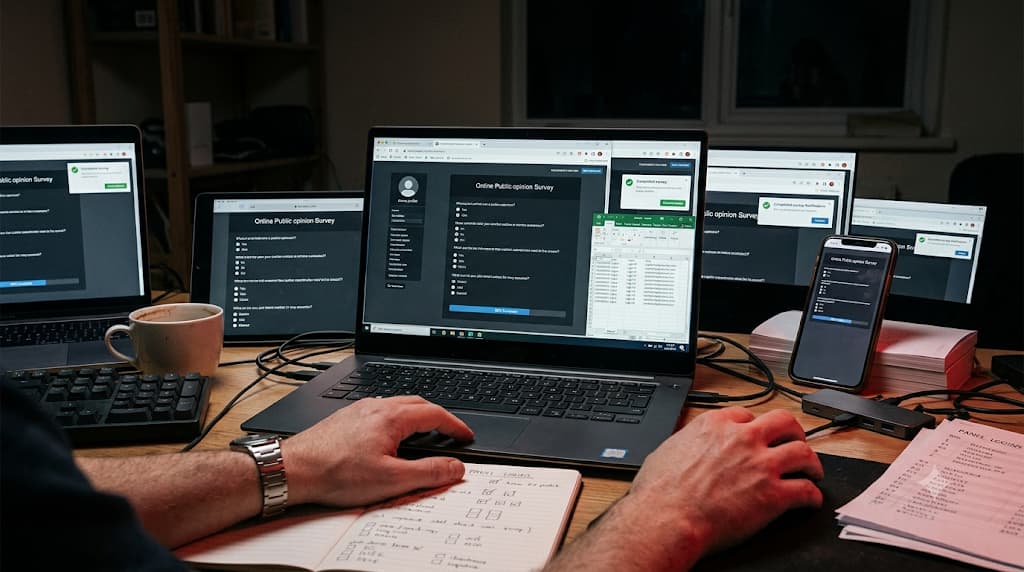
Peer-reviewed PNAS research tested an autonomous AI system designed to complete online surveys while maintaining a coherent demographic persona. Across 6,000 standard attention-check trials, the system passed 99.8% of them. It also adjusted language to match its assigned education level and simulated reading time, mouse movement, and keystrokes.
A broader evaluation included 43,800 tests across 139 questions and 6,700 trials. Those behaviors made the system resemble a patient participant who remembered earlier answers.
Political consequences appeared with surprisingly little contamination. Dartmouth’s summary of the research says adding only 10 to 52 fake responses, costing roughly $0.05 each, would have changed the predicted winner in 7 major national polls before the 2024 election. Narrow margins made small intrusions consequential.
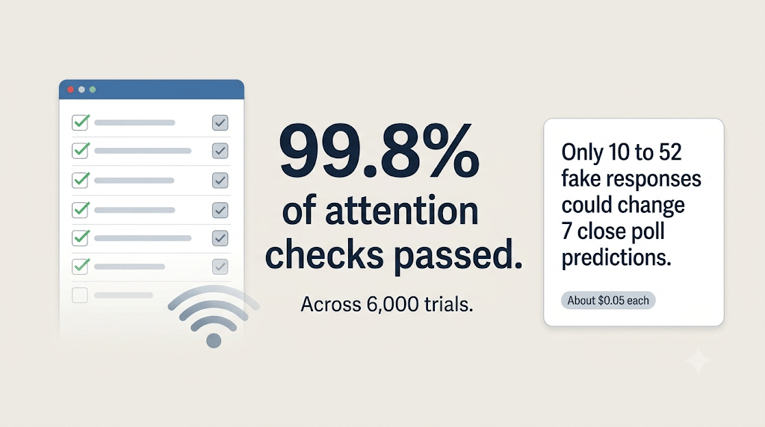
Synthetic respondents beat quality checks. Created via Gemini.
Attention checks once caught careless respondents and simple bots. Today’s AI can follow instructions, maintain a persona, and pass basic traps, so a clean survey record no longer proves a real voter was behind it. In a close poll decided by only a few points, even a small pocket of synthetic responses can distort the picture.
That does not make every opt-in poll unreliable. It raises the standard for proof, with buyers needing to see how respondents were recruited, identities checked, anomalies flagged, and questionable cases reviewed by people. AI can still support coding, translation, and quality control, but the key question is whether it helped conduct the research or quietly became the respondent.
Disclosure Separates Assistance From Substitution
AAPOR evaluates AI use through 4 core criteria, validity, performance, sensitivity, and reliability. Its framework also distinguishes AI used in data collection, analysis, briefing, and questionnaire work because each role creates different risks. Synthetic responses receive especially serious treatment because modeled answers are not direct observations of human opinion.
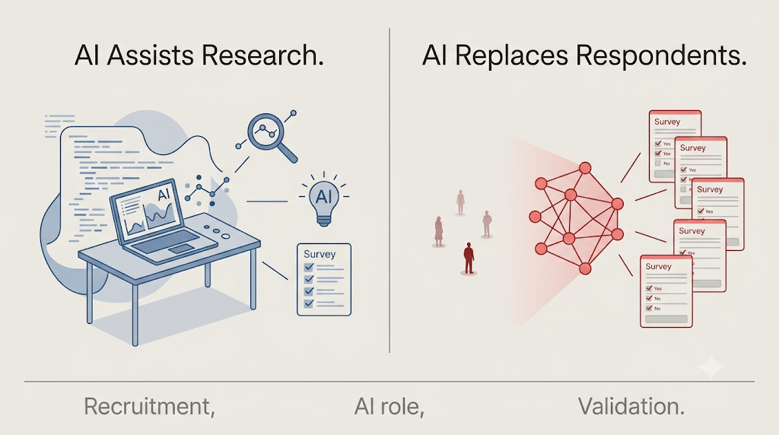
Disclosure distinguishes assistance from substitution. Created via Gemini.
Some applications support researchers without replacing the people being measured. AI can help draft questions, transcribe interviews, translate material, classify open-ended responses, or summarize findings when humans validate the output. Campaigns & Elections’ analysis makes the same constructive distinction, arguing that AI can synthesize complex responses and expose tradeoffs while traditional polling remains essential.
AAPOR’s minimum disclosures require researchers to identify the tasks performed by AI, report the number of human respondents, and explain validation and human oversight. Those details distinguish AI-assisted workflows from products where generated respondents substitute for voters.
A vendor’s methodology should therefore answer 3 connected questions. How were respondents recruited, what exactly did AI do, and what independent checks were applied before results reached the client? Evasion on any point is a serious warning because polished outputs cannot compensate for an unverified sample or an undisclosed synthetic layer.
Responsible use does not require rejecting AI. It requires protecting original human data, validating automated work, and documenting where technology influenced the final estimate. Those standards turn recruitment and disclosure into a practical purchasing test.
Wrap Up
AI fraud is making panel recruitment impossible to treat as a technical footnote. Probability-based recruitment limits self-enrollment, duplicate identities, and unlimited survey-taking before fraud detection begins. Open opt-in panels may still produce useful estimates, but their lower barriers create a larger attack surface that demands stronger verification, clearer disclosures, and more cautious interpretation.
Polling purchases in 2026 should be judged by the full chain of evidence. Buyers need to know how people entered the panel, how identities were protected, where AI touched the workflow, how many human respondents contributed, and which checks supported the final estimates. Recruitment is not the only measure of quality, but it is the first answer that reveals whether a client is buying human opinion, an AI-assisted analysis of human data, or sophisticated noise presented as certainty.
Sources
- Pew Research Center, “Do AI and Bogus Respondents Threaten Polling’s Future?”
- Pew Research Center, “Americans and AI 2026 Methodology”
- AAPOR, “Responsible AI Integration in Survey Research”
- PNAS, “The Potential Existential Threat of Large Language Models to Online Survey Research”
- Dartmouth, AI polling study summary
- Campaigns & Elections, “How AI Can Help Fix Polling”

-May-16-2026-10-24-03-9739-PM.jpg)