

Independent voters are warning that America feels off course, unaffordable, and short of its own ideals.
What to Know
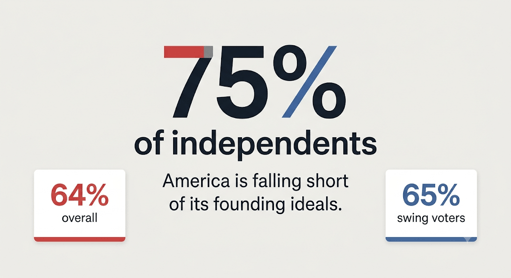
- 75% of independents say America is falling short of its founding ideals today.
- 61% of independents sit in the bottom 2 economic sentiment tiers.
- Independents trust Democrats more on affordability, economic pressure, and household costs.
- Independents trust Republicans more on immigration, crime, and public-safety enforcement.
- Swing voters prefer moderate candidates over loyalty-first political profiles heading into 2026.
Independent voters are not just waiting to choose a side late in the cycle. They are describing a country that feels economically strained, politically exhausted, and less confident in its own promise.
Cygnal’s June National Voter Trends survey gives that warning a clear shape. Its national survey of 1,500 likely 2026 general election voters, conducted June 2 to 3, shows dissatisfaction moving through patriotism, affordability, party trust, and candidate preference.
Independents See a Country Falling Short
A single number frames the story. In Cygnal’s June deck, 64% of voters say America is falling short of its founding ideals, including 75% of independents and 65% of swing voters.
Pride is still present, but confidence is uneven. The same deck shows 58% of voters are extremely or very proud to be American, while independents sit at 52% and 19% of independents say they are not proud at all.
Campaign Now (Gemini), tracking founding ideals among independents
Younger voters deepen the long-term warning. Only 28% of voters under 30 say they are extremely or very proud, compared with 68% of voters 65+ and 69% of voters ages 55 to 64.

John Rogers, senior partner and pollster at Cygnal
John Rogers, senior partner and pollster at Cygnal, described national pride as real but sharply divided:
"Overall, a majority say they're very or extremely proud to be American, which is fantastic, but the intensity is heavily partisan and generational."
Declinism is broader than one party. Cygnal’s top-numbers graphic shows 63% say Americans today are less proud than in the past, compared with 17% who say more proud and 15% who say about the same.
This is the first warning independents are sending. They are not only unhappy with politics, they are unsure whether the country is living up to the story it tells about itself.
That frustration moves naturally into daily life. Once voters say America is falling short, affordability becomes the place where that disappointment turns measurable.
Affordability Turns Discontent Into Pressure
Economic strain gives the civic warning its force. Cygnal’s Economic Sentiment Index places 61% of independents and 60% of swing voters in the bottom 2 tiers, meaning they are either falling behind or economically decimated.
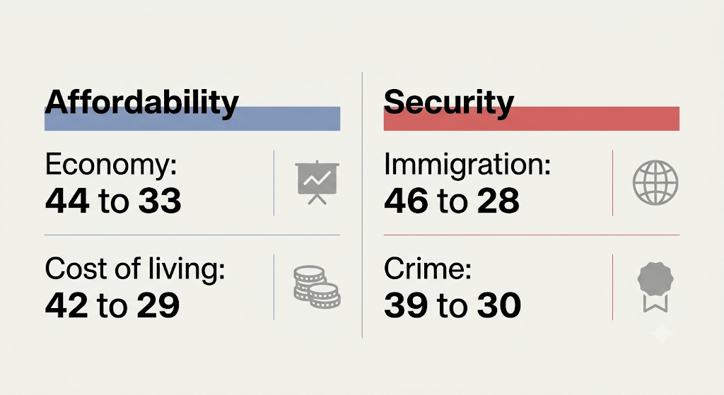
Issue trust shows the affordability problem clearly. Independents trust Democrats on the economy 44 to 33 and cost of living 42 to 29, while they trust Republicans on immigration 46 to 28 and crime 39 to 30.
Campaign Now (Gemini), comparing affordability and security trust
Issue priority data points in the same direction. Inflation and the economy rank first overall at 23.8%, ahead of threats to democracy at 17.7%, government spending and waste at 13.8%, and illegal immigration and border security at 11.6%.

Brent Buchanan, founder and CEO of Cygnal
Brent Buchanan, founder and CEO of Cygnal, emphasized that independent voters should not be treated as one simple category, arguing that “we can’t look at independents as a category.” Instead, the data divide independents into distinct voter blocs with different priorities and varying levels of openness to Republican candidates.
Affordability does not erase security concerns. It splits the persuasion field into separate lanes, with Republicans stronger on enforcement and Democrats stronger on economic trust among independents.
That split is why independent dissatisfaction remains unsettled rather than fully converted. Cost pressure is real, but the voter middle is still sorting which party can connect concern about the country with concern about the household.
Even voters who trust one party on enforcement may trust the other on prices. That creates a competition over credibility, not just ideology, and it explains why economic language has to sound practical rather than purely partisan.
A Smaller Middle Carries the Next Fight
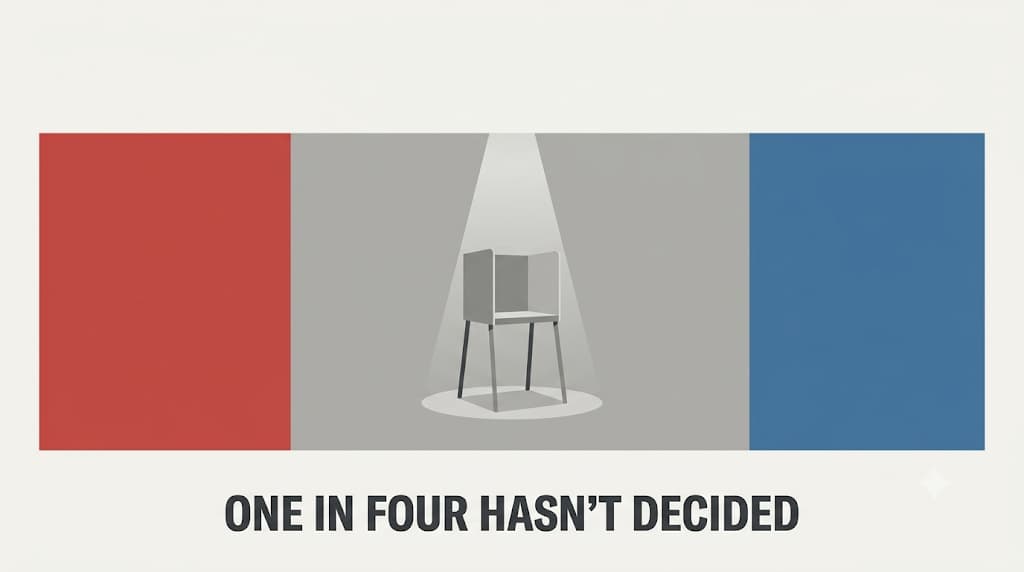
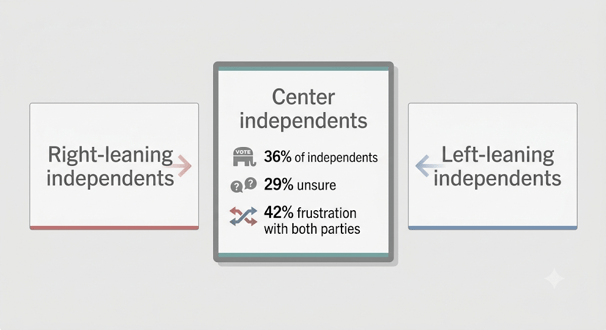
Independent voters are not one uniform bloc. Cygnal separates them into right-leaning independents, left-leaning independents, and center independents, with center independents making up 36% of independents.
Center independents are the real competitive group. Cygnal shows they sit at D+19, with 29% unsure, and their largest vote driver is frustration with both parties at 42%.
Campaign Now (Gemini), breaking independents into voter blocs
Swing voters add the candidate test. Among swing voters asked what kind of Republican candidate they would be open to supporting, 51% preferred a moderate Republican, 26% preferred a traditional fiscal conservative, and only 7% preferred a president-aligned option.
Brent Buchanan, founder and CEO of Cygnal, warned against treating independents as one simple category:
"we can't look at independents as a category."
Generic ballot numbers show why the middle still matters. Democrats lead nationally 49.1% to 43.9%, but swing voters are tied at 36 to 36, leaving decisive pressure in a narrow group that is skeptical, strained, and still movable.
November competition will not turn on a generic independent voter. It will turn on voters who feel the country is falling short, feel household pressure, and still want a candidate profile that sounds competent rather than captive to party identity.
This is where both parties face the same test from different directions. Economic credibility, candidate quality, and national confidence have to meet in the same message.
A narrow middle can still decide a close cycle when large partisan blocs are already locked in. Small shifts can become seat-level consequences very quickly across the most competitive races.
Wrap Up
Independent voters are delivering a warning that is bigger than ballot preference. Their doubts about founding ideals, national pride, affordability, and party credibility are all connected to the same broader concern: the country feels off course, and neither party has fully earned the middle’s trust. Cygnal’s data shows independents are not just reacting to one issue, one candidate, or one headline, but weighing the economy, national confidence, and party competence at the same time.
That makes the next election cycle harder to read through a simple partisan lens. Independents trust Democrats more on affordability, but they still trust Republicans more on immigration and crime. They feel economic pressure, but many remain undecided or open to candidates who sound moderate, practical, and less tied to party identity. That split is why independents can remain dissatisfied without automatically becoming reliable voters for either side.
The real fight will be over credibility. Candidates who can connect cost of living, national purpose, and competent leadership will have the best chance to move voters who are skeptical but still persuadable. In close districts and statewide races, even small shifts among center independents and swing voters could turn broad dissatisfaction into decisive electoral movement.