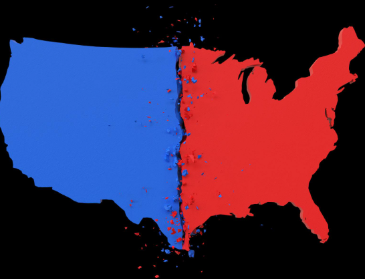


The difference between a Senate seat flip and a rounding error in the polls often comes down to a single, critical factor: a state’s political elasticity.
What to Know
- Political elasticity measures how much a state shifts relative to national trends. A 1-point national change can produce larger movement in elastic states and minimal change in inelastic ones
- Racial and partisan polarization reduces elasticity. Highly sorted states move less than states with more crossover voters
- Strong candidates can outperform their state’s baseline by building broader coalitions beyond their party
- The 2026 Senate map will test elasticity in states like Alaska, Iowa, and Maine, where local dynamics can override national trends
- Elasticity is more predictive than the generic ballot. National swings do not translate evenly across the map
In a nationalized political environment, it is tempting to assume that momentum translates evenly across the map. If a party leads by five points nationally, the expectation is that its candidates benefit uniformly. That assumption is flawed. The American electoral landscape does not move as a single unit. Some states respond sharply to national shifts, while others remain largely unchanged.
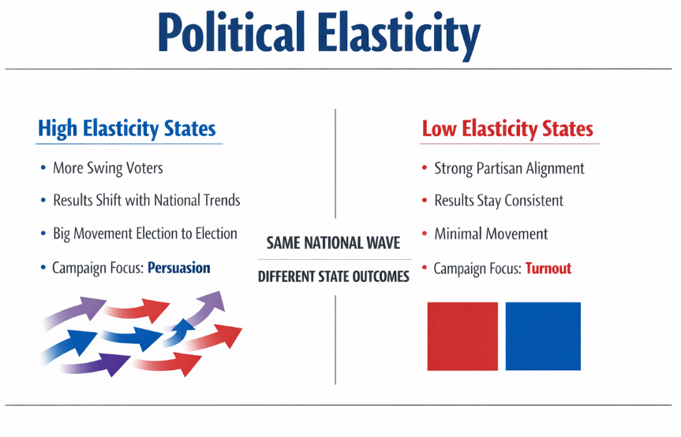
This dynamic is defined by political elasticity. High-elasticity states, typically with larger shares of swing voters, can amplify national trends and produce outsized movement. Low-elasticity states, where voters are firmly aligned along partisan lines, tend to resist those shifts. As a result, even a meaningful national swing may generate significant gains in some states and negligible change in others.
Polarization’s Dampening Effect
One of the most significant constraints on political elasticity is racial and partisan polarization. In large portions of the American South, voting coalitions are sharply defined, with white voters largely aligning with Republicans and Black voters forming a core Democratic base.
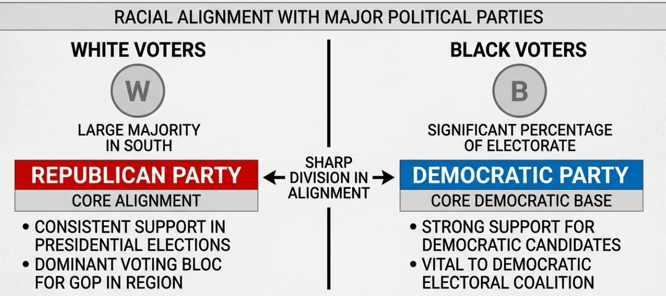
When electorates are this firmly sorted, the pool of persuadable voters shrinks considerably, limiting the potential for movement. This structural rigidity makes these states highly inelastic. Even in favorable national environments, results tend to remain stable because underlying voting patterns are deeply entrenched.
When the Candidate Is the Campaign
Structural factors shape the map, but they do not fully determine outcomes. Strong candidates can generate their own momentum, effectively creating what can be described as candidate-driven elasticity. In these cases, performance is not dictated by partisan lean alone, but by the ability to build coalitions that extend beyond a party’s base.
Recent elections provide clear examples. In Pennsylvania, Josh Shapiro won the governorship by 14.8 points, significantly outperforming the broader political environment. In Michigan, Gretchen Whitmer secured reelection by 10.5 points, expanding her margin during a challenging cycle for Democrats.


Governor Josh Shapiro (left) and Governor Gretchen Whitmer (right)
In Kentucky, Andy Beshear won reelection by 5.2 points in a state that typically favors Republicans. These outcomes reflect candidates who successfully attracted crossover and independent voters, rather than relying solely on partisan alignment.


Governor Andy Beshear (left) and Governor Gavin Newsom (right)
By contrast, results like Gavin Newsom’s 61.9% vote share in California, which closely mirrored his previous performance, illustrate what happens in low-elasticity environments.
Why Elasticity Matters More Than the Generic Ballot
Elasticity is one of the most practical tools available for understanding how elections actually unfold. National polling provides a snapshot of mood, but it does not determine outcomes at the state level. A Democratic advantage of three points nationally does not translate into a uniform three-point gain across the map.

In high-elasticity states, that same environment can produce outsized movement, potentially large enough to flip a Senate seat. In low-elasticity states, the impact is muted, often resulting in only marginal shifts that fall short of changing the outcome. This uneven distribution of movement is where most campaign strategies break down.
The 2026 Senate map runs directly through states where this dynamic matters most. Alaska, Iowa, and Maine all have histories of ticket-splitting and are highly sensitive to candidate quality and local conditions. These are not states that simply follow national trends. They respond to who is running, how they campaign, and whether they can build coalitions beyond their base.
Weaponizing Elasticity
Elasticity is only valuable if it changes behavior. Most campaigns acknowledge the concept and then ignore it when making decisions. That is where opportunities are lost. Elasticity should dictate where money goes first, not last. In high-elasticity states, persuasion is worth the investment. These are the environments where targeted media, voter contact, and narrative framing can actually move margins in a meaningful way. Every dollar has the potential to produce amplified returns.
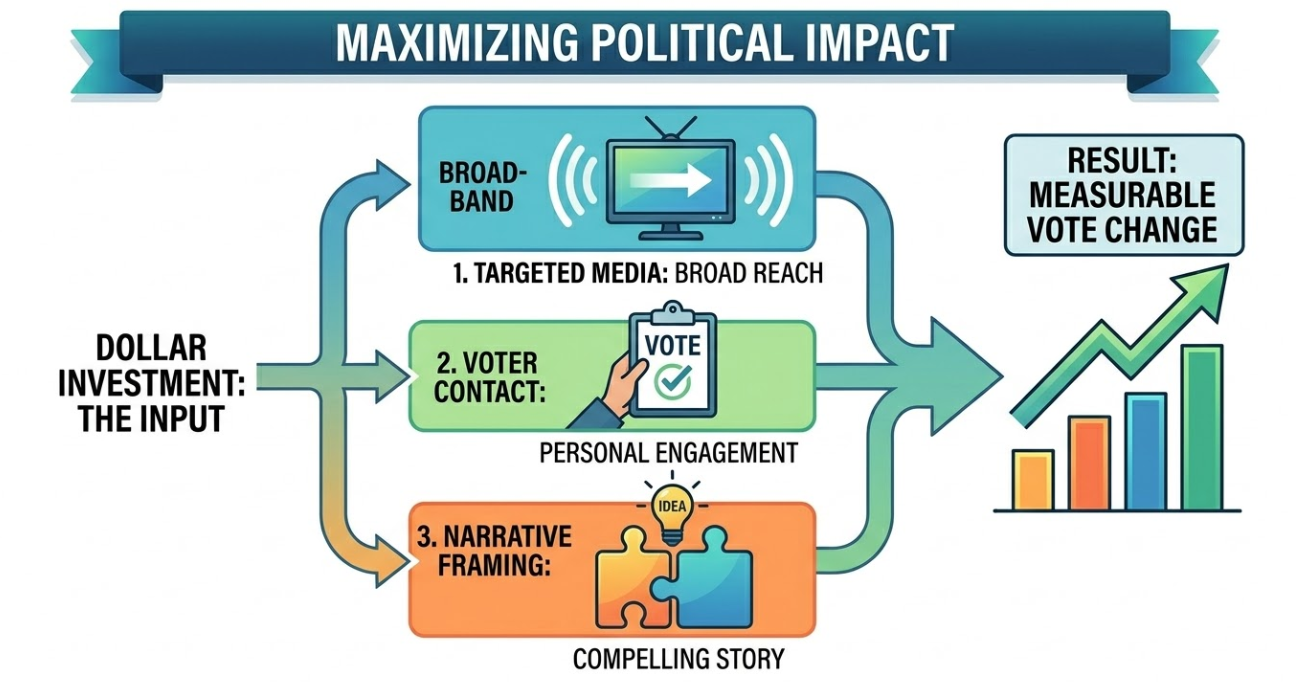
In low-elasticity states, that same strategy becomes wasteful. There is no large persuadable middle to capture. Spending heavily on persuasion in these markets delivers diminishing returns. The focus must shift to turnout operations, base mobilization, and vote protection. The objective is not to change minds. It is to maximize participation among voters who are already aligned.
Message Targeting
Elasticity determines how a message should be built. In high-elasticity states, messaging must be designed for expansion. That means emphasizing issues with broad appeal, reducing ideological friction, and creating space for crossover voters to justify their decision. Tone and framing matter as much as policy.
In low-elasticity states, the strategy is fundamentally different. Messaging should sharpen contrast, reinforce identity, and energize core supporters. Attempts to dilute the message for broader appeal often weaken turnout without gaining meaningful persuasion. One national message will underperform because the audience is not uniform.
Candidate Selection
Candidate selection is where elasticity becomes most tangible. In states with high elasticity, the wrong candidate can eliminate opportunity before the campaign begins. A purely partisan profile will struggle to expand beyond the base, even in a state that is capable of moving.
The right candidate, however, can create their own elasticity. This is especially true in states like Alaska and Maine, where independent appeal and coalition-building are decisive. Candidates with a track record of crossover support, local credibility, and message discipline can shift outcomes that would otherwise remain static.
Wrap Up
Elasticity is not an abstract concept. It is the operating system for modern campaign strategy. The 2026 Senate map will not be decided by who wins the national narrative, but by who correctly identifies where movement is possible and concentrates resources accordingly. Campaigns that continue to rely on uniform strategies will overinvest in the wrong states and underperform where opportunity actually exists.
The path to victory is narrower and more disciplined than it appears. It runs through a small number of states where elasticity, candidate quality, and message alignment intersect. Campaigns that treat the map as variable, not uniform, will have a structural advantage. Those that do not will be reacting to results instead of shaping them.