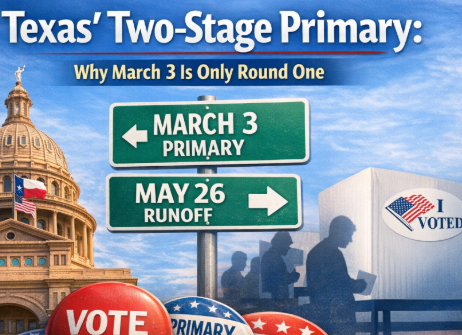

Texas’ 50 percent rule makes multi-candidate primaries structurally prone to May 26 runoffs, extending campaign season and reshaping the 2026 battlefield.
What to Know:
- March 3 may not decide the nominee if no candidate clears 50 percent.
- The May 26 runoff is built into Texas law, not a surprise outcome.
- Crowded fields make second-round elections likely in marquee races.
- Runoffs compress turnout and intensify ideological dynamics.
- Texas’ two-stage primary could shape national House and Senate control in 2026.
Texas does not award nominations with pluralities. State law requires a candidate to win more than 50% of the vote to secure a party nomination outright. If no one crosses that threshold, the top two finishers automatically advance to a runoff scheduled this cycle for May 26. In crowded fields, that structure all but guarantees a second round.
This year, several high-profile Republican primaries are positioned squarely in runoff territory. The U.S. Senate race featuring John Cornyn, Ken Paxton, and Wesley Hunt is the clearest example. With multiple well-known candidates competing for overlapping coalitions, even a strong first-place finish may fall short of a majority. A candidate polling in the high 30s can lead the field and still be structurally disadvantaged under Texas law.
Fragmented Fields and the Limits of Endorsements
The same dynamic is unfolding in a series of House contests, particularly in districts with open seats or redrawn boundaries. TX-10, TX-21, TX-32, TX-34, and TX-38 all feature multi-candidate Republican fields where vote fragmentation is likely. In these districts, endorsements and fundraising strength matter, but math matters more. Unless one candidate consolidates support early, a runoff becomes the default outcome rather than the exception.
|
U.S. Senate |
GOP |
A "three-headed" race. Paxton leads polling (~38%) but faces a likely runoff against Cornyn. |
|
|
U.S. Senate |
Dem |
Contrast in styles: Crockett’s firebrand activism vs. Talarico’s faith-based populism. |
|
|
TX-10 (Austin/Brazos) |
GOP |
Open Seat (McCaul retired). Gober holds Trump's endorsement in a 10-candidate field. |
|
|
TX-21 (SA/Austin) |
GOP |
Open Seat (Chip Roy running for AG). 13 candidates are vying for this solidly red seat. |
|
|
TX-32 (Dallas/East) |
GOP |
Open Seat (Julie Johnson left). Trump-endorsed Yarbrough faces well-funded rivals. |
|
|
TX-34 (RGV/Border) |
Mixed |
A "Flores vs. Flores" GOP primary. Eric Flores has Trump's endorsement over Mayra. |
|
|
TX-38 (Houston) |
GOP |
Open Seat (Wesley Hunt running for Senate). A 10-candidate field in a deep-red stronghold. |
Endorsements from high-profile figures, including President Trump, can shape the top-two outcome but do not guarantee first-ballot victories. In a multi-candidate field, even a strong endorsement can split the vote if multiple contenders claim ideological alignment with the same faction. Texas primaries are decided by turnout coalitions, not just signals. When several candidates appeal to similar voters, the majority requirement becomes a hurdle few can clear in March.
Spending Escalation and Turnout Compression
The financial implications of a runoff are significant. Campaigns must prepare for two elections spaced nearly three months apart. That means reserving funds for late-spring media buys, sustaining field operations, and recalibrating messaging for a smaller electorate. Outside groups often reengage in May, concentrating spending into a compressed window when voters are less attentive but more ideologically committed.
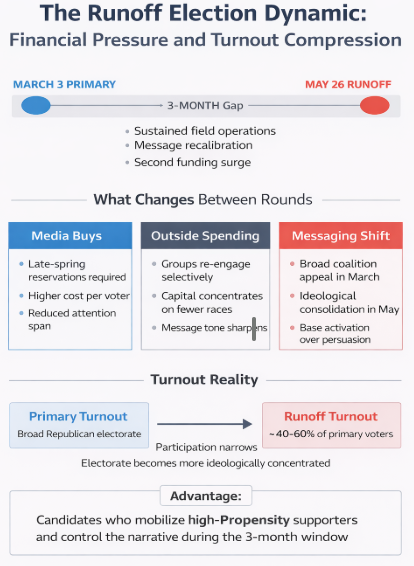
Turnout patterns also shift. Runoffs typically produce lower participation and a more concentrated voter base. Casual voters who participate in the initial primary may not return in May. Campaigns that can identify and mobilize high-propensity supporters gain an advantage in this environment. In practical terms, a candidate who barely makes the top two in March can reframe the race and build momentum for May if they are structurally better suited for a lower-turnout contest.
How a Texas Runoff Actually Works and How Candidates Win It
Texas primaries require a candidate to receive more than 50% of the vote to secure the nomination outright. If no one crosses that threshold, the top two finishers automatically advance to a May 26 runoff. It does not matter how large the plurality is in March. A candidate who earns 49% advances just the same as someone who earns 25%, so long as they finish in the top two.
Once the field narrows, the race resets. The runoff is not a continuation of March. It is a second election with a different electorate. Turnout drops, often significantly, and the voter pool becomes smaller, older, and more ideologically committed. Casual primary voters frequently do not return. Campaigns must therefore shift from broad persuasion to targeted mobilization.
To remain visible during the three-month gap, candidates must do three things:
1. Preserve Cash and Rebuild Momentum
Campaigns that spend heavily to finish first in March can enter the runoff depleted. The stronger runoff candidates typically hold back enough funds to reserve late-May media and maintain digital presence. Outside groups also reassess and often reengage only in competitive matchups.
2. Consolidate Eliminated Factions
Candidates who finish third or fourth often control small but decisive voter blocs. The top two must actively court those supporters, seeking endorsements or issue alignment that consolidates fractured coalitions. Runoffs are won by addition, not just intensity.
3. Identify High-Propensity Voters
Data becomes more important than broad messaging. Campaigns narrow their targeting universe to high-propensity primary voters who are most likely to participate again. Field operations become more surgical. Mail, digital, and turnout programs focus on reliability rather than persuasion at scale.
Messaging also tends to evolve. In March, candidates often speak to the widest possible ideological lane to survive a crowded field. In May, the incentive shifts toward sharper contrasts. With fewer candidates on the ballot, differentiation becomes essential. Debates, earned media, and direct voter contact tend to intensify around specific ideological contrasts rather than broad platform appeals.
The structural reality is straightforward: a runoff rewards organization, patience, and disciplined resource management. Finishing second in March is not fatal. In some cases, it is strategically advantageous if that campaign is better positioned for a lower-turnout environment. Understanding that distinction is critical. In Texas, March determines who advances. May determines who wins.
Wrap Up
The broader national stakes are real. Senate control in 2026 could hinge on nominee strength in large states, and Texas remains central to Republican strategy. A prolonged primary fight drains resources and extends intra-party divisions. In the House, redistricting has created new opportunities but also new risks. A runoff can reshape the ideological profile of a nominee in districts that will matter in November.
March 3 will generate headlines, but it is unlikely to produce finality in several marquee races. Texas’ majority requirement turns primary season into a two-stage contest, with May 26 serving as a decisive second election. Campaigns that plan for both rounds, not just the first, will be positioned to convert early viability into lasting advantage.
-1.png)