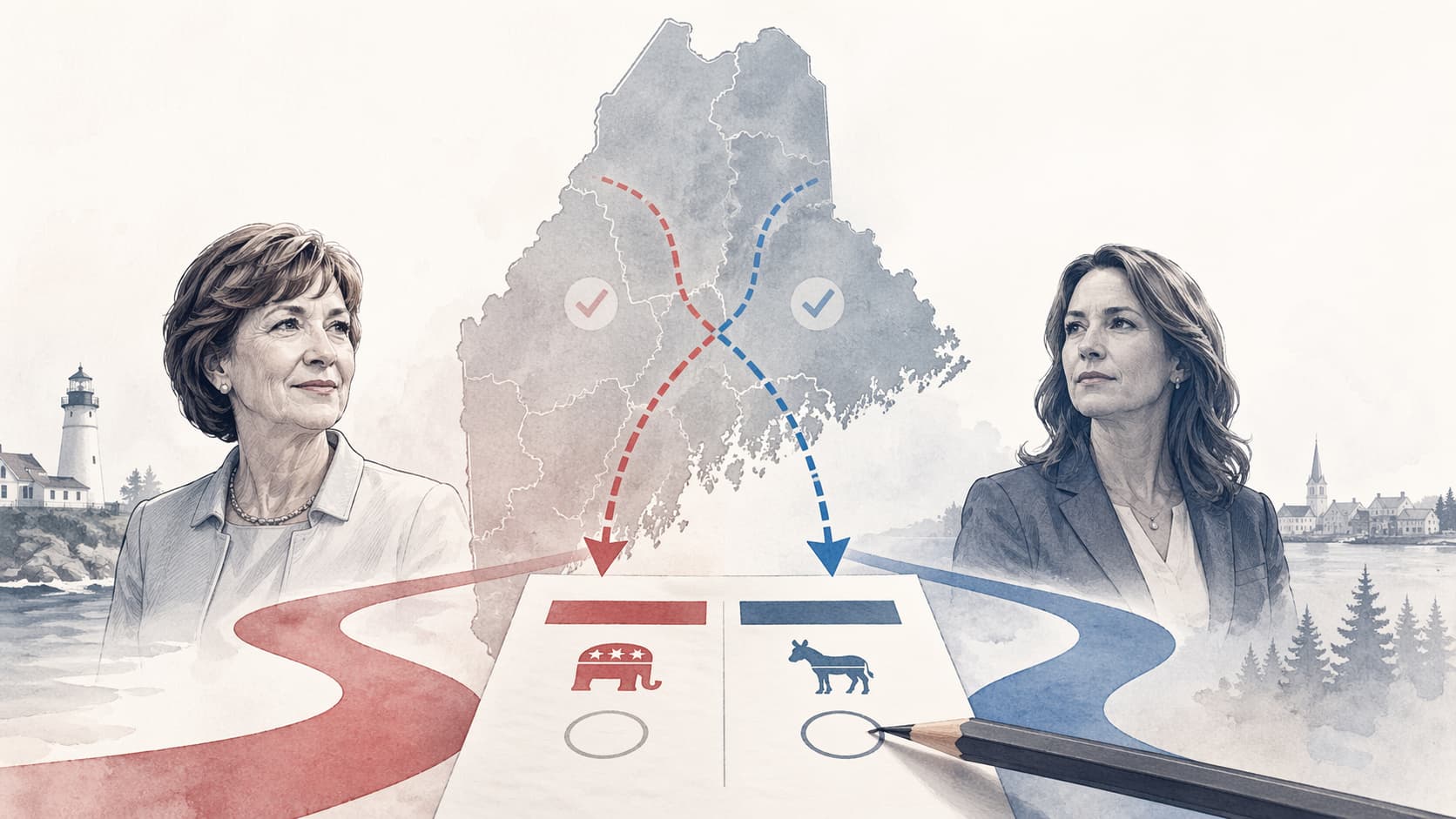

One race is showing how candidate identity can still bend party gravity in a polarized state.
What to Know
- Emerson’s first Maine Senate survey found Graham Platner leading Janet Mills 55% to 28% in the Democratic primary, with 13% undecided.
- In the general election tests, Platner led Susan Collins 48% to 41%, while Mills led Collins 46% to 43%.
- Collins was underwater at 38% favorable and 57% unfavorable, while Platner ran better with independents than either Collins or Mills.
- Maine still rewards candidate-specific movement, but its electorate is less loosely independent than its reputation suggests, with active voters now split 36.2% Democratic, 29.5% Republican, and 28.8% unenrolled.
- Presidential and Senate outcomes diverged more in 2024 than in the recent past, which makes Maine’s candidate-driven volatility strategically important again.
Most Senate races now behave like straight-line extensions of presidential partisanship. Maine is one of the few places where that model can still miss what is actually happening on the ground. The new polling does not prove a final November outcome, but it does show a state where party alignment and candidate appeal are not moving in perfect sync.
That matters because Republicans usually survive national headwinds by limiting persuasion losses and maximizing partisan loyalty. But the Collins model has always depended on something extra: personal crossover credibility with voters willing to separate the candidate from the party. If that personal cushion keeps shrinking, Maine stops looking like a standard incumbent-defense race and starts looking like a test of whether candidate-specific split-ticket behavior can still break through in 2026.
Maine Still Makes Space for Candidate Differentiation
Maine remains one of the rare states where voters have a long habit of distinguishing between offices, personalities, and governing styles. That does not mean the state is immune to polarization. It means polarization has to compete with a durable local instinct to judge candidates individually.
-jpg-Apr-25-2026-11-46-28-7585-AM.jpeg?width=200&height=300&name=image%20(3)-jpg-Apr-25-2026-11-46-28-7585-AM.jpeg)
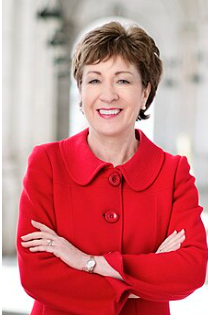
Susan Collins, U.S. Senator from Maine
The core problem for Susan Collins is that her old crossover formula looks weaker than it once did. The survey found her with a 57% unfavorable rating statewide, and with independents she was even deeper underwater, at 32% favorable to 62% unfavorable. That is the kind of number that turns a brand advantage into a turnout and persuasion liability.
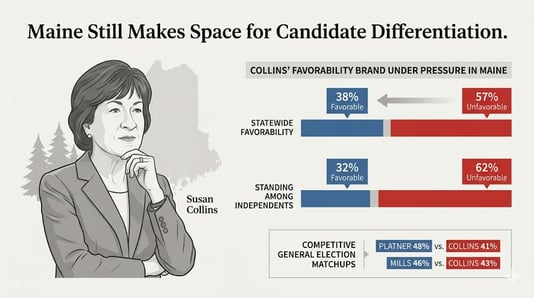
Campaign Now (Gemini), data from Emerson College Polling, favorability and matchup spread
At the same time, Collins is still running on the argument that made her durable for years: clout, appropriations power, and the ability to deliver tangible results for Maine. The Portland Press Herald reported that she is leaning again on her institutional influence as chair of the Senate Appropriations Committee. In a normal environment, that pitch reinforces her separation from the national GOP brand. In a more nationalized environment, it has to work harder than before.
As John Gramlich, writer at Pew Research Center, explained in Pew’s review of the 2024 map:
"Four states that Republican Donald Trump carried in this month’s presidential election also elected Democratic senators."
That does not mean split-ticket voting is broadly back. It means the few places where candidate differentiation still works have become more valuable, and more dangerous, because there are so few of them left. Maine is one of those places.
The Democratic Primary Is Shaping the General Election Story
The biggest mistake Republicans could make is treating the Democratic primary as a side show. It is not. It is the mechanism through which the general-election contrast is being built.
-jpg-Apr-25-2026-11-47-02-3665-AM.jpeg?width=429&height=286&name=image%20(4)-jpg-Apr-25-2026-11-47-02-3665-AM.jpeg)
Graham Platner, Democratic U.S. Senate candidate
The topline is striking because Graham Platner is not a conventional front-runner. He led Mills 55% to 28% in the primary and posted a better standing with independents than either Mills or Collins. Bangor Daily News describes him as a former Marine and oyster farmer whose outsider profile became the breakout political story of the race. That matters because outsider candidates can sometimes activate a different kind of crossover attention than establishment Democrats can.
-jpg-Apr-25-2026-11-47-09-0434-AM.jpeg?width=333&height=257&name=image%20(5)-jpg-Apr-25-2026-11-47-09-0434-AM.jpeg)
Janet Mills, Governor of Maine
Janet Mills offers Democrats something more familiar: statewide experience, institutional credibility, and a more recognizable electability argument. But Maine Public and Bangor Daily News both report that Mills and Platner are now running sharply different campaigns, with Platner pushing harder through advertising, digital intensity, and outsider energy while Mills leans more on conventional structure and staff.
-jpg-Apr-25-2026-11-47-20-8132-AM.jpeg?width=530&height=353&name=image%20(2)-jpg-Apr-25-2026-11-47-20-8132-AM.jpeg)
Campaign Now (Gemini), data from Maine Public, outsider versus establishment contrast
As Kevin Miller, reporter at Maine Public, wrote while describing Platner’s rise:
"It’s a Tuesday night and more than 250 people are gathered on the outskirts of Augusta to hear from Graham Platner, the gruff-talking Marine Corps veteran-turned-oysterman who rose from obscurity to become the apparent frontrunner in Maine’s closely watched Democratic U.S. Senate primary."
That is the strategic signal Republicans should not miss. If Democrats nominate a candidate who looks less like a standard partisan vessel and more like a cultural or outsider disruptor, the persuasion burden on Collins gets heavier, not lighter.
Independents Are Still the Deciding Layer, But Not in the Old Way
The phrase “independent-minded Maine” is still useful, but only if campaigns understand what has changed underneath it.
AP reported in 2024 that unenrolled voters were no longer Maine’s largest active bloc. Democrats led with 36.2%, Republicans followed at 29.5%, and unenrolled voters were at 28.8% after voter-list cleanup. So Maine is not a giant free-floating middle anymore. It is a more sorted state that still preserves some room for office-by-office decision-making.
That distinction matters because Maine law now gives unenrolled voters a low-friction way to participate in one party primary without joining that party. The statute states that an unenrolled voter may participate in a party’s primary without enrolling and may vote in only one party’s primary election. That makes candidate-specific testing more meaningful, because it allows politically uncommitted voters to affect the nomination process without formally changing teams.
As Graham Platner, Democratic U.S. Senate candidate, said while trying to expand his reach beyond the progressive base:
"We cannot allow ourselves to write off people in our communities who have the same needs as us."
For Democrats, that is an obvious persuasion play toward soft anti-establishment and nonurban voters. For Republicans, it is a warning. If Collins cannot hold enough center-right and independent voters while also resisting Democratic candidate-specific leakage, then the race becomes a referendum on whether her personal brand still outruns the national party environment.
This Is Less About Nostalgia Than About Electoral Mechanics
The temptation is to romanticize this as the return of the old Maine, where ticket splitting was common and ideological lines felt softer. That is not the right read.
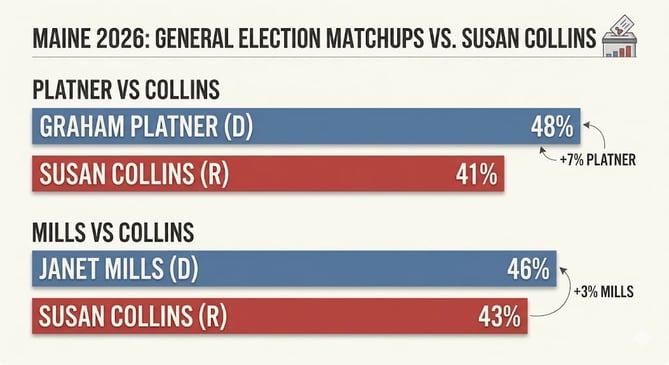
Maine general election matchups
Pew’s national analysis shows that party-line alignment remains strong overall, even with more presidential-Senate mismatches in 2024 than in the recent past. Maine’s significance is not that it disproves national polarization. It is that it shows how a small number of candidate-sensitive states can still produce strategic openings when candidate identity, unfavorable ratings, and independent voter behavior stop lining up neatly.
That is why the Collins race matters beyond Maine. Republicans need to know whether the old crossover incumbent model can still survive in a state that has drifted away from loose independence but has not fully abandoned it. Democrats need to know whether anger at Collins is enough by itself, or whether nominee style will determine how much of that anger can actually be converted into votes. The early polling suggests nominee style may matter a lot.
Wrap Up
Maine is not proving that split-ticket voting has fully returned. It is showing that under the right conditions, it can still matter. That is a more limited claim, but for Senate strategy it is the one that matters.
If Collins remains personally underwater while Democrats field a nominee who can compete for independents and soften partisan resistance, then Maine becomes a live test of whether candidate-specific persuasion still has real power in a polarized age. If she rebuilds the gap between her own brand and the national Republican brand, the old Collins model may survive one more time. Either way, this is no longer a race campaigns can read through party registration alone.
-Aug-18-2026-07-55-14-0174-AM.jpg)